
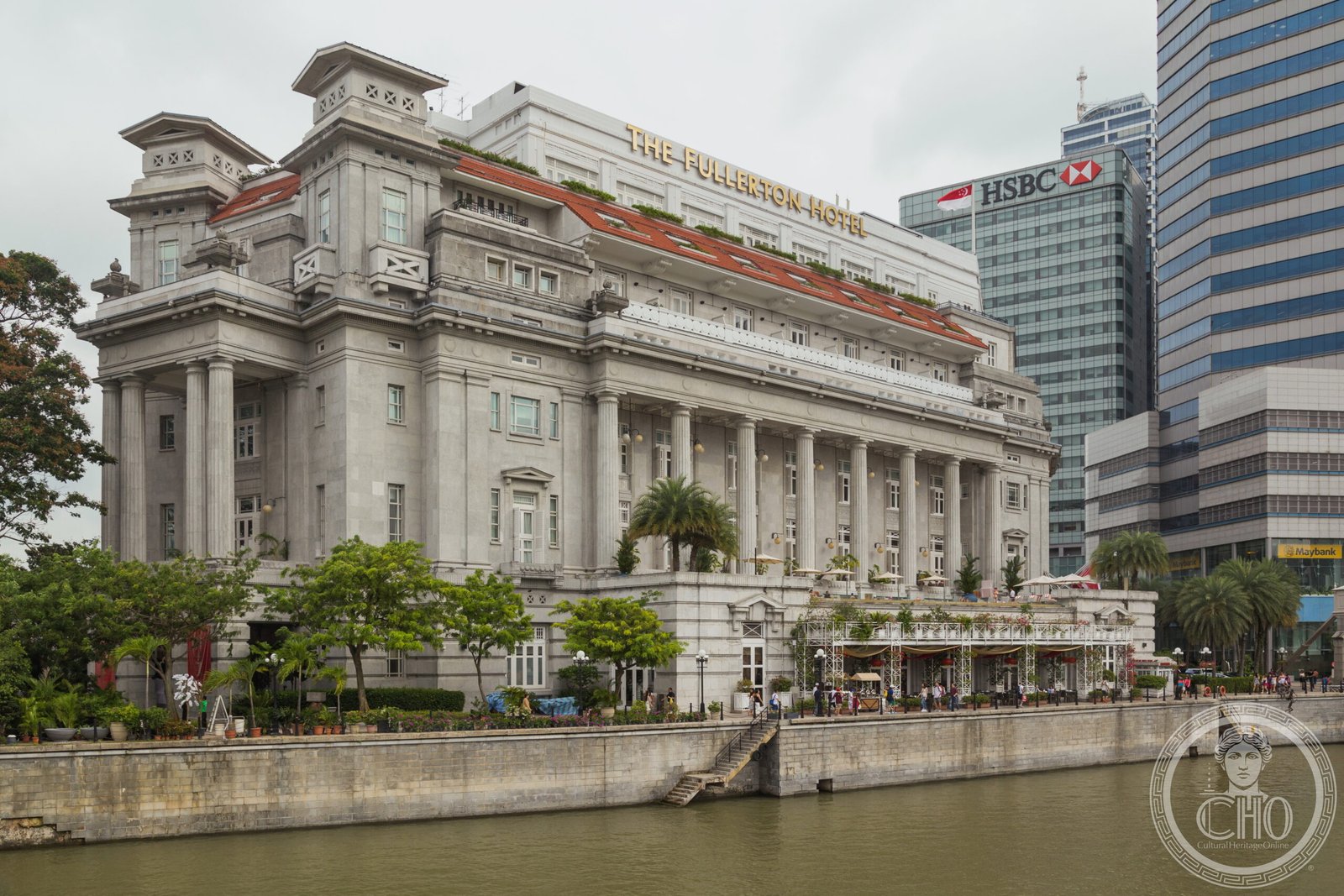
Anchoring the mouth of the Singapore River with the authority of a Roman temple transplanted to the tropics, The Fullerton Hotel Singapore is one of the most recognisable landmarks in Southeast Asia. Built between 1924 and 1928 as the General Post Office and seat of colonial administration, it was designed by Major Percy Howard Keys of the Shanghai firm Keys and Dowdeswell in a grand Palladian Classicism that spoke of imperial permanence and civic ambition. Its colossal Doric columns, rusticated base, and symmetrical facades drew on European precedents while adapting to Singapore’s equatorial heat through generous internal courtyards and shaded colonnades. Designated a national monument of Singapore in 2015, the building now operates as a five-star luxury hotel, its restoration preserving the ceremonial scale and marble grandeur of the original while accommodating 400 guestrooms around a spectacular atrium at the heart of the former trading post office hall.
At a glance
- Type
- Heritage hotel / national monument
- Period
- 1924–1928 (construction); hotel conversion 2001
- Style
- Palladian Classicism / Colonial
- Location
- 1 Fullerton Square, Singapore
- Coordinates
- 1.2866° N, 103.8520° E
- Architect(s)
- Major P. H. Keys (Keys & Dowdeswell, Shanghai)
Overview
The Fullerton Building occupied one of the most strategic sites in colonial Singapore: the southern bank of the Singapore River at its junction with Marina Bay, where trade, administration, and communications converged. Commissioned to mark the centennial of the British colony, it unified in a single monumental structure the General Post Office, Exchange, and chambers of commerce that had previously occupied separate buildings. Its colonnaded facade became the backdrop to the civic ceremonies of a growing port city, and it remained the fulcrum of Singapore’s civic life until the post office functions relocated in 1996 and restoration began for its hotel conversion, which opened in December 2001.
History
The site had been occupied since 1861 by Fort Fullerton, a small coastal battery named after Robert Fullerton, the first Governor of the Straits Settlements (1826–1829). When the fort was demolished, the land became a key civic address. The architectural competition launched in 1919 was won by Keys and Dowdeswell, a Shanghai-based practice experienced in large colonial commissions across Asia. Construction began in 1924 and was completed in 1928. During World War II the building served as a military headquarters and evacuation coordination centre; the Singapore River War Memorial directly outside commemorates the civilian dead. Independence brought new functions: the building served government ministries until 1996, when the post office finally vacated. The SGD 400 million restoration, completed by 2001, stripped decades of partitions to reveal original floor plans and decorative details.
Architecture & Design
The Fullerton Building draws on the grammar of Palladio as filtered through British imperial architecture: a podium of rusticated granite, a piano nobile of smooth ashlar, and a crowning entablature topped by a balustraded parapet. The principal facade on Fullerton Square presents eight colossal Doric columns spanning three storeys, flanked by symmetrical wings that curve gently to follow the riverbank. Internal courtyards admitted natural light to the deep floor plates before the hotel conversion introduced a 25-metre atrium over the former trading floor. The building’s footprint covers over 18,000 square metres, yet the classical ordering of facades and the hierarchy of spaces from public colonnade to private office give it a legibility and calm unusual in structures of such scale.
Cultural significance
As Singapore’s General Post Office, the Fullerton Building was the communication hub of an empire: every telegram to London, every letter home from planters across Malaya, every shipping manifest passed through its counters. Its national monument designation in 2015 acknowledged both its architectural distinction and its role as a witness to colonial administration, Japanese occupation, independence, and the economic transformation that turned Singapore from a trading post into one of the world’s wealthiest cities. The building stands at the symbolic heart of Singapore’s historical narrative, surrounded by the steel-and-glass towers of the modern financial district, a material dialogue between the inherited past and the constructed present.
Visiting today
Non-guests may visit the hotel’s ground-floor public spaces, including The Courtyard atrium, Town Restaurant, and Post Bar — all housed in the former post office trading hall and counters. The exterior colonnade is freely accessible and provides a shaded vantage point over the Singapore River and the Merlion Park across the water. Hotel amenities include a rooftop pool and Heritage Gallery. Guided architectural tours of the building can be arranged through the hotel concierge. Dress code applies for restaurant dining. The adjacent Fullerton Bay Hotel and Arts House complete the historic precinct.
Getting there
The nearest MRT station is Raffles Place (East-West and North-South lines), a five-minute walk through the financial district along Chulia Street. The Downtown MRT station (Downtown Line) is equally close via Boat Quay. The Fullerton is also served by numerous bus routes along Collyer Quay and Shenton Way. From Changi International Airport, the MRT East-West Line connects to Raffles Place in approximately 35 minutes. Water taxis operate from the Singapore River quays nearby.
Sources & resources
Find it on the map
See this place and what’s around it →Record researched and written by Luigi De Marchi for Cultural Heritage Online, 2026.
📷 Become a Cultural Heritage Online photographer
Share your photos of places: they stay published under your name as the author. The more they're seen, the more you get noticed — and soon a contest will reward the most appreciated photos.
Log in or sign up free to add a photoIs this page about you?
This page is read by travellers and heritage enthusiasts who find it on Google. Tell us how you are connected to this place and we will take it from there.