
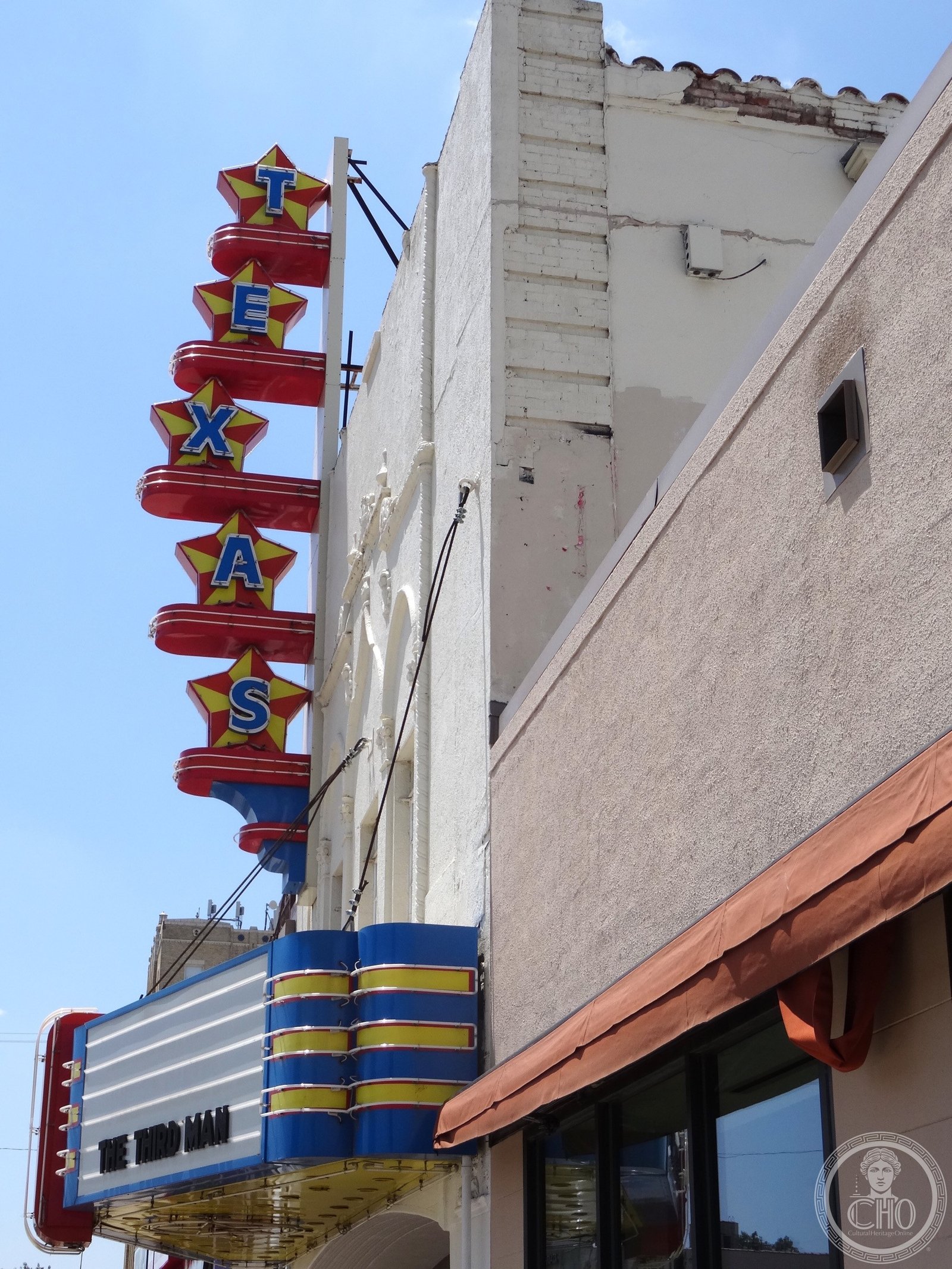
W. Scott Dunne’s 1931 Art Deco cinema on West Jefferson Boulevard in the Oak Cliff neighborhood of Dallas — the theater where Lee Harvey Oswald was arrested on the afternoon of November 22, 1963, ninety minutes after the assassination of President Kennedy, making it one of the most historically charged entertainment buildings in the United States.
At a glance
The Texas Theatre at 231 West Jefferson Boulevard in Oak Cliff is a survivor of the Art Deco theater-building era whose historical significance extends far beyond its architectural quality. Built in 1931 to serve Oak Cliff’s growing residential and commercial community — then a separate municipality that was annexing itself piece by piece into Dallas — the theater’s terracotta ornament and streamlined vertical marquee represent the confident vernacular Deco that American cities deployed for neighborhood cinemas throughout the 1930s. On November 22, 1963, within hours of the assassination of President John F. Kennedy, Lee Harvey Oswald slipped into the theater without paying. A ticket seller noticed and called police; Oswald was apprehended inside after a brief struggle. That event, and the half-century of cultural memory it generated, transformed a neighborhood movie house into a site of national historical consciousness.
Key facts
- Address: 231 West Jefferson Boulevard, Dallas (Oak Cliff), TX 75208
- Opened: 1931
- Architect: W. Scott Dunne
- Style: Art Deco
- GPS: 32.7448° N, 96.8335° W
- Status: Active cinema and event venue; Dallas Landmark
- Historical note: Site of Lee Harvey Oswald’s arrest, November 22, 1963
History
Oak Cliff in 1931 was a middle-class Dallas neighborhood undergoing rapid residential expansion, its Jefferson Boulevard commercial corridor serving the population of single-family houses spreading south and west from the Trinity River crossing at the Houston Street viaduct. W. Scott Dunne designed the Texas Theatre in the Art Deco idiom that chain theaters were deploying across American commercial streets — streamlined geometric ornament, a projecting marquee that read as modern and entertaining from half a block away, and the vertical sign tower that became the standard identifier for the neighborhood cinema. The theater spent its first three decades as a straightforward commercial entertainment venue serving the residential community of Oak Cliff.
That history was altered irrevocably on November 22, 1963. Within an hour and a half of the assassination of President Kennedy in Dealey Plaza, Dallas Police Officer J.D. Tippit was shot and killed approximately one mile from the Texas Theatre. Lee Harvey Oswald, who had been observed entering the theater without paying by a shoe store employee named Johnny Brewer, was confronted inside the auditorium by officers who had surrounded the building. The arrest occurred mid-film; Oswald drew a pistol before being subdued. The event placed the Texas Theatre into every account of that day and of the subsequent decade of American political trauma.
Subsequent decades brought the theater the commercial vicissitudes common to neighborhood cinemas — competition from multiplexes, declining downtown retail, periods of closure and renovation. A community effort in the 2000s and 2010s preserved the building and reestablished it as an operating cinema with cultural programming. The Texas Theatre now screens repertory, independent, and revival films, and presents live events, maintaining its position on Jefferson Boulevard as both a neighborhood cultural anchor and a site of American historical memory.
What you see
The facade deploys the Art Deco vocabulary of the neighborhood theater with particular clarity: the white terracotta ornamental panels, the vertical marquee sign that extends the building’s presence vertically above the cornice, and the streamlined horizontal moldings that layer the composition into legible zones — entrance, marquee, upper facade, sign tower — constitute the standard grammar of the 1930s commercial entertainment building applied with careful proportional judgment. The marquee, which bears the simple word “Texas” in bold vertical lettering, has become one of the most recognizable typographic objects in the city.
Inside, the auditorium preserves the basic configuration of the 1931 design: a single screen, sloped seating, the decorative plasterwork of the proscenium arch and side walls. The seating capacity is modest compared to the great downtown palaces — the Texas Theatre was always a neighborhood house — but the spatial quality, and the knowledge that the room looks essentially as it did on the afternoon of November 22, 1963, invests even a routine film screening with an unusual density of historical implication.
Practical information
- Access: Active cinema and event space; check thetexastheatre.com for current programming
- Location: Oak Cliff neighborhood, Dallas; Bishop Arts District begins approximately 4 blocks west on Jefferson Boulevard
- Transit: DART bus routes serve Jefferson Boulevard; the Dallas Streetcar connects Union Station to the Oak Cliff area
- Duration: Film screenings vary; allow extra time to walk the Jefferson Boulevard commercial corridor
Getting there
Dallas Love Field Airport (DAL) is approximately 9 miles north via I-35E and Woodall Rodgers Freeway; Dallas/Fort Worth International Airport (DFW) is approximately 25 miles northwest via I-30. From downtown Dallas, the Texas Theatre is accessible via the Houston Street Viaduct crossing the Trinity River, then south on Jefferson Boulevard (approximately 2 miles total from Union Station). The Dallas Streetcar runs from Union Station south into Oak Cliff, stopping at several points along the corridor. By road, I-30 (Tom Landry Freeway) passes through Oak Cliff and provides connections from the east and west.
Nearby
- Bishop Arts District — West Jefferson to West Davis Street corridor, approximately 4 blocks west; one of Dallas’s most lively independent retail and dining neighborhoods, occupying a grid of early twentieth-century commercial buildings
- Dealey Plaza — approximately 2 miles northeast; site of the November 22, 1963 assassination; the Sixth Floor Museum at the former Texas School Book Depository documents the assassination and its context
- Dallas Museum of Art — 1717 N. Harwood Street, approximately 4 miles northeast; Art Deco and Moderne collections among the strongest in the Southwest
- Trinity River Audubon Center — 6 miles southeast; 6,000-acre urban forest on the Trinity River floodplain, an ecological reserve at the edge of the city
Sources
- Texas Theatre official site — thetexastheatre.com
- Warren Commission Report — testimony on Oswald’s arrest at the Texas Theatre
- Dallas Landmark Commission — Texas Theatre designation documentation
- Wikimedia Commons — Facade of Texas Theatre, Oak Cliff, Dallas (CC BY-SA 2.0, Adam Jones from Kelowna, BC, Canada)
- Dallas Historical Society — Oak Cliff commercial district records
Find it on the map
See this place and what’s around it →Record researched and written by Luigi De Marchi for Cultural Heritage Online, 2026.
📷 Become a Cultural Heritage Online photographer
Share your photos of places: they stay published under your name as the author. The more they're seen, the more you get noticed — and soon a contest will reward the most appreciated photos.
Log in or sign up free to add a photoIs this page about you?
This page is read by travellers and heritage enthusiasts who find it on Google. Tell us how you are connected to this place and we will take it from there.