
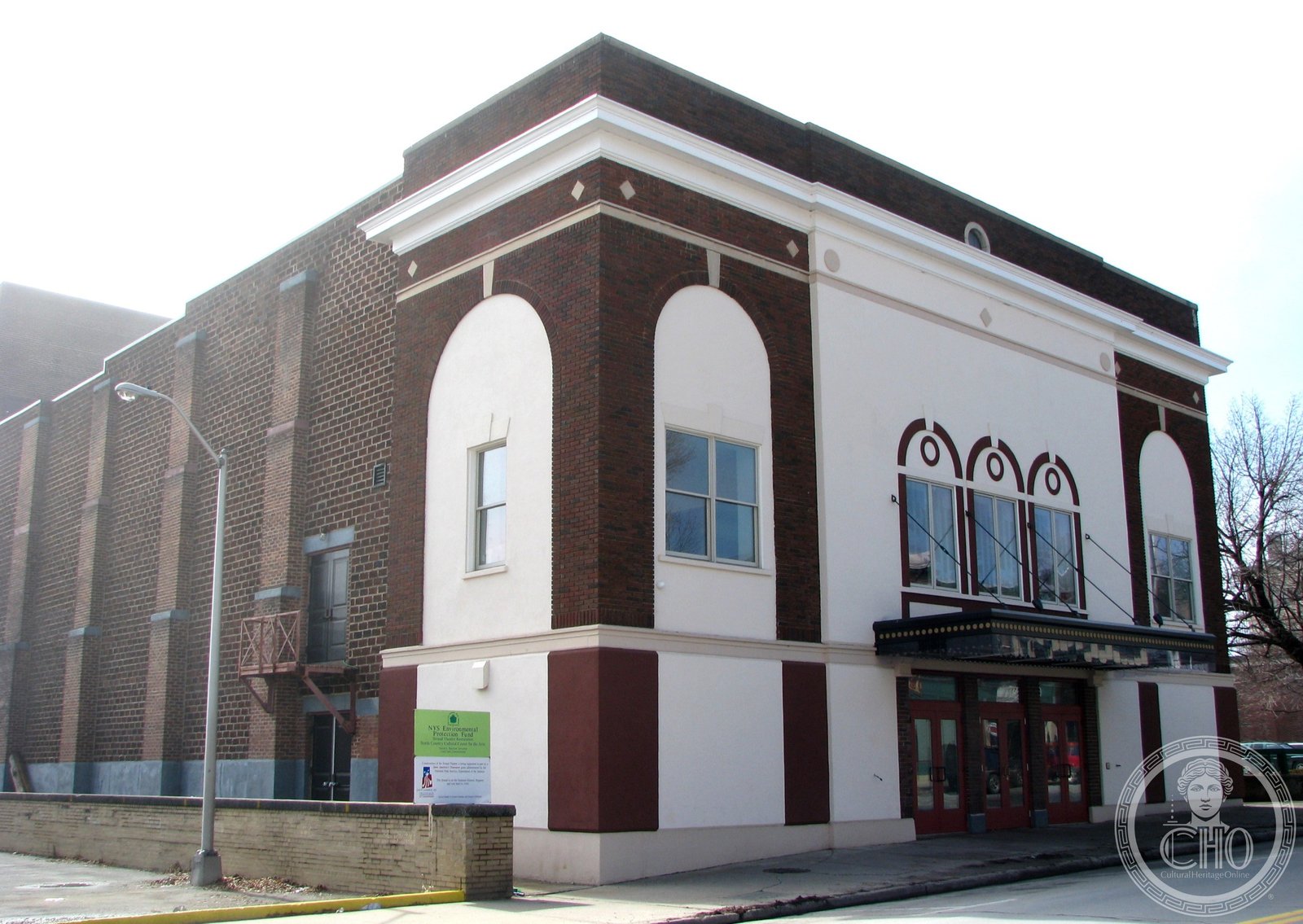
A main-street cinema in the Champlain Valley city of Plattsburgh, its Art Deco facade rising above a downtown shaped by the same lake commerce, military history, and cross-border economy that have defined this northernmost corner of New York State since the early republic.
At a glance
The Strand Theatre occupies a key position on Margaret Street in downtown Plattsburgh, New York, a Champlain Valley city that has historically functioned as the commercial, military, and cultural center for the region bounded by the Adirondacks to the west, Lake Champlain to the east, and the Canadian border approximately 20 miles to the north. Built in the 1920s in the Art Deco idiom that standardized American commercial architecture of the interwar period, the Strand brought professional cinema exhibition to a market that already had strong cultural ties to both Burlington, Vermont, across the lake, and to Montreal, within comfortable driving distance to the north. The theater’s brick-and-terracotta facade and its prominent marquee remain characteristic features of Plattsburgh’s downtown commercial streetscape.
Key facts
- Address: Margaret Street, Plattsburgh, NY 12901
- Built: c.1920s
- Style: Art Deco commercial theater
- GPS: 44.6995° N, 73.4529° W
- Setting: Champlain Valley, Clinton County, northern New York
- Region: Adirondack/Champlain corridor
History
Plattsburgh’s strategic position on the western shore of Lake Champlain has shaped its history since the French colonial period. The lake served as the primary corridor connecting New England to Canada, and the city’s military importance was confirmed at the Battle of Plattsburgh in September 1814, when American naval forces under Commodore Thomas Macdonough defeated a superior British fleet in the decisive naval engagement of the War of 1812’s northern theater. That victory, which secured the American claim to the northern lake frontier and influenced the subsequent boundary settlement, remains the defining event in the city’s historical identity.
By the 1920s, Plattsburgh had evolved from a garrison town into a regional commercial center. The Delaware and Hudson Railway connected it to Albany and New York City; lake steamers maintained commercial ties to Burlington and the Vermont shore; and the North Country’s timber, iron, and agricultural industries fed a prosperity that could support a modern theater. The Strand was built into this economic moment, part of the national theater-building boom that brought Art Deco design to hundreds of American cities between 1920 and 1935. Its design vocabulary — the stylized ornamental lettering, the marquee as architectural anchor, the geometric relief work that gave even modest commercial theaters a claim to modernity — was drawn from the same sources that were simultaneously shaping theaters from New York City to Los Angeles.
The establishment of Plattsburgh Air Force Base during World War II and the postwar growth of SUNY Plattsburgh (founded 1889) reinforced the city’s dual character as both a military installation and an educational center. The theater served both populations through the mid-century decades, and its survival as a physical structure reflects the Champlain Valley’s pattern of preserving commercial landmarks that have become anchors of downtown identity.
What you see
The Strand’s facade reads as a confident application of the Art Deco commercial template to a North Country main street: brick construction with terracotta ornamental elements, the marquee projecting above the sidewalk as the primary visual anchor, and the vertical sign tower that identifies the theater from the blocks approaching along Margaret Street. The ornamental work — geometric relief panels, stylized lettering in the bold typefaces characteristic of 1920s commercial signage, horizontal banding that layers the composition — is restrained compared to the great metropolitan palaces but executed with the care appropriate to a building intended to represent the best of its city’s commercial culture.
The building’s presence in the downtown streetscape is reinforced by its siting at a key pedestrian node, where the theater becomes a directional anchor for the commercial district. Inside, the auditorium has undergone the modifications common to working cinema houses of this era — lighting upgrades, sound system improvements, projection equipment replacements — while retaining the basic spatial configuration of the original design: a single-screen house with steeply tiered seating oriented toward a proscenium that gives every row a clear view of the screen.
Practical information
- Access: Check current programming and operating status locally
- Season: Plattsburgh is accessible year-round; the Champlain Valley’s most favorable conditions are May–October
- Duration: The theater warrants 30–60 minutes; combine with the nearby Battle of Plattsburgh historic sites for a half-day visit
- Parking: Street parking and municipal garages in downtown Plattsburgh
Getting there
Burlington International Airport (BTV) in Vermont is approximately 25 miles from Plattsburgh via the Lake Champlain ferry crossing from Port Kent, New York (approximately 20 minutes; the airport is a few miles from the Burlington ferry dock), or approximately 90 miles by road via I-87 south and I-89 north. Albany International Airport (ALB) is approximately 160 miles south via the Adirondack Northway (I-87). By road from New York City, the Adirondack Northway provides a direct four-hour connection. Amtrak’s Adirondack service (New York Penn Station to Montreal) stops at Plattsburgh station on Cornelia Street, connecting the city to both New York (~5 hours south) and Montreal (~1.5 hours north).
Nearby
- Battle of Plattsburgh Historic Site — the 1814 naval engagement that secured the northern border; interpretive sites at Cumberland Head and in the city center
- Lake Champlain waterfront — Plattsburgh City Beach, the ferry landing at Cumberland Head, and the Champlain Bridge connecting to Vermont at Crown Point (~35 miles south)
- Adirondack Park — the western boundary of the park is approximately 20 miles from Plattsburgh; the High Peaks region and Lake Placid are 60–70 miles via NY-374 and NY-86
- Montreal, Quebec — approximately 65 miles north via I-87 (Autoroute 15); the Musée des beaux-arts de Montréal on Sherbrooke Street holds the largest art collection in Canada
Sources
- Clinton County Historical Association — Plattsburgh and Champlain Valley historical records
- New York State Office of Parks, Recreation and Historic Preservation — regional survey
- Battle of Plattsburgh Association — 1814 naval engagement documentation
- Wikimedia Commons — Strand Theater, Plattsburgh, New York (CC BY-SA 3.0, Mwanner)
- Amtrak Adirondack route information — amtrak.com
Find it on the map
See this place and what’s around it →Record researched and written by Luigi De Marchi for Cultural Heritage Online, 2026.
📷 Become a Cultural Heritage Online photographer
Share your photos of places: they stay published under your name as the author. The more they're seen, the more you get noticed — and soon a contest will reward the most appreciated photos.
Log in or sign up free to add a photoIs this page about you?
This page is read by travellers and heritage enthusiasts who find it on Google. Tell us how you are connected to this place and we will take it from there.