
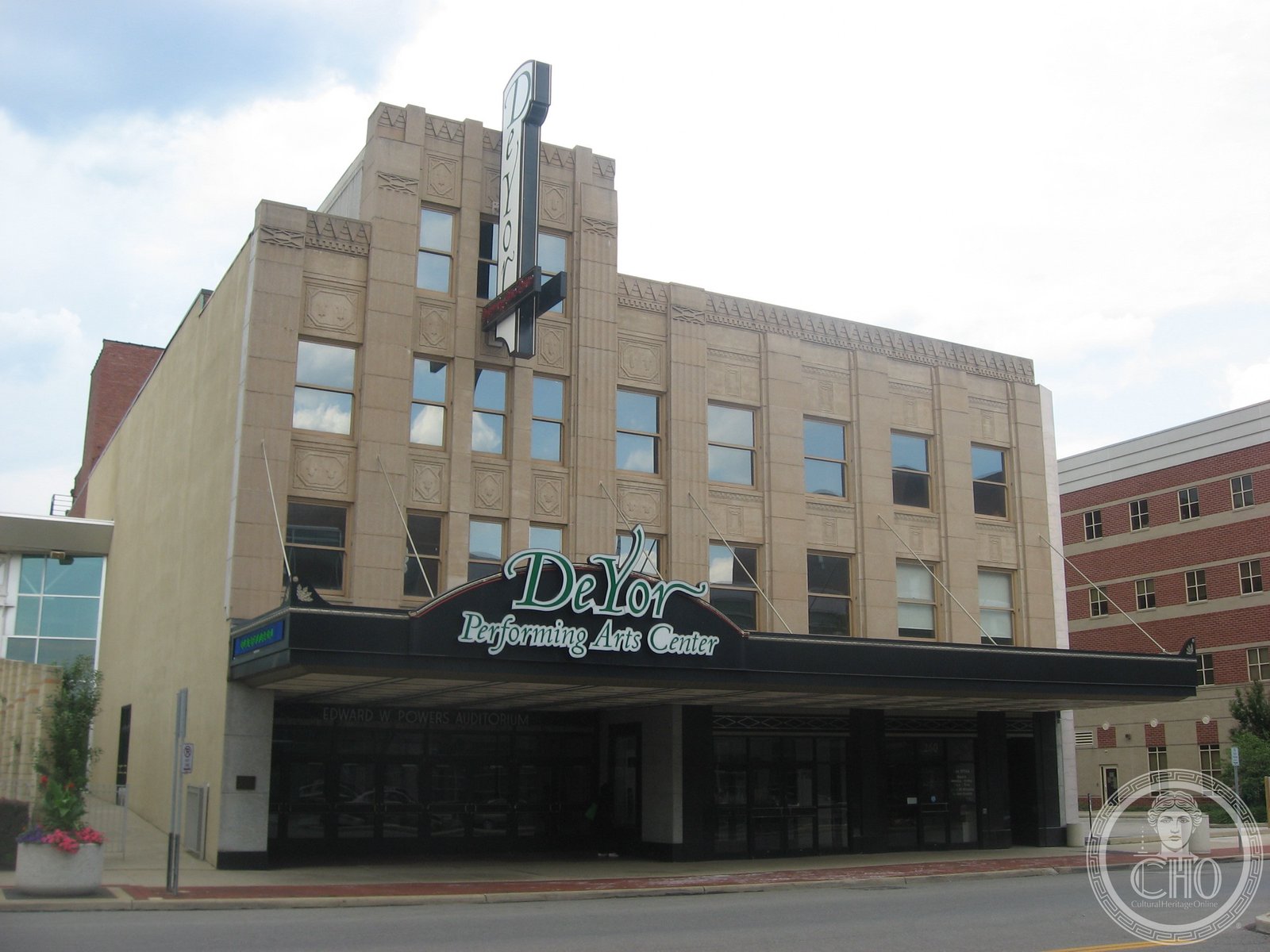
C. Howard Crane’s 1931 Art Deco theater for the Warner circuit in Youngstown, Ohio — the performance hall that has anchored the cultural life of the Mahoning Valley through the entire arc of the American steel industry’s rise, peak, and transformation, surviving as the permanent home of the Youngstown Symphony Orchestra in a city that has made the reinvention of industrial identity one of its defining projects.
At a glance
The Powers Auditorium at 260 West Federal Street in downtown Youngstown is one of the most complete surviving examples of the Art Deco theater palace in the industrial Midwest. Designed by C. Howard Crane — whose practice spanned the Detroit Fox Theatre, the Elgin Theatre in Ottawa, and dozens of other major American cinema palaces — and opened in 1931 as the Warner Theatre, the building served the entertainment needs of a steelworkers’ city at the height of its prosperity. Renamed the Powers Auditorium in 1969 in honor of benefactor Edward W. Powers, it continues to serve the Mahoning Valley as the home of the Youngstown Symphony Orchestra and as a venue for touring productions, concerts, and civic events, representing one of the more complete institutional continuities in the performing arts history of northeastern Ohio.
Key facts
- Address: 260 West Federal Street, Youngstown, OH 44503
- Opened: 1931 (as the Warner Theatre)
- Architect: C. Howard Crane
- Style: Art Deco
- Current name: Powers Auditorium (renamed 1969)
- GPS: 41.0985° N, 80.6526° W
- Status: National Register of Historic Places; home of Youngstown Symphony Orchestra
History
C. Howard Crane came to the design of the Youngstown Warner Theatre from a practice that had already reshaped the physical experience of cinema and live performance in several American cities. His Fox Theatre in Detroit (1928) had set a standard for atmospheric extravagance — a building whose interior reproduced the sky, complete with clouds and stars, above an audience seated in a simulacrum of a Persian courtyard. The Youngstown commission was more modest in scale but no less serious in its architectural intentions: a building that brought the vocabulary of the Art Deco movement — the geometric relief ornament, the stylized metalwork, the bold vertical massing of the facade — to a steel city whose workers expected, and received, a theater that expressed prosperity and aspiration.
Youngstown in 1931 was at the center of one of the most productive steel-producing regions in the world. The Mahoning Valley’s integrated mills served the automobile industry, the construction industry, and the infrastructure of a rapidly urbanizing nation. The Warner Theatre opened into this economy as a statement about what a steel town could afford in cultural terms — not a scaled-down approximation of the metropolitan palace, but a full-scale entertainment venue built to the standards of the major urban circuits. The theater’s prosperity tracked the steel industry’s own: strong through the postwar boom, troubled through the 1970s as the mills began to close, and eventually transformed by institutional stewardship into its current role as a performing arts anchor.
The 1977 renaming of the theater as the Powers Auditorium in honor of Edward W. Powers, a local patron whose support was critical to the building’s preservation and programming, marked the transition from commercial entertainment to civic cultural institution. The Youngstown Symphony Orchestra, one of the older community orchestras in Ohio, has been the auditorium’s anchor tenant since the mid-twentieth century, providing the season structure and the audience base that have kept the building in active use through the industrial transformations that reshaped the surrounding city.
What you see
The West Federal Street facade deploys the Art Deco vocabulary of the early 1930s theater with characteristic authority: vertical pilasters that extend the building’s height above the marquee, geometric relief panels in the spandrels between floors, and the stylized bronze and terracotta ornament that Crane used to distinguish the theater from its commercial neighbors. The marquee, which now bears the Powers name in the same position that the Warner name once occupied, extends over the sidewalk in the protective canopy form that the theater architects of the era used to create the transition zone between the street and the interior world of the theater.
The auditorium interior carries the Art Deco program into the principal performance space: the proscenium arch and its flanking ornamental pilasters form the terminal element of the room’s decorative axis, and the ceiling’s coffers and moldings continue the geometric vocabulary of the exterior into the more intimate zone of the seated audience. The seating configuration — orchestra level, mezzanine, and balcony — provides a range of price points and distances from the stage that reflects the theater’s original commercial purpose while remaining fully functional for the orchestral performances that now define its primary use.
Practical information
- Access: Performing arts venue; check youngstownsymphony.com for season schedule
- Season: Youngstown Symphony season typically September–May; summer programming varies
- Duration: Symphony concerts typically 2–2.5 hours; allow 30 minutes to explore downtown Youngstown
- Parking: Surface lots and garages throughout downtown Federal Plaza area
Getting there
Youngstown is approximately 75 miles southeast of Cleveland via I-80 (Ohio Turnpike) and approximately 70 miles northwest of Pittsburgh via I-76 (Pennsylvania Turnpike) and US-422 or I-80. Cleveland Hopkins International Airport (CLE) is approximately 80 miles northwest; Pittsburgh International Airport (PIT) is approximately 75 miles southeast. Akron-Canton Regional Airport (CAK) is approximately 45 miles west and provides a closer option with regional carrier service. Amtrak service to Youngstown was discontinued; the nearest active Amtrak station is Cleveland or Pittsburgh. The theater is in downtown Youngstown on West Federal Street, walkable from most downtown parking structures.
Nearby
- Butler Institute of American Art — 524 Wick Avenue; the first museum in the United States dedicated exclusively to American art (founded 1919), with collections ranging from Winslow Homer and Mary Cassatt to contemporary artists working in the region
- Youngstown Historical Center of Industry & Labor — 151 W. Wood Street; Ohio History Center’s documentation of the steel industry and its workers, including the industrial and social history of the Mahoning Valley
- Arms Family Museum — 648 Wick Avenue; a 1905 Georgian Revival mansion preserving the domestic architecture of Youngstown’s industrial prosperity
- Mill Creek MetroParks — 7574 Columbiana-Canfield Road; a 2,600-acre greenway with gorges, lakes, and trails at the edge of the city, one of the largest municipal park systems in Ohio
Sources
- Youngstown Symphony Orchestra — youngstownsymphony.com (institutional history)
- National Register of Historic Places — Youngstown Downtown Historic District nomination
- C. Howard Crane papers — Michigan State University Library archives
- Wikimedia Commons — Powers Auditorium in Youngstown (Public Domain, Nyttend)
- Mahoning Valley Historical Society — Powers Auditorium documentation
Find it on the map
See this place and what’s around it →Record researched and written by Luigi De Marchi for Cultural Heritage Online, 2026.
📷 Become a Cultural Heritage Online photographer
Share your photos of places: they stay published under your name as the author. The more they're seen, the more you get noticed — and soon a contest will reward the most appreciated photos.
Log in or sign up free to add a photoIs this page about you?
This page is read by travellers and heritage enthusiasts who find it on Google. Tell us how you are connected to this place and we will take it from there.