
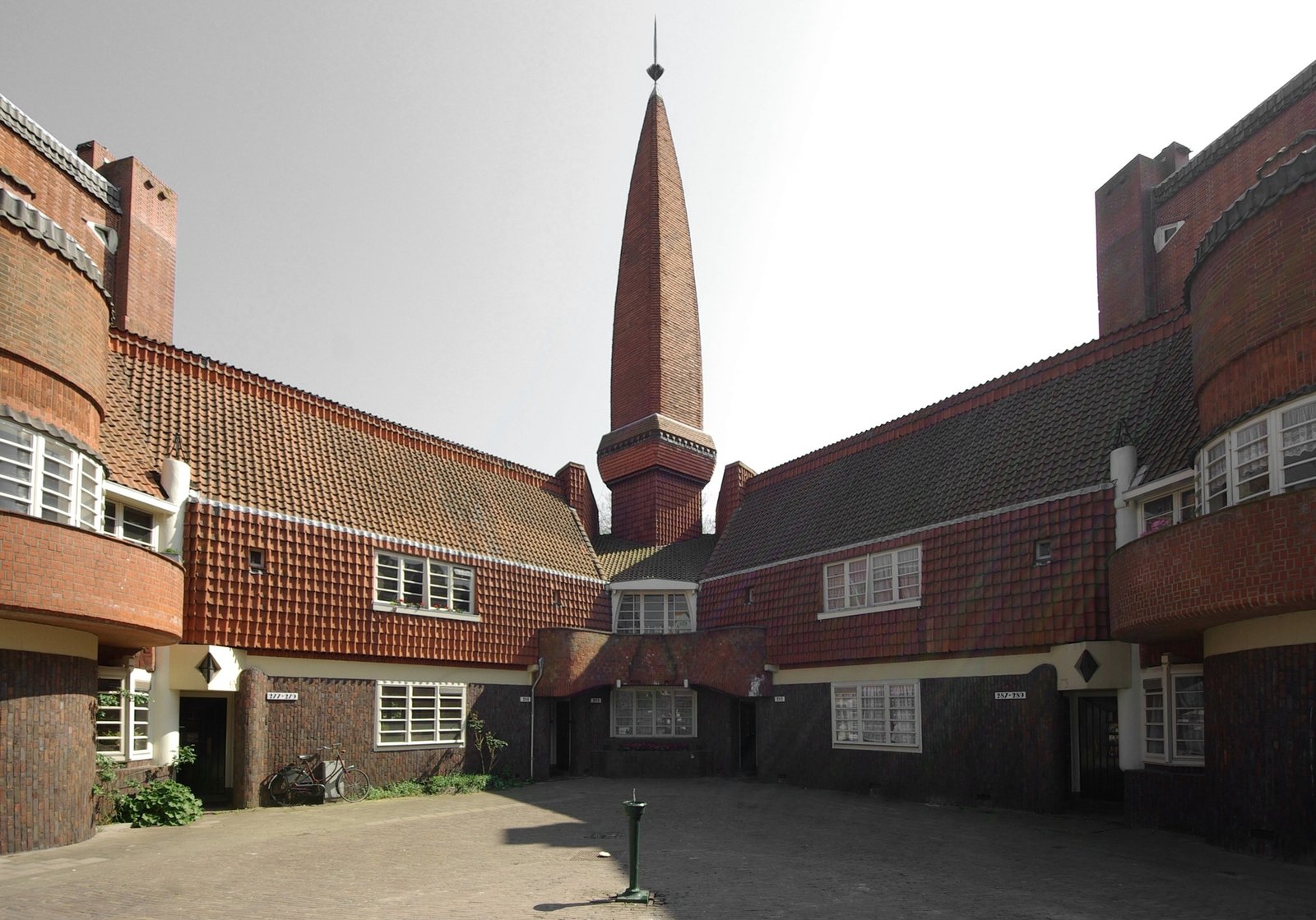

Michel de Klerk’s housing complex for Amsterdam’s working class became the defining statement of the Amsterdam School — a building shaped like a ship, clad in wave-coursed brick, and finished with ornamental details that turned social housing into monumental art.
At a glance
Het Schip stands at the corner of Oostzaanstraat and Zaanstraat in the Spaarndammerbuurt, a working-class neighbourhood northwest of Amsterdam’s historic centre. De Klerk designed the third and final block of a planned housing estate between 1919 and 1921, and the result was unlike anything that had been built for labourers anywhere in Europe. The complex contains 102 workers’ apartments, a post office, a small meeting hall and a school, all unified by an unbroken surface of expressive brickwork that curves, rises and narrows into a pointed turret at the corner — the prow that gave the building its name. Since 2001 the former school and post office have served as a museum dedicated to Amsterdam School architecture.
Key facts
- Architect: Michel de Klerk (1884–1923)
- Built: 1919–1921 (third block of Spaarndammerbuurt complex; earlier blocks 1913–1917)
- Address: Oostzaanstraat 45, 1013 WG Amsterdam, Netherlands
- GPS: 52.3905° N, 4.8737° E — Google Maps
- Housing corporation: Eigen Haard (commissioned the three Spaarndammerbuurt blocks)
- Museum: open since 2001 in the former school and post office
- Protection: Rijksmonument no. 3961
- Style: Amsterdam School (expressionist brick architecture)
History
At the turn of the twentieth century, Amsterdam faced a severe housing crisis. The Housing Act of 1901 empowered housing associations to finance construction with public guarantees, and the borough of Amsterdam-West became the testing ground for a new approach to workers’ housing — one that refused to treat cheapness as a design virtue. The Eigen Haard housing corporation commissioned Michel de Klerk to design three successive building blocks in the Spaarndammerbuurt. The first two, on Spaarndammerplantsoen and Hembrugstraat, were completed between 1913 and 1917. They already showed De Klerk’s characteristic compression of ornament into every surface: stepped gables, ceramic tiles, iron railings shaped like flowering stems.
The third block, built between 1919 and 1921 on Oostzaanstraat, was the culmination. De Klerk treated the triangular plot as a compositional challenge, pushing the corner into a tapered turret that rises above the roofline in tiers of curved brick. The post office he incorporated into the ground floor of the block became one of the most photographed interiors of the movement: its ribbed vaulting, stained-glass clerestory and tile-work counter survive almost intact. De Klerk did not live to see the wider impact of his work; he died in 1923, aged thirty-nine, of meningitis.
The building’s 102 apartments were occupied by working-class families throughout the twentieth century. By the 1980s the fabric had deteriorated, and a lengthy restoration programme brought the complex back to its original condition. The Stichting Museum Het Schip was founded in 1995 and the museum opened in the recovered school and post office in 2001, reconstructing a 1920s workers’ flat to give visitors a direct sense of how the apartments were originally furnished and used.
What you see
The exterior announces itself through contrast: across the street, ordinary brick tenements; on the corner, a surface that breathes. De Klerk varied the coursing angle along the facade so that the brickwork catches light differently at different heights — what looks like a solid wall from a distance resolves, up close, into a grid of projecting and receding headers. The pointed turret at the corner compresses all of this energy upward: each tier narrows slightly, and the iron weather-vane at the summit is shaped as a ship under sail. Ornamental brick reliefs — stylised birds, wave patterns, abstract foliage — appear at window surrounds and string courses, never repeated in exactly the same configuration.
Inside the museum, the restored post office retains its original counter, tiled floor and the ribbed vault that De Klerk designed to give a municipal transaction the gravity of a civic ceremony. The reconstructed workers’ flat on the upper floor shows the 1920s interior as it would have been furnished by a typical Eigen Haard tenant: a parlour with a built-in bed alcove, modest ceramics, a coal range. The scale of the rooms — low ceilings, narrow corridors — makes the spatial ambition of the exterior more legible. De Klerk was designing for people with very little space. Every square centimetre of ornament was a deliberate argument that they deserved beauty.
Practical information
- Opening hours: Tuesday–Sunday 11:00–17:00; closed Monday. Check the museum website for seasonal variations and group tour bookings.
- Admission: see museum website for current ticket prices.
- Guided tours: available in Dutch and English; reservation recommended.
- Time needed: allow 1.5–2 hours for the museum and exterior walk.
- Accessibility: ground-floor museum spaces are step-free; upper-floor flat accessible via lift — confirm in advance.
- Photography: permitted inside (no flash in the restored flat).
Getting there
From Amsterdam Centraal, tram line 22 (direction Surinameplein) stops at Spaarndammerstraat, a two-minute walk from the main entrance on Oostzaanstraat. The journey takes approximately 12–15 minutes. By bicycle — the most Amsterdam way — the Spaarndammerbuurt is about 20 minutes from the historic centre via the Jordaan and the Haarlemmerbuurt. Street parking is limited; the neighbourhood operates a paid parking zone on weekdays.
Nearby heritage
- Anne Frank House (Prinsengracht 263) — approximately 2.5 km southeast; wartime hiding place now a memorial museum.
- Westerkerk (Westermarkt) — approximately 2.5 km southeast; the tallest church in Amsterdam (1631), overlooking the canal-ring UNESCO World Heritage site.
- Rijksmuseum (Museumplein) — approximately 4 km south; the national museum of Dutch art and history, housed in a landmark P.J.H. Cuypers building of 1885.
- Stedelijk Museum Amsterdam (Museumplein) — approximately 4 km south; municipal museum of modern and contemporary art, with strong holdings in De Stijl — Amsterdam School’s functionalist counterpart.
Sources
- Wikipedia, “Het Schip” — en.wikipedia.org/wiki/Het_Schip
- Wikipedia, “Amsterdam School (architecture)” — en.wikipedia.org/wiki/Amsterdam_School_(architecture)
- Wikipedia, “Michel de Klerk” — en.wikipedia.org/wiki/Michel_de_Klerk
- Rijksdienst voor het Cultureel Erfgoed, Monumentenregister, Rijksmonument 3961 — monumentenregister.cultureelerfgoed.nl
- Museum Het Schip official website — hetschip.nl
Find it on the map
See this place and what’s around it →📷 Become a Cultural Heritage Online photographer
Share your photos of places: they stay published under your name as the author. The more they're seen, the more you get noticed — and soon a contest will reward the most appreciated photos.
Log in or sign up free to add a photoIs this page about you?
This page is read by travellers and heritage enthusiasts who find it on Google. Tell us how you are connected to this place and we will take it from there.