
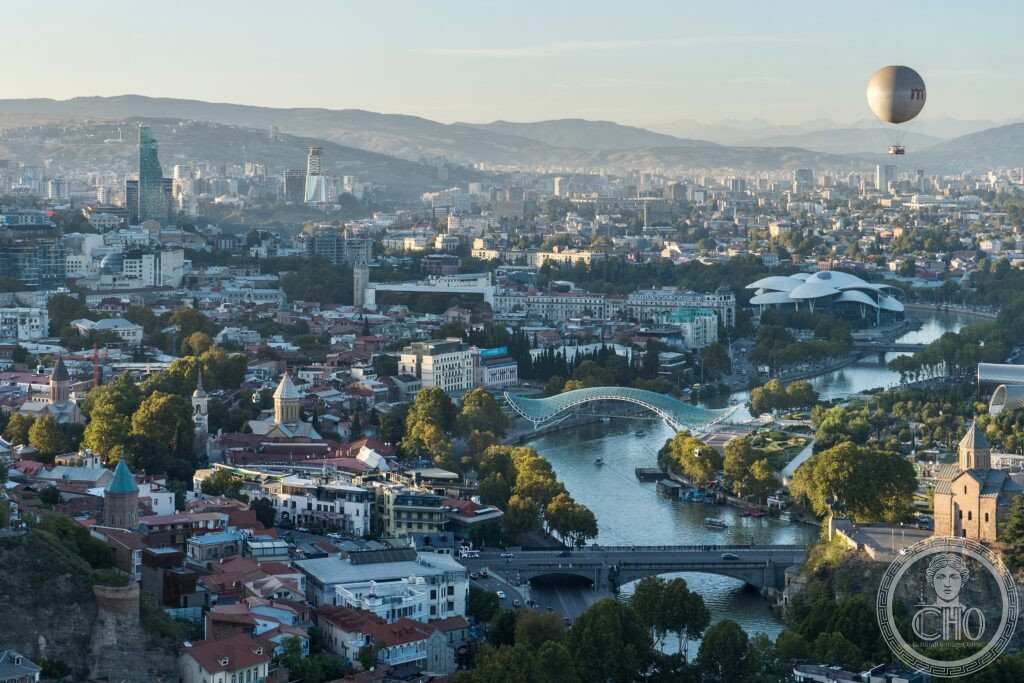
Tbilisi has been the capital of Christian Georgia since the fifth century, when the royal seat moved here from Mtskheta for the sake of the hot sulphur springs that gave the city its name. Persian, Arab, Georgian, Ottoman, Russian and Soviet layers meet in its Old Town, where carved wooden balconies lean over the lanes between the domed bath-houses of Abanotubani and the ridge-top walls of the Narikala Fortress.
At a glance
Founded in 458, according to the traditional date, when the capital of the Georgian kingdom was transferred from Mtskheta, Tbilisi owes its site and its name to warm water: tbili means “warm” in Georgian, and legend has King Vakhtang Gorgasali choosing the spot after a hunt led him to the steaming springs. The city grew where the Silk Road squeezed through the valley of the Mtkvari (Kura) River — a position that made it rich, and made everyone from the Arabs to the Russians want it.
The Historic District stands on Georgia’s UNESCO Tentative List as an outstanding example of urban heritage shaped by centuries of foreign influence creatively absorbed into Georgian tradition; it is not an inscribed World Heritage Site.
Key facts
- Founded: 458 CE by tradition, when the Georgian capital moved from Mtskheta; associated with King Vakhtang Gorgasali
- Name: from tbili, “warm”, after the natural sulphur springs of the Abanotubani district
- Turning point: retaken from Muslim rule in 1122 by King David IV the Builder after the Battle of Didgori, opening Georgia’s Golden Age
- Russian era: annexed with eastern Georgia in 1801 and ruled as Tiflis, capital of the Caucasus
- Landmarks: Narikala Fortress, Metekhi Church, the Abanotubani bath-houses, Rustaveli Avenue, the Sameba Cathedral (2004) and the Peace Bridge (2010)
- Heritage status: Tbilisi Historic District, on Georgia’s UNESCO Tentative List
History
Tbilisi’s story is one of conquest absorbed. The early medieval city passed under Persian and then Arab control — for four centuries it was the seat of a Muslim emirate — until David IV the Builder took it in 1122 and made it the capital of a kingdom that, under Queen Tamar, stretched from sea to sea. At that court, around 1200, Shota Rustaveli wrote The Knight in the Panther’s Skin, the national epic whose author now names the city’s grandest avenue.
Mongol domination in the thirteenth century, the raids of Timur, and long tugs-of-war between Ottomans and Persians followed; the city was devastated as late as 1795 by a Persian sack. In 1801 the Russian Empire annexed eastern Georgia, and Tiflis, as the Russians called it, became the administrative and cultural capital of the whole Caucasus — the era that gave the city its European boulevards and opera house alongside the old Persian-inflected quarters.
Through the Soviet twentieth century and the independence restored in 1991, the Old Town kept its intimate scale, and the post-2000 city has added bold contemporary landmarks — the vast Sameba Cathedral consecrated in 2004, and the glass Peace Bridge by Italian architect Michele De Lucchi, opened in 2010.
What you see
The Old Town (Dzveli Kalaki) folds along the right bank of the Mtkvari beneath the Narikala Fortress, whose walls — ancient in origin, rebuilt by Arabs and Georgians, ruined in the nineteenth century — still frame the skyline; a cable car glides up from Rike Park. Across the river, the Metekhi Church stands on its cliff above the water beside the equestrian statue of Vakhtang Gorgasali.
In Abanotubani, the bath district, brick domes at street level cover the sulphur baths below, fed by naturally hot mineral water; most of the surviving houses were built between the seventeenth and nineteenth centuries, and Pushkin was among their celebrated bathers. All around, the signature of old Tbilisi: carved and painted wooden balconies overhanging courtyards and lanes.
Nineteenth-century Tbilisi is best read along Rustaveli Avenue — parliament, opera house, theatre and museums in a Caucasian version of the European boulevard — while the city’s newest layer glitters in the Peace Bridge and the buildings of Rike Park.
Practical information
- Getting around: the Old Town is compact and walkable; the metro and the Narikala cable car cover the rest
- Baths: the Abanotubani bath-houses operate daily with private and public rooms; booking ahead is wise at weekends
- Season: spring and autumn are the most pleasant; summer is hot, winter mild by Caucasus standards
Getting there
Tbilisi International Airport lies south-east of the centre, with direct flights from many European and Middle Eastern cities. The Old Town is a short taxi or bus ride from the airport and within walking distance of the central metro stations. GPS: 41.6938, 44.8015.
Nearby
- Mtskheta — the ancient capital just north-west of the city, its churches a UNESCO World Heritage Site since 1994, with Jvari Monastery above the river confluence
- Uplistsikhe — rock-hewn town west along the Mtkvari, inhabited from antiquity to the Middle Ages
- Gori — market town west of the capital, known for its fortress and the Stalin Museum
- Kakheti — Georgia’s principal wine region, east of Tbilisi
Sources
- UNESCO World Heritage Centre, Tentative Lists — Tbilisi Historic District
- Encyclopaedia Britannica — Tbilisi; Georgia; David IV; Vakhtang Gorgaslani
Find it on the map
See this place and what’s around it →📷 Become a Cultural Heritage Online photographer
Share your photos of places: they stay published under your name as the author. The more they're seen, the more you get noticed — and soon a contest will reward the most appreciated photos.
Log in or sign up free to add a photo