
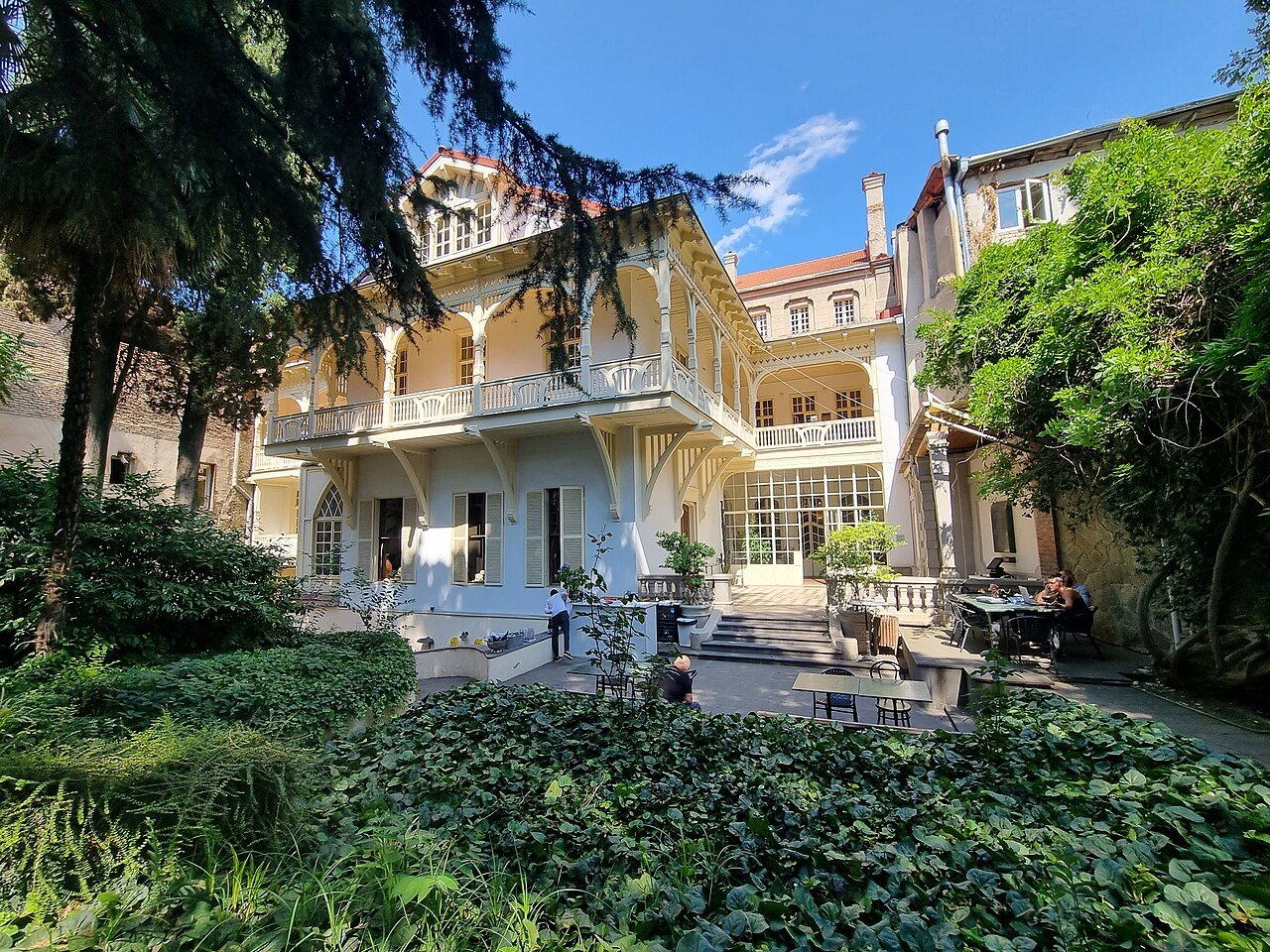
Tbilisi entered the twentieth century rich from trade and oil money, and that wealth left ornate facades across its hillside quarters. Its Art Nouveau belongs to a Caucasian capital, not a Western European one.
At a glance
The capital of Georgia carries one of the more unusual chapters of European Art Nouveau, set on the old caravan routes between Europe and Asia. The article on the city notes that its architecture is “a mix of medieval, neoclassical, Beaux Arts, Art Nouveau, Stalinist, and Modern structures.” In the first years of the twentieth century, merchants and industrialists enriched by Caucasian trade commissioned apartment houses and private mansions whose facades carried floral relief, curved ironwork, and decorative tilework. The clearest single example is the Writers’ House of Georgia, the former residence of the cognac entrepreneur David Sarajishvili, built between 1903 and 1905 to designs by the German architect Karl Zaar.
Key facts
- Country: Georgia
- Key period: c. 1900–1915
- Essential sites: Writers’ House of Georgia (former Sarajishvili mansion, 1903–1905, architect Karl Zaar); the apartment houses along Rustaveli Avenue and Davit Aghmashenebeli Avenue; the carved-balcony houses of the old town
- Style: Art Nouveau combined with neobaroque elements (Writers’ House); broader Art Nouveau / Modern fabric across the central districts
History
Tbilisi spent the nineteenth century as the administrative seat of Russian rule in the Caucasus, and its urban form was reshaped accordingly. The main new thoroughfare laid out under Russian administration was Golovin Avenue, today’s Rustaveli Avenue, which became the city’s principal stage for grand public and commercial buildings. A second axis, Davit Aghmashenebeli Avenue, developed across the river as a long commercial street lined with two- and three-storey houses. Both remain, in the words of the city’s own account, among its “notable tourist destinations.”
The Art Nouveau moment arrived with money. David Sarajishvili, who lived from 1848 to 1911, had built a fortune in brandy and cognac production across the Russian Empire, pioneering the use of Caucasian oak barrels. In 1902 he cleared his parents’ old house and commissioned a new family residence; the German architect Karl Zaar completed the building in 1905 in the Sololaki district, on Ivane Machabeli Street. The result combined Art Nouveau with neobaroque detail, a pairing typical of the eclectic confidence of the period’s wealthy patrons. After Sarajishvili’s death the house passed through several uses and in time became the home of Georgia’s writers, the function that gives it its present name.
The same decades filled the central districts with rental apartment houses whose owners borrowed the new decorative vocabulary spreading from Vienna, Riga, and Saint Petersburg, adapting it to local stone, local craft, and the carved wooden balconies that were already a Tbilisi tradition. The mix of imported style and indigenous building habit is what gives the city’s early-twentieth-century architecture its particular character.
What you see
The Writers’ House is the anchor of any Art Nouveau walk. From its garden the facade shows the soft, curving lines of Art Nouveau set against firmer neobaroque framing, the work of Karl Zaar for a patron who wanted his success made visible. It stands in Sololaki, a hillside quarter that itself rewards slow walking, where decorative doorways, stained glass, and tiled entrance halls survive behind unassuming street fronts.
Beyond it, the Art Nouveau of Tbilisi is dispersed rather than concentrated. Along Rustaveli Avenue and Davit Aghmashenebeli Avenue, and in the lanes of the old town, individual facades carry floral plasterwork, sinuous balcony rails, and the carved timber galleries for which the historic centre is known. There is no single museum-piece street; the pleasure is in reading one building at a time, noticing where a merchant of 1910 chose to be modern.
Practical information
- The Writers’ House of Georgia is at Ivane Machabeli Street 13, in the Sololaki district.
- Rustaveli Avenue and Davit Aghmashenebeli Avenue are the two main axes to walk for early-twentieth-century facades.
- The old town and Sololaki are best explored on foot; many decorative interiors are in private apartment buildings, so admire from the street.
- Check current opening arrangements at the Writers’ House before visiting, as access depends on its events and café programme.
- Allow a half-day to combine Sololaki, Rustaveli Avenue, and a crossing to Davit Aghmashenebeli Avenue.
Getting there
Tbilisi International Airport (IATA code TBS) lies about 17 km (11 mi) southeast of the city. The George W. Bush Avenue, also known as the Kakheti Highway, leads from the airport into the centre; an infrequent rail link runs two trains a day each way, and taxis cover the route directly. From the central districts, the Art Nouveau sites are reached on foot or by the city’s metro and buses.
Related in CHO
- Vienna — Capital of the Vienna Secession
- Riga — (Art Nouveau)
- Saint Petersburg — The Singer House and Russian Style Moderne
Sources
Find it on the map
See this place and what’s around it →Record researched and written by Luigi De Marchi for Cultural Heritage Online, 2026.
📷 Become a Cultural Heritage Online photographer
Share your photos of places: they stay published under your name as the author. The more they're seen, the more you get noticed — and soon a contest will reward the most appreciated photos.
Log in or sign up free to add a photo