
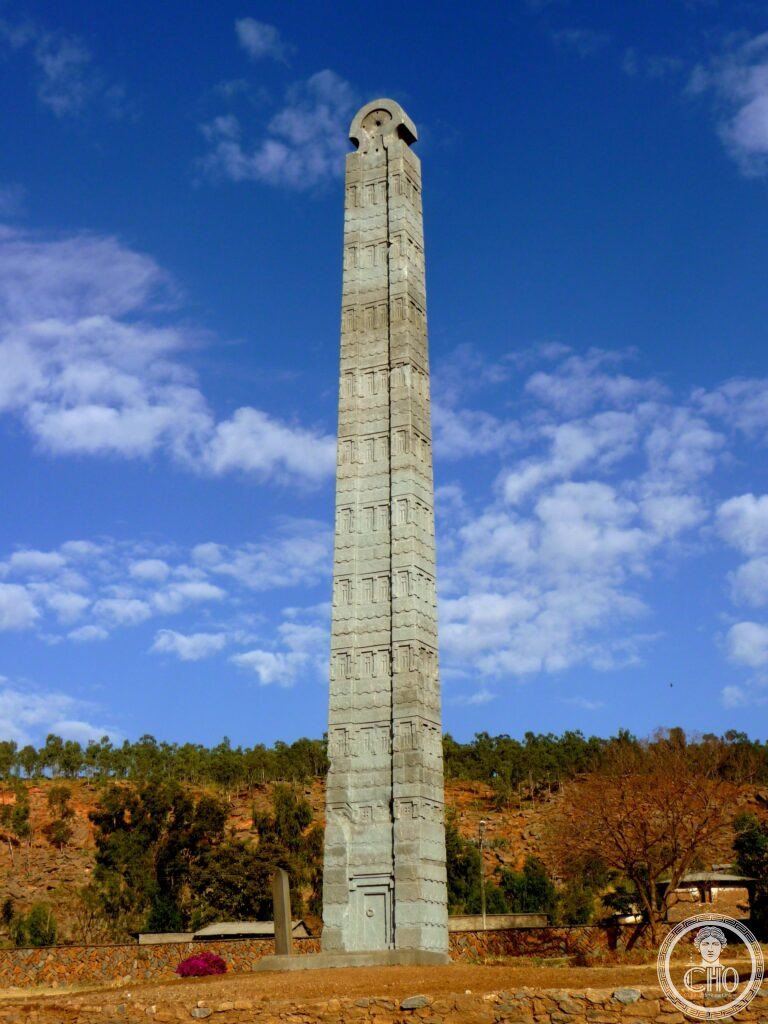
Aksum was the capital of a kingdom whose merchant fleets linked Rome, Arabia and India, and whose kings raised the tallest single blocks of stone ever quarried in the ancient world. It remains Ethiopia’s most sacred city, home to a church that Orthodox tradition holds guards the Ark of the Covenant.
At a glance
Aksum grew wealthy on control of Red Sea trade between the Roman world, Arabia and India, exporting gold, ivory, obsidian and live animals. Tradition credits the 3rd-century Persian prophet Mani with naming Axum alongside Persia, Rome and China as one of the great powers of his age. Ethiopian tradition also identifies Aksum as the home of the Queen of Sheba, whose son by King Solomon, Menelik I, is said to have brought the Ark of the Covenant to Ethiopia.
Key facts
- Site: Northern Stelae Park, with more than 150 carved granite obelisks dating from the 3rd and 4th centuries CE, marking elite tombs beneath.
- Great Stele: the largest of the stelae, fallen since antiquity, was the largest single piece of stone ever quarried and erected in the ancient world.
- Rome Obelisk: Stele 2, taken to Rome by Mussolini in 1937 as war booty and returned to Ethiopia in 2008.
- Church of Our Lady Mary of Zion: adjacent chapel said by the Ethiopian Orthodox Church to house the Ark of the Covenant, watched over by a single guardian monk.
- Christianisation: King Ezana adopted Christianity as the state religion around 330 CE, making Aksum one of the first states in the world to do so.
- Recognition: inscribed as a UNESCO World Heritage Site in 1980.
History
The Kingdom of Axum flourished from around the 1st to the 10th century CE, built on control of Red Sea trade routes connecting the Roman world, Arabia and India. King Ezana’s conversion to Christianity around 330 CE made Ethiopia the first African kingdom to adopt the faith as a state religion.
From the 7th century, the rise of Islamic power along the Red Sea cut Aksum off from its trading networks, and the kingdom’s political centre gradually shifted south, leaving Aksum’s monuments behind. In the 20th century, Italy occupied Ethiopia between 1935 and 1941; during this period Mussolini had the Rome Obelisk removed to Italy and reportedly planned to demolish the stelae field for a road. Ethiopian emperors were traditionally crowned at Aksum, the last being Haile Selassie, later revered by the Rastafari movement.
What you see
The Northern Stelae Park holds the great carved granite obelisks, the largest of which lies fallen where it toppled in antiquity. Nearby stands the Rome Obelisk, restored to its original site after decades in Italy. The Tomb of the False Door, an underground royal tomb reached by steps, carries a carved false door typical of Aksumite architecture.
The Church of Our Lady Mary of Zion, whose original foundation dates to the 4th century and whose present building was rebuilt in the 17th century, is Ethiopia’s most sacred church. A modern chapel beside it is said to hold the Ark of the Covenant, though access to the inner sanctuary is restricted to Orthodox worshippers.
Practical information
- Access: the Church of St Mary of Zion complex is open to visitors, but non-Orthodox visitors may not enter the inner sanctuary said to hold the Ark.
- Time needed: a full day allows for the stelae park, the tombs and the church complex.
- Best season: the dry season, from October to February, is generally recommended.
- Regional advisory: Tigray experienced armed conflict between 2020 and 2022; travellers should check current government travel advisories before planning a visit.
Getting there
Aksum is reached by domestic flight from Addis Ababa to Aksum Airport, or by road. Given the region’s recent history of conflict, it is worth checking current travel advisories and transport conditions before setting out.
Nearby
- Lalibela — roughly 480 km to the south, a UNESCO World Heritage Site since 1978, with eleven rock-hewn churches carved from volcanic tuff in the 12th century, still in use for Orthodox worship.
- Yeha Temple — about 52 km east, a pre-Aksumite Sabaean temple dating from the 5th or 6th century BCE, standing some 9 metres high and considered the oldest standing building in sub-Saharan Africa.
Sources
- Wikipedia: Aksum
- Wikipedia: Obelisk of Axum
- Wikipedia: Church of Our Lady Mary of Zion
- Wikipedia: Aksumite Empire
- UNESCO
Find it on the map
See this place and what’s around it →📷 Become a Cultural Heritage Online photographer
Share your photos of places: they stay published under your name as the author. The more they're seen, the more you get noticed — and soon a contest will reward the most appreciated photos.
Log in or sign up free to add a photo