
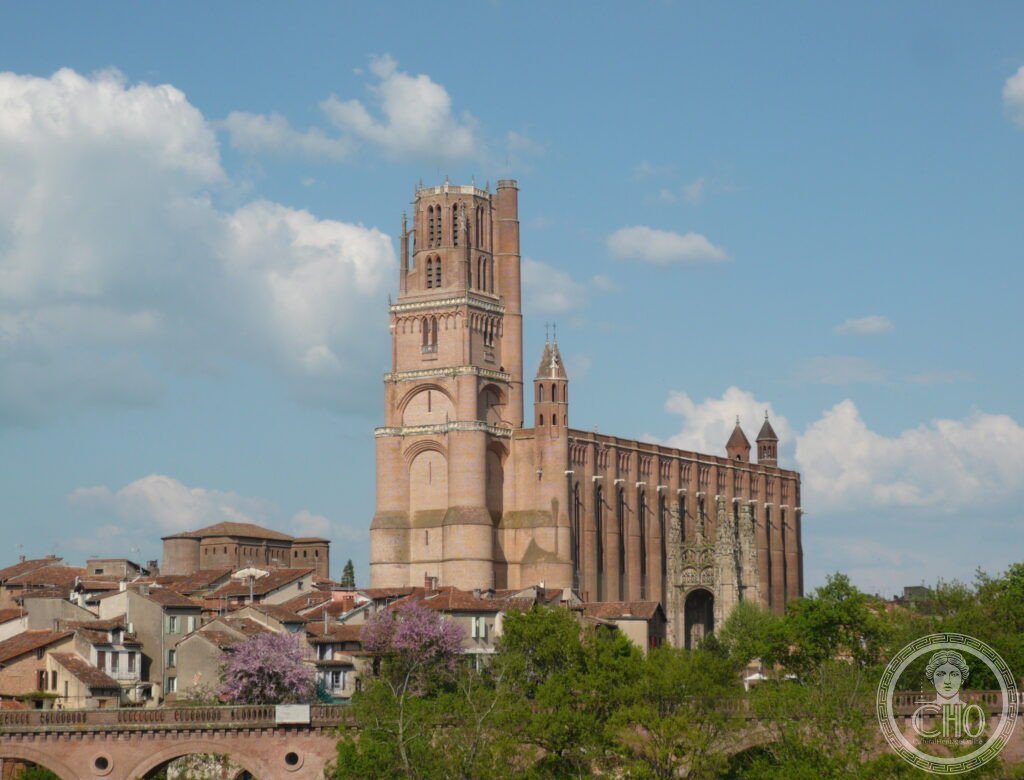
A red-brick cathedral raised as a statement of Catholic power after the Cathar wars still dominates this Tarn river town, while the bishop’s fortified palace beside it now holds the world’s largest collection of work by Albi-born painter Henri de Toulouse-Lautrec.
At a glance
Albi was the nominal target of the Albigensian Crusade, the campaign launched by Pope Innocent III against the Cathar movement of Languedoc. The Cathedral of Sainte-Cécile was built in the decades after that war to reassert Catholic authority over the region, and its red-brick Gothic bulk still rises above the Tarn river, giving the old episcopal city one of the most distinctive skylines in France.
Henri de Toulouse-Lautrec, the Post-Impressionist chronicler of Parisian cabaret life, was born here in 1864. The bishop’s former palace next to the cathedral now houses a museum devoted to his work.
Key facts
- Cathedral: Sainte-Cécile, begun 1282 under Bishop Bernard de Castanet, completed 1480; built in red-brick Gothic style, 113 metres long and about 35 metres high inside, with external walls up to 7 metres thick and no side chapels.
- Museum: the Toulouse-Lautrec Museum, in the 13th-century Palais de la Berbie, holds over 1,000 works by the artist, including his Moulin Rouge posters and the Jane Avril series.
- Historical context: the cathedral was built as a fortress-cathedral following the Albigensian Crusade of 1209–1229, waged against the Cathar sect of Languedoc.
- Coordinates: 43.9297° N, 2.1481° E.
History
The Albigensian Crusade of 1209 to 1229 was directed against the Cathars, a dualist Christian sect established across Languedoc, and brought devastating loss of life to the region, though historians disagree on the exact scale. Construction of Sainte-Cécile did not begin until 1282, nearly fifty years after the crusade ended, and the building took two centuries and twenty-two successive bishops to complete. Its scale and defensive character were intended as an unmistakable assertion of Catholic presence in a region the Church had just crushed.
The cathedral’s structure, from the first stone laid in 1282 to its completion in 1480, has remained architecturally consistent, without major later rebuilding or stylistic change. The Pont Vieux, an eleventh-century bridge across the Tarn, predates the cathedral by two centuries and is described as the oldest bridge in the wider region; it remains narrow enough that two cars cannot pass and still carries traffic today.
What you see
Inside the cathedral, a Late Gothic fresco cycle begun around 1500 covers much of the interior, and the choir screen, or jubé, is counted among the finest surviving Gothic choir screens in France. The Last Judgement fresco on the west wall, painted between 1474 and 1484, is the largest fifteenth-century fresco in France, though part of it was cut through by a doorway added in the eighteenth century. The cathedral organ, built by Christophe Moucherel between 1734 and 1736, is regarded as one of the finest Baroque organs in France and is used for concerts.
Next door, the Palais de la Berbie holds the Toulouse-Lautrec Museum, and from its terrace on the Place du Palais the cathedral is seen rising directly above the Tarn, in what is generally held to be Albi’s most photographed view.
Practical information
- Cathedral access: the interior can be visited without charge; organ concerts run through the summer months, with current dates and any charges published by the cathedral itself.
- Toulouse-Lautrec Museum: entry is ticketed; current prices and opening arrangements are available from the museum’s own website.
- Time needed: allow at least half a day to see the cathedral and museum together, and a full day to take in the wider old town.
- Market: the old town’s covered market runs on Saturday mornings.
Getting there
Albi is reached via Toulouse-Blagnac Airport, roughly 80 kilometres away, with onward rail connections from Toulouse Matabiau station to Albi-Ville. Current timetables and fares are best checked directly with the rail operator.
Nearby
- Cordes-sur-Ciel — about 25 km northwest; a hilltop bastide town founded in 1222, car-free within its walls, with Gothic buildings contemporary with Sainte-Cécile.
- Toulouse — about 80 km southwest; the Pink City, built in the same Languedoc red brick as Albi, home to the Basilique Saint-Sernin, an eleventh- to twelfth-century church inscribed on the UNESCO World Heritage List as part of the Camino de Santiago routes.
- Millau Viaduct — about 100 km north; a bridge designed by Norman Foster, opened in 2004, crossing the Tarn gorge.
Sources
- Wikipedia (Albi Cathedral)
- Wikipedia (Albi)
- Wikipedia (Toulouse-Lautrec Museum)
- Wikipedia (Albigensian Crusade)
- UNESCO (Episcopal City of Albi)
Find it on the map
See this place and what’s around it →📷 Become a Cultural Heritage Online photographer
Share your photos of places: they stay published under your name as the author. The more they're seen, the more you get noticed — and soon a contest will reward the most appreciated photos.
Log in or sign up free to add a photo