
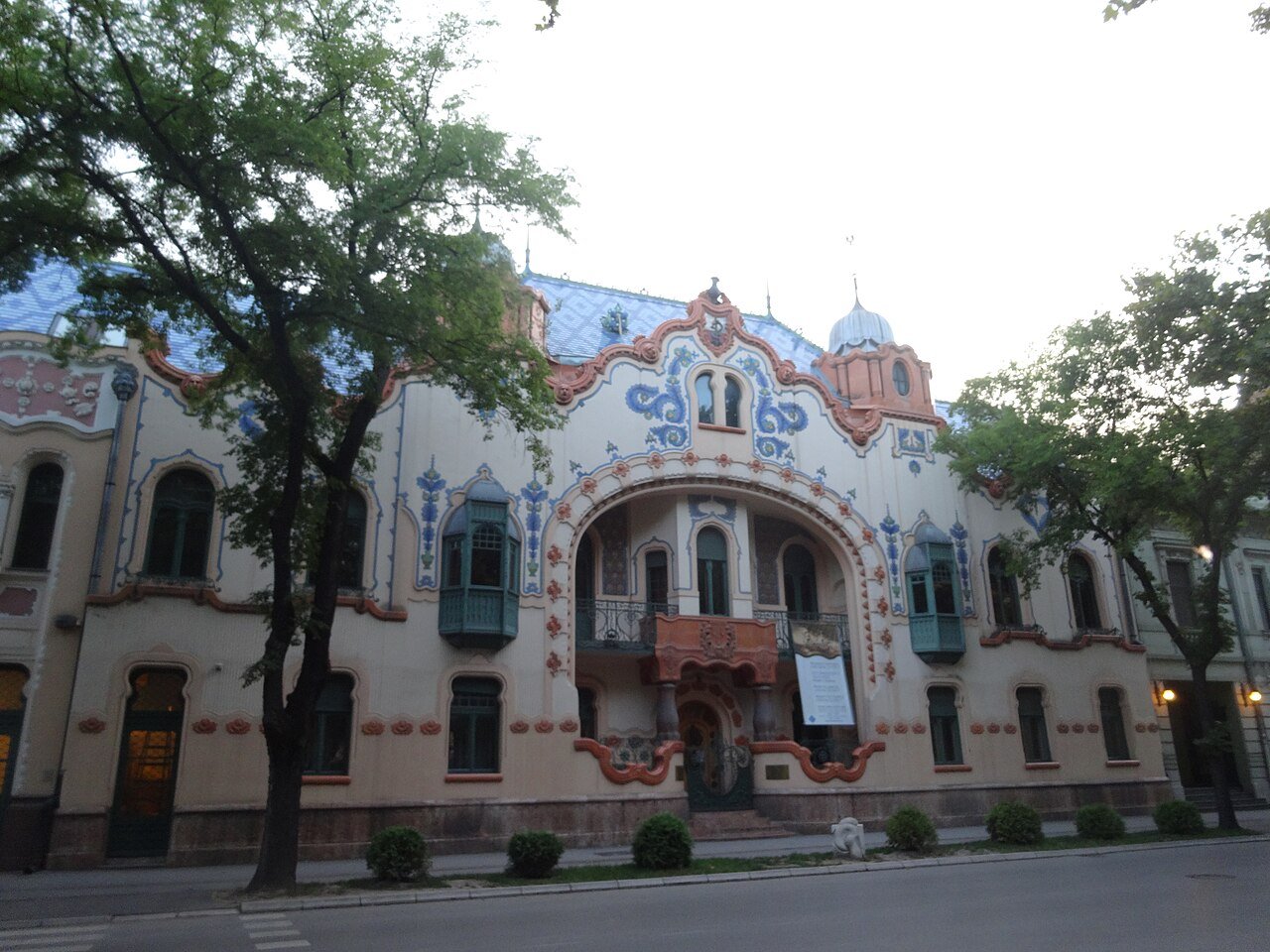
In the flat farmland of northern Serbia, a provincial market town spent the early 1900s reinventing itself in ceramic flowers and folk-art curves. Subotica holds one of Europe’s densest concentrations of Hungarian Secession architecture.
At a glance
Subotica sits at the northern edge of Serbia, roughly ten kilometres from the Hungarian border and at the heart of the Vojvodina region. Under the Austro-Hungarian Dual Monarchy it grew into a prosperous railway and agricultural town, and between 1901 and 1912 its civic ambitions found expression in a remarkable group of buildings designed in the Hungarian Secession style — the local branch of Art Nouveau that fused vegetal ornament with Magyar folk motifs. Three monuments anchor the ensemble: the Synagogue, the City Hall, and the Raichle Palace. Together they make a compact, walkable open-air museum of an architecture that exists almost nowhere else in such concentration outside Hungary itself.
Key facts
- Country: Serbia
- Region: Vojvodina (historically Austria-Hungary)
- Key period: 1900–1912
- Architects: Ferenc J. Raichle (Raichle Palace, 1904); Marcell Komor & Dezső Jakab (Synagogue, 1901–1903; City Hall, 1908–1910, interiors to 1912)
- Essential sites: Raichle Palace, City Hall, Synagogue
- Style: Hungarian Secession (Magyar Szecesszió)
History
Subotica’s golden age began with the establishment of the Dual Monarchy in 1867. The railway arrived in 1869 and electricity by 1896, and by the turn of the century the town had become one of the larger urban centres of the Hungarian half of the empire. Wealth from grain, livestock, and trade gave the municipality and its citizens both the means and the appetite for monumental building, and they turned to the most modern Hungarian style of the day.
That style was the Hungarian Secession, a national variant of Art Nouveau associated with the school of Ödön Lechner, who sought a distinctively Magyar architecture by grafting folk-art ornament and Zsolnay ceramics onto the flowing lines of Jugendstil. Marcell Komor and Dezső Jakab, the partnership behind two of Subotica’s three masterpieces, worked squarely within that current. Their Synagogue, built between 1901 and 1903, places a single congregation beneath a self-supporting dome carried on a modern steel structure — today regarded as one of the finest surviving Art Nouveau religious buildings in Europe, and the second-largest synagogue on the continent after the Dohány Street Synagogue in Budapest. The same pair won the public tender announced in 1906 for a new town hall, and built the City Hall between 1908 and 1910, with interior works finishing in 1912.
The twentieth century was harder on these buildings than the architects could have foreseen. The Synagogue fell into disrepair after the Second World War and the near-destruction of the local Jewish community; a long restoration returned it to public use only in 2018. The Raichle Palace, built in 1904 as the private residence of architect Ferenc J. Raichle, has housed the city’s Gallery of Contemporary Art since 1968.
What you see
The Raichle Palace is the most exuberant of the three. Raichle covered his own house in a vocabulary of hearts and flowers rendered in ceramics from the Zsolnay factory in Pécs, Murano mosaic, wrought iron, carved wood, and stucco. A heart-shaped motif recurs across the facade, and a floral wrought-iron parapet crowns the composition — ornament treated not as applied decoration but as the building’s whole language.
The City Hall, by Komor and Jakab, combines Art Nouveau vegetal ornament and symbolic figures with traditional Hungarian motifs across a vast facade on Trg slobode, its tower dominating the central square. The Synagogue, a short walk away, is quieter outside and overwhelming within: a gold-painted dome interior and palm-leaf reliefs over a unified central space. All three stand within easy walking distance of one another in the historic core, and the Synagogue and parts of the City Hall are open to visitors.
Practical information
- The three principal buildings lie within a short walk of the central square, Trg slobode.
- The Synagogue, reopened in 2018, functions as a cultural venue and welcomes visitors; check current opening hours locally.
- The Raichle Palace houses the Gallery of Contemporary Art (Likovni susret); its interior is accessible during gallery hours.
- The City Hall remains the seat of local government and a tourist attraction; guided access to interiors and the tower is sometimes available.
- The historic centre is compact and best explored on foot.
Getting there
Subotica is the northernmost city in Serbia, about ten kilometres from the Hungarian border and close to Szeged. It lies on the Budapest–Belgrade railway, with rail and road connections south to Belgrade and north into Hungary, though train service has at times been interrupted by reconstruction works on the line. Many visitors arrive as a day trip from Szeged or as a stop between Budapest and Belgrade.
Related in CHO
- Budapest — Ödön Lechner and the Hungarian Szecesszió
- Oradea — Romania’s Art Nouveau Capital
- Vienna — Capital of the Vienna Secession
Sources
Find it on the map
See this place and what’s around it →Record researched and written by Luigi De Marchi for Cultural Heritage Online, 2026.
📷 Become a Cultural Heritage Online photographer
Share your photos of places: they stay published under your name as the author. The more they're seen, the more you get noticed — and soon a contest will reward the most appreciated photos.
Log in or sign up free to add a photo