
High on a plateau at 2,325 metres, Asmara holds one of the densest concentrations of early-twentieth-century modernist architecture in the world. Built largely between 1935 and 1941 under Italian colonial administration, it became a UNESCO World Heritage Site in 2017.
At a glance
Asmara is the capital of Eritrea and, since 2017, a UNESCO World Heritage Site listed as “Asmara: A Modernist African City.” Most of its monumental centre was constructed in a short, intense building campaign between 1935 and 1941, when the city served as the showcase capital of Italian Eritrea. Architects working there drew on Rationalism, Futurism, Art Deco and the Italian Novecento, producing cinemas, service stations, government buildings and bars that translated European avant-garde ideas into the East African highlands. The result is an exceptionally coherent modernist townscape — admired today for its preservation, and studied as a rare application of early modernist urbanism in an African context.
Key facts
- Country: Eritrea
- Key period: 1935–1941
- Elevation: 2,325 metres above sea level
- UNESCO: Asmara: A Modernist African City, inscribed 2017
- Essential sites: Fiat Tagliero Building, Cinema Impero, the former Opera House, Bar Zilli
- Architectural languages: Rationalism, Futurism, Art Deco, Novecento
- Context: built under Italian colonial administration
History
Italy occupied the highland settlement in 1889 and, in 1897, Governor Ferdinando Martini made Asmara the capital of the colony of Italian Eritrea. For its first decades the town grew modestly, but everything changed in the mid-1930s. As Italy prepared for and then prosecuted the invasion of Ethiopia, Asmara was recast as a logistical hub and a propaganda capital, and capital and labour poured into a rapid programme of construction.
Between 1935 and 1941 the city’s monumental core took shape. Italian architects and engineers, many of them young and steeped in the debates of European modernism, built cinemas, offices, factories, service stations and apartment blocks at remarkable speed. They worked in the idioms of the moment — the clean geometry of Rationalism, the dynamism of Futurism, the streamlined ornament of Art Deco — adapting them to the light, climate and altitude of the Eritrean plateau. The brevity and intensity of the campaign is precisely what gives Asmara its unusual unity.
The colonial period ended in 1941, when British forces took Eritrea during the Second World War. The city passed through British administration, federation with and then annexation by Ethiopia, a long war of independence, and finally Eritrean independence in 1993. Through all of this its modernist fabric survived largely intact — partly through neglect, partly through care — until in 2017 UNESCO inscribed the historic centre on the World Heritage List, recognising it as an exceptional example of early modernist urbanism applied in an African setting.
What you see
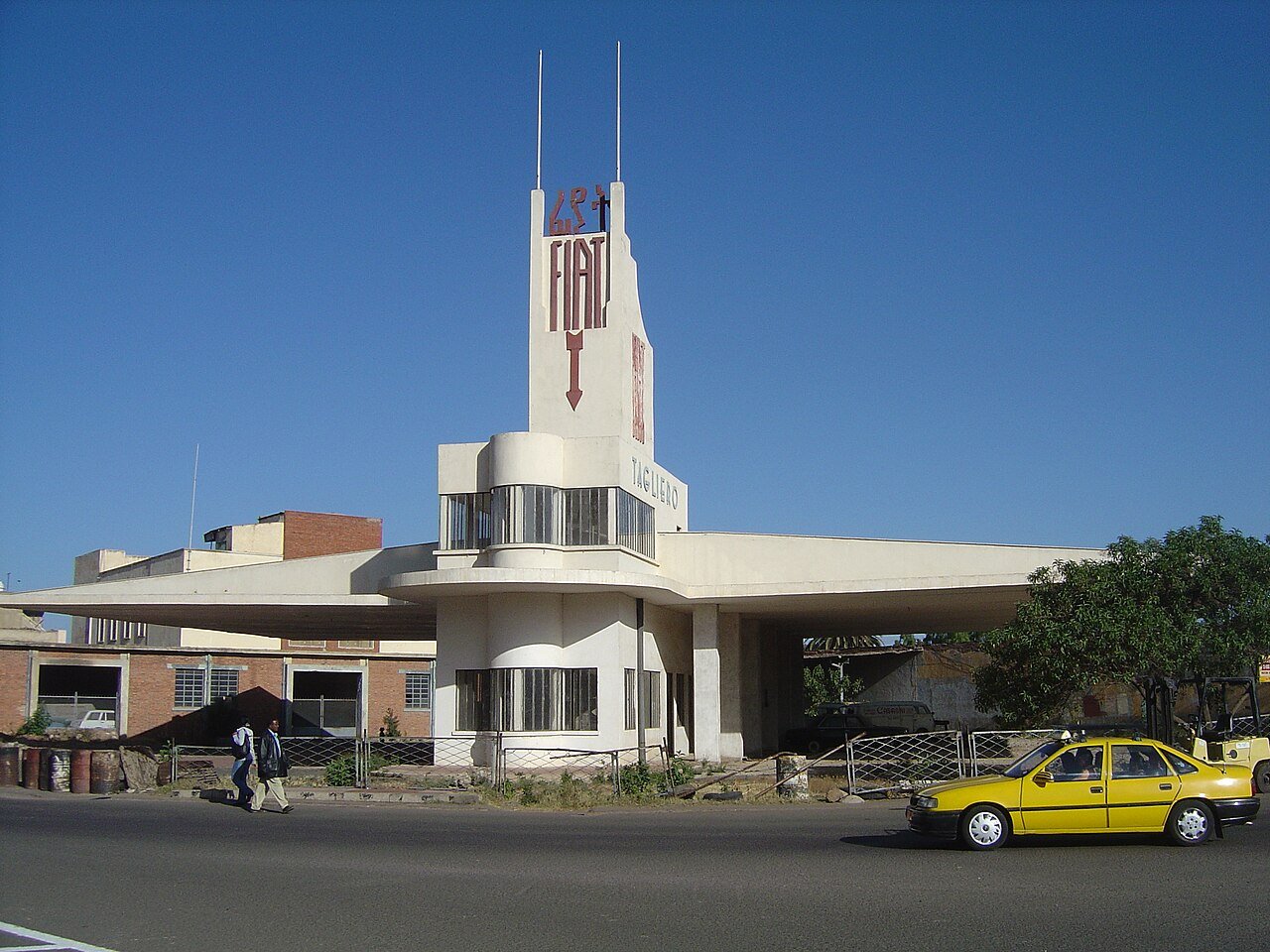
The icon of modernist Asmara is the Fiat Tagliero Building, a service station completed in 1938 to a design by the engineer Giuseppe Pettazzi. Shaped like an aeroplane, it rises from a central tower — holding office, cashier and shop — and stretches out two long cantilevered wings of reinforced concrete, roughly fifteen metres to each side, unsupported at their tips. The story of how the formwork was removed has become local legend; what is not in doubt is that the structure is a bravura piece of Futurist engineering that still stands.
A short walk away is Cinema Impero, opened in 1937 to a design by Mario Messina: an Art Deco picture palace whose façade carries dozens of round lights and the cinema’s name in tall illuminated letters. Around it, the streets reveal the rest of the repertoire — the former Opera House (Teatro d’Opera), the streamlined Bar Zilli, and block after block of Rationalist offices and apartments. Asmara is best experienced on foot, reading one building against the next; the pleasure is less in any single monument than in the consistency of the whole ensemble.
Practical information
- Asmara is a high-altitude city (2,325 m); allow time to acclimatise on arrival.
- Travel to Eritrea requires a visa, and visitors have historically needed travel permits to move outside Asmara — check the current rules with the Eritrean authorities before booking.
- Photography of government, military and some infrastructure sites is restricted; ask before photographing.
- The historic centre is compact and walkable, which suits a self-guided architectural itinerary.
- Many landmark buildings remain in use; interiors are not always open to visitors.
Getting there
Asmara is served by Asmara International Airport (ASM), a short distance from the city centre, with a limited number of international connections. There is no regular international rail or road tourist access, so flights are the practical option for most visitors; from the airport the modernist centre is reached by taxi in a few minutes.
Related in CHO
- Rome — Liberty Romano, EUR and Italian Rationalism
- Milan — Liberty, Rationalism and the World Capital of Design
- Brno — Villa Tugendhat and Czech Functionalism
Sources
Find it on the map
See this place and what’s around it →Record researched and written by Stefano Vigolo for Cultural Heritage Online, 2026.

📷 Become a Cultural Heritage Online photographer
Share your photos of places: they stay published under your name as the author. The more they're seen, the more you get noticed — and soon a contest will reward the most appreciated photos.
Log in or sign up free to add a photo