
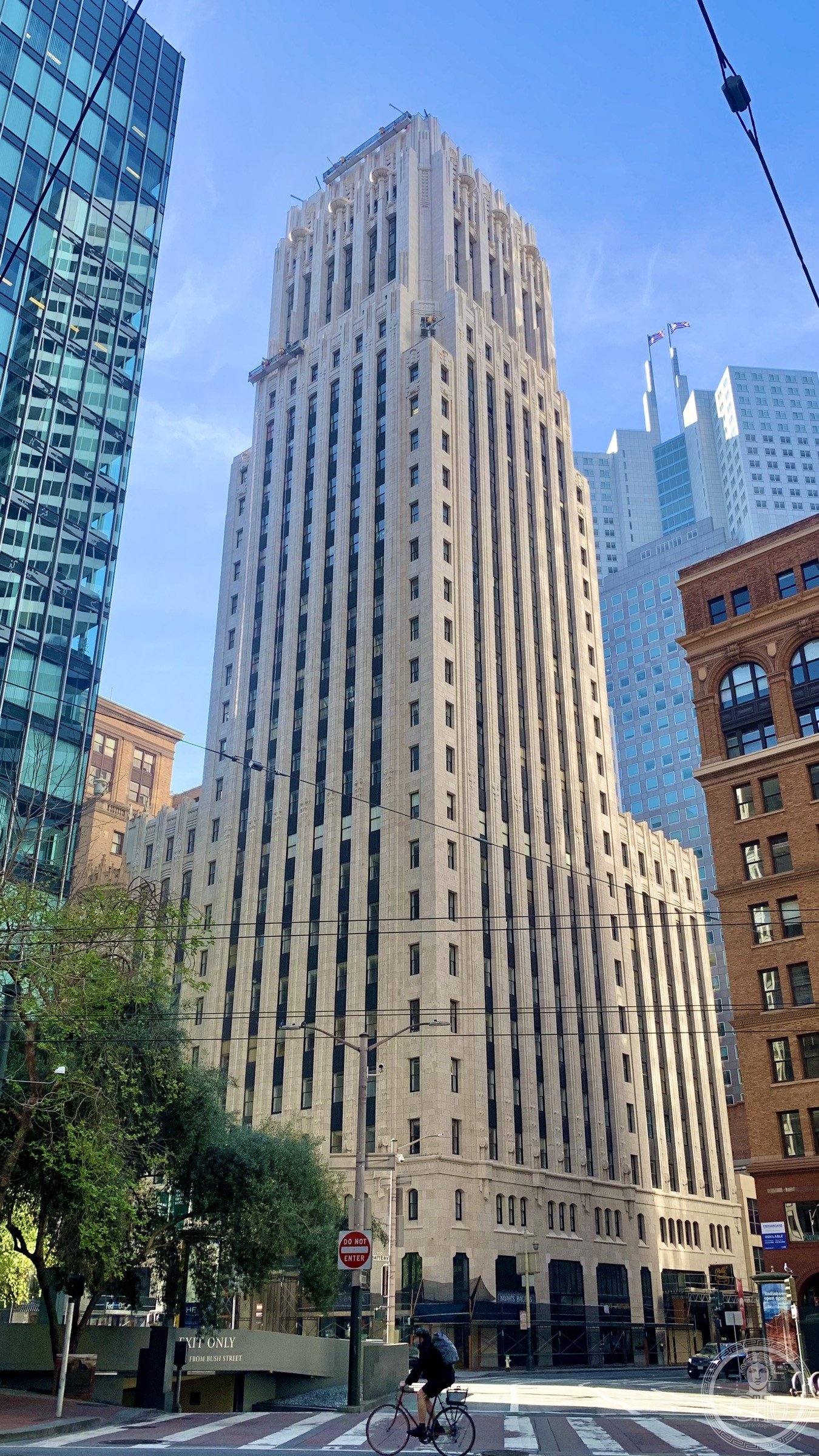

The most architecturally distinguished skyscraper in San Francisco’s Financial District — a 28-story Art Deco tower by George Kelham whose stepped setbacks, terra cotta cladding, and ornamental crown have defined the Bush-Battery corner since 1929.
At a glance
The Shell Building at 100 Bush Street in San Francisco’s Financial District is the finest Art Deco skyscraper in the city and one of the most accomplished examples of the style on the West Coast. Designed by the architect George Kelham and completed in 1929 for the Shell Oil Company, the 28-story tower rises from a narrow corner lot at the intersection of Bush and Battery Streets in a sequence of setback profiles that emphasize the building’s height and verticality without sacrificing the ornamental richness that characterizes the best Art Deco commercial architecture. Listed as a San Francisco Landmark, the building has undergone careful preservation since its completion and retains the original terra cotta cladding, ornamental details, and lobby finishes that make it a reference point for California’s Art Deco heritage.
Key facts
- Address: 100 Bush Street, Financial District, San Francisco, California 94104
- Completed: 1929
- Architect: George W. Kelham
- Original client: Shell Oil Company
- Floors: 28
- Style: Art Deco (setback tower)
- Designation: San Francisco Designated Landmark No. 184
- GPS: 37.7917°N, 122.3975°W
History
George Kelham was the most prolific and technically accomplished architect working in San Francisco in the 1920s, responsible for the design of dozens of significant commercial buildings in the Financial District in the decade following the 1906 earthquake, when the city was rebuilt at a rate that provided an architect of his generation with an extraordinary range of opportunities. The Shell Building commission of 1927–1929 represented Kelham’s fullest engagement with the emerging Art Deco aesthetic that was transforming American skyscraper design during the decade; his previous buildings had been primarily in the Classical and Beaux-Arts modes that dominated postquake reconstruction.
The building was constructed for the Shell Oil Company as its West Coast corporate headquarters. The narrow corner lot at Bush and Battery — a site shaped by San Francisco’s post-earthquake grid — required a tower that could function efficiently despite its constrained footprint. Kelham responded by emphasizing verticality: the setback profile rises through three distinct stages of recession, each marked by a band of ornamental terra cotta, until the crown narrows to a distinctive stepped cap that is visible from the bay and from the hills to the west of the Financial District.
Shell Oil occupied the building until the mid-twentieth century; it subsequently passed to commercial real estate investors and has been in continuous office use since completion. Its San Francisco Landmark designation (No. 184) reflects both the quality of Kelham’s design and the building’s significance as a survivor of the pre-war Financial District’s architectural density, much of which was lost to postwar redevelopment and the 1989 Loma Prieta earthquake’s repair program.
What you see
The building’s most distinctive feature is its stepped crown, which rises above the surrounding Financial District in a way that makes it immediately recognizable from the upper decks of the Bay Bridge and from the hills of Sausalito across the bay. Seen from Bush or Battery Street at ground level, the tower presents an almost classical composition: a rusticated base with large-scale ornamental framing at the entrance, a middle section of terra cotta-clad offices divided by vertical pilaster bands, and a setback crown that narrows at each stage with progressively richer ornamental detail.
The terra cotta cladding — a warm buff-to-cream palette consistent with most of the Financial District’s Art Deco and Classical commercial buildings — was an unusual choice in 1929, when San Francisco’s peers in New York and Chicago were exploring stainless steel and polished granite. Kelham’s decision to remain with the terra cotta tradition that had defined Bay Area commercial architecture gave the Shell Building a West Coast character distinct from its East Coast counterparts; the material responds to the bay’s diffuse coastal light differently than polished metal surfaces, producing a warmer and more textured visual effect. The lobby retains its original Art Deco metalwork and marble finishes.
Practical information
- Lobby: Accessible during business hours; original Art Deco finishes visible
- Best exterior view: From the intersection of Bush and Battery Streets (the building’s corner); also visible from the Embarcadero promenade to the east
- Time needed: 20–30 minutes for exterior and lobby; combine with Financial District walking tour
- Walking context: The Financial District between Embarcadero and Kearny Street concentrates San Francisco’s densest collection of 1920s–1930s commercial architecture
Getting there
The Shell Building stands at 100 Bush Street at Battery Street in San Francisco’s Financial District. By BART, the Embarcadero station is three blocks east on Market Street; the Montgomery Street station is two blocks west. The F-Market & Wharves streetcar line on Market Street is two blocks south. By car from the Bay Bridge, take the Harrison Street exit, proceed north to Bush Street, and turn left; parking is available in several Financial District garages. The Ferry Building on the Embarcadero is a five-minute walk east; the Transamerica Pyramid and Russ Building are two to three blocks northwest.
Nearby
- Pacific Telephone Building / 140 New Montgomery (1925) — three blocks south; AT&T’s Art Deco West Coast headquarters
- Russ Building (1927) — two blocks west on Montgomery Street; gothic-influenced Art Deco tower
- Ferry Building (1898, renovated 2003) — four blocks east on the Embarcadero; Beaux-Arts transportation hub
- Transamerica Pyramid (1972) — three blocks northwest; postmodern landmark defining the Financial District skyline
Sources
- San Francisco Landmarks Preservation Advisory Board — designation report, Shell Building, Landmark No. 184 (sf.gov)
- San Francisco Planning Department — Survey of Historic Resources, Financial District (1985, updated)
- Michael Corbett, Splendid Survivors: San Francisco’s Downtown Architectural Heritage — documentation of the Financial District’s commercial buildings
- Gray Brechin, Imperial San Francisco: Urban Power, Earthly Ruin — context of pre-war commercial construction and Kelham’s role in Financial District design
- San Francisco Chronicle, coverage of the Shell Building opening (1929) — ProQuest Historical Newspapers
Find it on the map
See this place and what’s around it →Record researched and written by Luigi De Marchi for Cultural Heritage Online, 2026.
📷 Become a Cultural Heritage Online photographer
Share your photos of places: they stay published under your name as the author. The more they're seen, the more you get noticed — and soon a contest will reward the most appreciated photos.
Log in or sign up free to add a photoIs this page about you?
This page is read by travellers and heritage enthusiasts who find it on Google. Tell us how you are connected to this place and we will take it from there.