
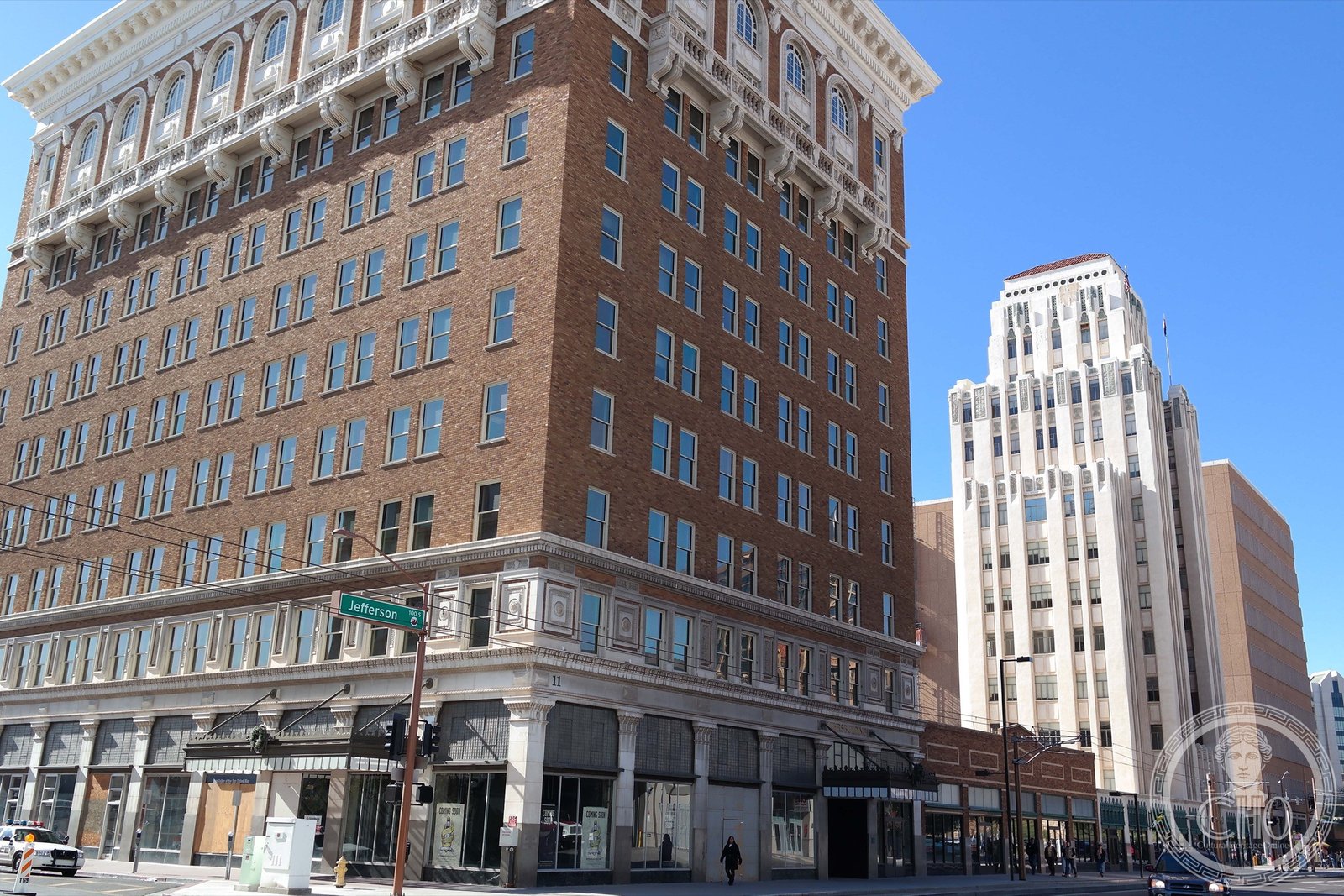
Rising above Jefferson Street since 1929, the Luhrs Tower brought skyscraper ambition to the desert Southwest — a 14-story Art Deco statement that still anchors Phoenix’s historic legal district.
At a glance
The Luhrs Tower is the taller half of the Luhrs Block, a two-building Art Deco ensemble in downtown Phoenix that has defined the city’s legal and commercial district for nearly a century. Together with the 1924 Luhrs Building to the west, it forms one of Arizona’s most coherent pre-war urban clusters. The tower’s warm brick shaft rises from a ground-floor arcade to a stepped crown ornamented with geometric terra cotta patterns — a vocabulary lifted directly from the late-1920s Deco playbook, translated into the materials and scale of a still-small Sun Belt city reaching for the sky.
Key facts
- Built: 1929
- Stories: 14
- Address: 45 West Jefferson Street, Downtown Phoenix, AZ 85003
- Style: Art Deco
- Status: National Register of Historic Places (as part of Luhrs Block)
- Commissioned by: George H.N. Luhrs Jr., following the success of his father’s 1924 Luhrs Building
- GPS: 33.4484°N, 112.0752°W
History
The Luhrs family arrived in Phoenix during the territorial era and built one of the city’s most durable real estate legacies. George H.N. Luhrs erected the original Luhrs Building in 1924 — an office block that immediately became a center of legal activity given its position near the Maricopa County Courthouse. His son commissioned the adjacent tower in 1929, at the peak of the decade’s commercial confidence, to double the complex’s capacity and signal Phoenix’s growing aspirations.
The tower opened in the months immediately before the October 1929 stock market crash. It survived the Depression as a symbol of the city’s resilience, filling its offices with law firms, insurance companies, and government agencies. For decades the ground-floor arcade maintained the kind of continuous street-level activity that is rare in Sun Belt cities otherwise dominated by parking and setbacks.
The Luhrs Block was listed on the National Register of Historic Places, recognizing its intact pre-war character in a downtown that has otherwise been substantially rebuilt. Today the tower serves primarily as office space, its lobby preserving original terrazzo floors and brass hardware.
What you see
The Luhrs Tower reads as a study in graduated richness. The base is restrained: broad pilasters frame street-level storefronts beneath a continuous cornice; the shaft rises in uniform warm brick, each window set in a slightly projecting frame that casts a fine shadow line in the desert light. The upper floors shift registers entirely. Stepped setbacks pull the crown back in stages; terra cotta panels at the parapet level carry stylized geometric motifs — compressed chevrons and stylized foliage — in the decorative idiom that signaled modernity in 1929 without yet committing to the pure abstraction of later Deco towers.
The corner entrance on Jefferson Street anchors the composition with a shallow recessed portal flanked by vertical pilasters that draw the eye upward. From across the street, the interplay of brick plane, shadow reveal, and ornamental terra cotta gives the tower a weight and precision that distinguish it from the stucco commercial buildings that surround it.
Practical information
- Access: Ground-floor lobby and arcade open during business hours (Mon–Fri); exterior always freely visible
- Best time to visit: October through April; summer temperatures regularly exceed 43°C (110°F)
- Photography: Best light in the morning when the east and south faces are lit; afternoon sun bleaches the brick
- Time needed: 20–30 minutes for exterior; add 10 minutes for the lobby if open
Getting there
The Luhrs Tower stands in central downtown Phoenix, one block west of 1st Avenue on Jefferson Street. The nearest Valley Metro Rail station is Washington/Central Avenue (4 minutes on foot). Street parking and commercial garages are available on surrounding blocks; the adjacent Maricopa County Courthouse parking is public on weekends.
Nearby
- Maricopa County Courthouse (1 block east)
- Heritage Square and Rosson House Museum (3 blocks northeast)
- Arizona Science Center (0.5 miles)
- Phoenix Convention Center and Symphony Hall (0.4 miles east)
Sources
- National Register of Historic Places nomination, Luhrs Block, Maricopa County, Arizona
- City of Phoenix Historic Preservation Office, Downtown Phoenix Historic Survey
- Arizona Preservation Foundation, “Historic Commercial Architecture of Phoenix”
Find it on the map
See this place and what’s around it →Record researched and written by Luigi De Marchi for Cultural Heritage Online, 2026.
📷 Become a Cultural Heritage Online photographer
Share your photos of places: they stay published under your name as the author. The more they're seen, the more you get noticed — and soon a contest will reward the most appreciated photos.
Log in or sign up free to add a photoIs this page about you?
This page is read by travellers and heritage enthusiasts who find it on Google. Tell us how you are connected to this place and we will take it from there.