
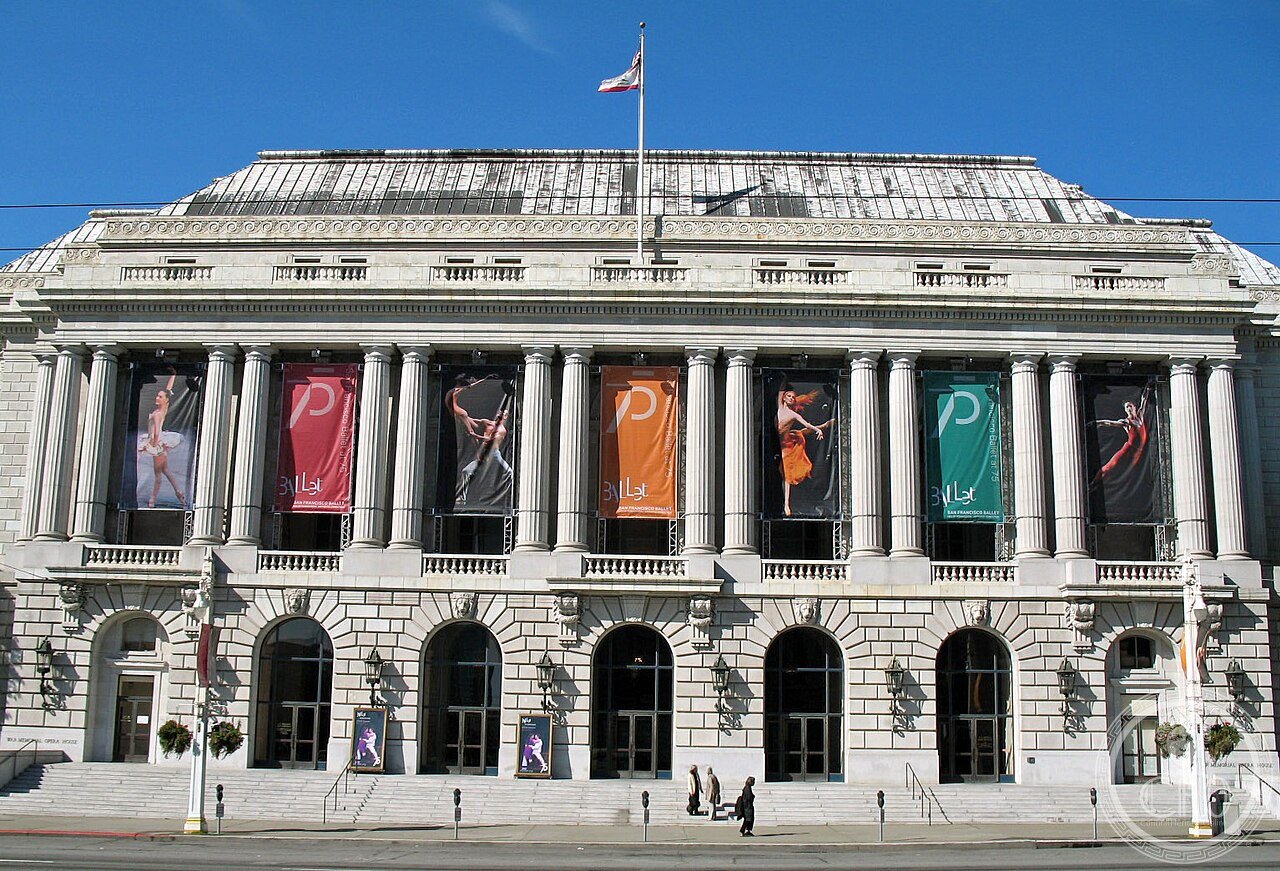
On 26 June 1945, in this auditorium, representatives of 50 nations signed the United Nations Charter — the founding document of the post-war international order. That act of world history in a civic building makes the San Francisco War Memorial Opera House unlike any other performance venue on earth. Designed by Arthur Brown Jr. in the Beaux-Arts tradition and opened in 1932, it was built as part of a memorial complex honouring the dead of the First World War, its monumental limestone facade drawing direct inspiration from the Paris Opéra. The 3,146-seat auditorium is the permanent home of the San Francisco Opera and San Francisco Symphony, making it one of the most storied musical institutions in North America. A National Historic Landmark, it stands at the heart of the Civic Center — one of the finest ensembles of monumental civic architecture in the United States.
At a glance
- Type
- Opera house / civic memorial
- Period
- 1932 (commissioned post-WWI; opened 15 October 1932)
- Style
- Beaux-Arts / Classical
- Location
- 301 Van Ness Avenue, San Francisco, California, USA
- Coordinates
- 37.7787° N, 122.4210° W
- Architect(s)
- Arthur Brown Jr.
Overview
The War Memorial Opera House is the centrepiece of the War Memorial and Performing Arts Center, a complex that also includes the Veterans Building directly across Van Ness Avenue. Together the two buildings form a symmetrical memorial ensemble designed by Arthur Brown Jr., who also designed San Francisco City Hall. The Opera House seats 3,146 in a horseshoe auditorium of exceptional acoustic quality. Since 1932 it has been the home of the San Francisco Opera — the second-largest opera company in North America — and has hosted shared programming with the San Francisco Symphony. Its historical significance as the site of the UN Charter signing in 1945 elevates it beyond the category of performing arts venue into a landmark of international constitutional history.
History
The idea for a war memorial complex in San Francisco dates to 1918, when veterans' organisations and arts patrons began planning a building that would honour WWI dead while serving the city's cultural life. The project was mired in disagreement between veterans and arts advocates for over a decade; a compromise produced twin buildings — one for veterans' functions, one for opera — sharing a common Beaux-Arts design. Construction began during the Depression; the Opera House opened on 15 October 1932. Its greatest moment came in June 1945, when the United Nations Conference on International Organization chose it as the signing venue for the UN Charter, attended by delegations from 50 nations. The Loma Prieta earthquake of 1989 damaged the building significantly; a meticulous seismic retrofit and restoration was completed in 1997.
Architecture & Design
Arthur Brown Jr. modelled the facade on the grand tradition of European opera houses: a rusticated limestone base, engaged Doric columns, and a central bay articulated with arched windows. The interior is in the French academic tradition — a grand foyer with coffered ceilings and marble floors, and a horseshoe auditorium in ivory and gold with four tiers of boxes and balconies. The proscenium arch frames a stage large enough to mount full-scale grand opera productions. The acoustic design was carefully calculated for unamplified voice and orchestra, unusual sophistication for 1932. Brown's building succeeds in being simultaneously monumental and intimate — the challenge of all great opera house architecture.
Cultural significance
The dual identity of the Opera House — as a place of musical culture and of world-historic political significance — gives it a depth that few buildings of any kind possess. The UN Charter signing on 26 June 1945 is commemorated by a plaque in the foyer and draws scholars, diplomats, and visitors from around the world. As a performing arts institution, it has hosted every major opera company and artist of the 20th and 21st centuries. The building is a National Historic Landmark and part of the San Francisco Civic Center Historic District on the National Register of Historic Places.
Visiting today
The Opera House is open for performances of the San Francisco Opera (September–July season) and occasional Symphony programmes. Guided tours of the building are offered on most Monday mornings when no rehearsals are scheduled; check the SF Opera website for current availability. The lobby and foyer are accessible before performances without a tour booking. Photography of the interior is permitted outside performances. Wheelchair access is available at the main entrance on Van Ness Avenue and through side entrances.
Getting there
The Opera House is at 301 Van Ness Avenue, corner of Grove Street, in the Civic Center district. By BART: Civic Center/UN Plaza station is a 5-minute walk. By Muni: lines 47 and 49 stop on Van Ness Avenue; F, J, K, L, M, N lines stop on Market Street. By car: paid parking in the Civic Center Garage and the Davies Symphony Hall garage nearby. Rideshares drop off directly on Van Ness Avenue.
Sources & resources
Find it on the map
See this place and what’s around it →📷 Become a Cultural Heritage Online photographer
Share your photos of places: they stay published under your name as the author. The more they're seen, the more you get noticed — and soon a contest will reward the most appreciated photos.
Log in or sign up free to add a photoIs this page about you?
This page is read by travellers and heritage enthusiasts who find it on Google. Tell us how you are connected to this place and we will take it from there.