
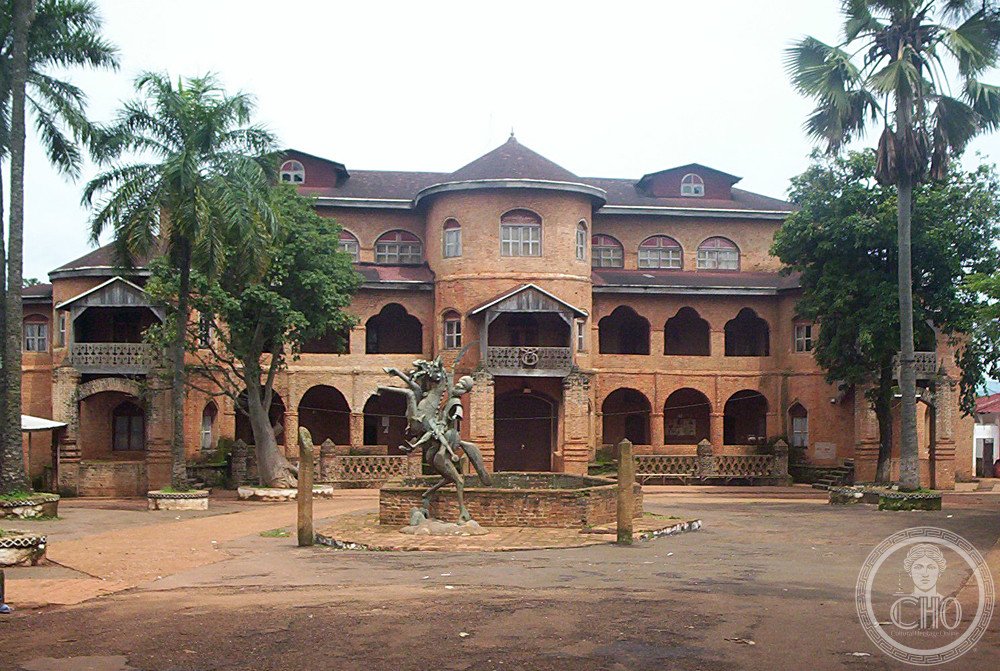
The palace of Sultan Njoya, inventor of a script and a religion – Bamum genius housed in a building that quotes German colonial architecture to outface it.
At a glance
- Type
- Royal palace and museum
- Period
- 1917
- Style
- Bamum royal architecture with German Renaissance references
- Location
- Foumban, West Region, Cameroon
- Coordinates
- 5.7269, 10.8986
- Patron
- Sultan Ibrahim Njoya
Overview
The Royal Palace of Foumban is the seat of the Bamum sultanate, a West African kingdom founded in 1394 and still reigning. Sultan Ibrahim Njoya – one of the most remarkable intellects of colonial-era Africa – built the present palace in 1917, deliberately echoing the brick gables of the German governor’s residence in Buea to declare equality with the colonizers who had marvelled at his court.
History
Njoya invented the Bamum script (a-ka-u-ku) around 1896, refining it through six versions to write his kingdom’s history and laws; he founded schools, a syncretic religion blending Islam and Christianity, and mapped his realm. The French, succeeding the Germans after 1916, found him too independent and exiled him to Yaounde, where he died in 1933. His descendants reign on; the 19th sultan opened a vast new museum beside the palace in 2021, its form a colossal spider and double-bell – the royal symbols.
Architecture and Design
The palace’s arcaded brick front, stepped gables, and timber galleries fuse German Renaissance borrowings with Bamum spatial order around the throne hall, where the beaded two-figure throne (its twin famously in Berlin) receives homage at the great Nguon festival. The archives hold Njoya’s manuscripts in his own script – a corpus unique in Africa, listed in UNESCO’s Memory of the World.
Cultural significance
Foumban is the intellectual capital of Cameroonian heritage – palace, script, brass-casters’ street, and the Nguon assembly (inscribed by UNESCO in 2023) form a living royal culture that colonialism interrupted but never replaced. The palace museum displays thrones, masks, and the sultan-inventor’s legacy.
Visiting today
The palace museum opens daily; the artisans’ quarter below produces the brass and beadwork of the court tradition. The biennial Nguon festival fills the city with the sultanate’s pageantry.
Getting there
Foumban is five hours by road from Yaounde or Douala via Bafoussam; the palace crowns the old town beside the great mosque.
Sources and resources
Find it on the map
See this place and what’s around it →📷 Become a Cultural Heritage Online photographer
Share your photos of places: they stay published under your name as the author. The more they're seen, the more you get noticed — and soon a contest will reward the most appreciated photos.
Log in or sign up free to add a photoIs this page about you?
This page is read by travellers and heritage enthusiasts who find it on Google. Tell us how you are connected to this place and we will take it from there.