

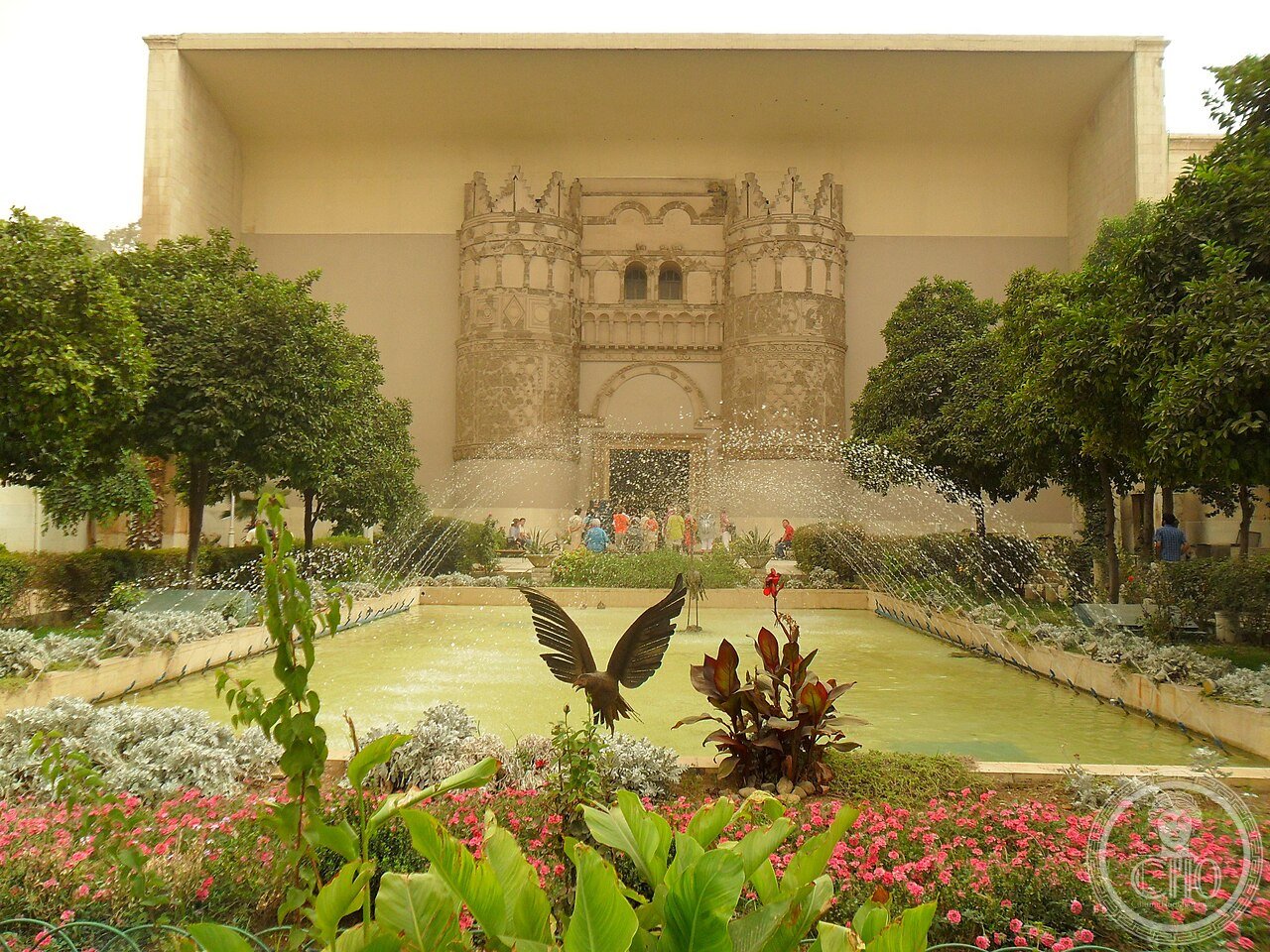
The National Museum of Syria in Damascus is one of the great repositories of Near Eastern civilisation, housing artefacts spanning more than ten thousand years of continuous human habitation on Syrian soil. Founded in 1919 and installed in its current purpose-built home in 1936, the museum is renowned above all for its astonishing entrance: the entire decorated portal of Qasr al-Hayr al-Gharbi, an eighth-century Umayyad desert palace discovered in the Syrian steppe, was dismantled stone by stone, transported to Damascus, and painstakingly reassembled as the museums front facade. Walking into the National Museum means passing through a medieval Islamic palace gateway, creating one of the most architecturally arresting museum entries in the world. Beyond this threshold lie galleries encompassing Bronze Age cuneiform tablets from the royal archives of Ebla (among the oldest written documents on earth), Palmyrene funerary portrait sculptures of haunting realism, Hellenistic and Roman mosaics, and the globally celebrated Dura-Europos synagogue — an entire third-century CE painted synagogue interior, with its extraordinary cycle of biblical murals, relocated intact from the Euphrates frontier city. The museum sustained damage and significant collection evacuations during the Syrian conflict after 2011 and has been reopening in stages since 2018.
At a glance
- Type
- National archaeology and art museum
- Period
- Founded 1919; current building 1936
- Style
- Art Deco with Arabic Revival portal (Umayyad, 8th century CE)
- Location
- Shukri al-Quwatli Street, Damascus, Syria
- Coordinates
- 33.5113 N, 36.3047 E
- Architect(s)
- French Mandate-period architects; Umayyad portal from Qasr al-Hayr al-Gharbi
Overview
Situated on the western edge of the Old City of Damascus near the National Library, the museum draws together the archaeological wealth of a country that was home to some of the worlds earliest cities and writing systems. Its eleven galleries are organised chronologically and by civilisation, moving from prehistoric Syria through the Bronze Age Eblaite and Ugaritic kingdoms, into the Aramaic, Assyrian, Persian, Hellenistic, Nabataean, Roman, Byzantine, and Islamic periods. Syria position at the crossroads of Mesopotamia, the Levant, and the Mediterranean means the collections reflect an extraordinary plurality of ancient cultures.
History
The museum was established in 1919 under the French Mandate, initially housed in the Azem Palace in the Old City. The current building on Shukri al-Quwatli Street was inaugurated in 1936. The Qasr al-Hayr al-Gharbi portal was relocated to serve as its entrance in the same decade, following the excavation of the Umayyad site. The Dura-Europos synagogue interior was excavated in 1932-33 by a Yale University and French Academy joint expedition and installed in the museum in 1934. Following the outbreak of civil conflict in 2011, museum staff undertook an urgent evacuation of the most fragile and portable objects; the building sustained some structural damage. Partial reopening began in 2018 and continued through subsequent years.
Architecture and Design
The 1936 building is a rectilinear Art Deco structure with clean horizontal lines and a restrained facade that serves as a neutral backdrop for its extraordinary portal. The Qasr al-Hayr al-Gharbi entrance, dating to the reign of Caliph Hisham ibn Abd al-Malik (724-743 CE), features intricately carved stucco geometric and floral ornament, a pointed arched gateway, and twin cylindrical towers — a masterwork of early Islamic decorative art transplanted wholesale into a twentieth-century institutional setting. Interior gallery spaces are organised in a rational modernist plan, allowing the collections to be read chronologically or thematically depending on visitor preference.
Cultural significance
The Damascus National Museum holds objects of world-historical importance: the Ebla tablets are among the oldest administrative archives ever found, the Dura-Europos synagogue murals are the largest surviving cycle of pre-Byzantine Jewish figurative painting, and the Palmyrene portrait sculptures constitute a uniquely personal window into the multicultural society of the Roman Syrian frontier. The museum is a living argument for Syria extraordinary role in the formation of Western and Near Eastern civilisation, and its survival through conflict is itself a monument to the resilience of Syrian cultural institutions.
Visiting today
The museum has been reopening in stages since 2018 following conflict-period closures. Visitors should verify current opening hours and gallery availability through official Syrian Ministry of Culture channels before travel, as access to specific wings may be restricted during ongoing conservation and reinstallation work. The surrounding area near the Old City and National Library is walkable.
Getting there
The museum is located on Shukri al-Quwatli Street in central Damascus, within walking distance of the Hijaz Railway Station and the western entrances to the Old City UNESCO World Heritage Site. Local minibuses and taxis serve the area from central Damascus. Visitors exploring the city heritage circuit can combine the museum with the Umayyad Mosque, Azem Palace, and the covered souks of the Old City in a single day.
Sources and resources
Find it on the map
See this place and what’s around it →Record researched and written by Luigi De Marchi for Cultural Heritage Online, 2026.
📷 Become a Cultural Heritage Online photographer
Share your photos of places: they stay published under your name as the author. The more they're seen, the more you get noticed — and soon a contest will reward the most appreciated photos.
Log in or sign up free to add a photoIs this page about you?
This page is read by travellers and heritage enthusiasts who find it on Google. Tell us how you are connected to this place and we will take it from there.