
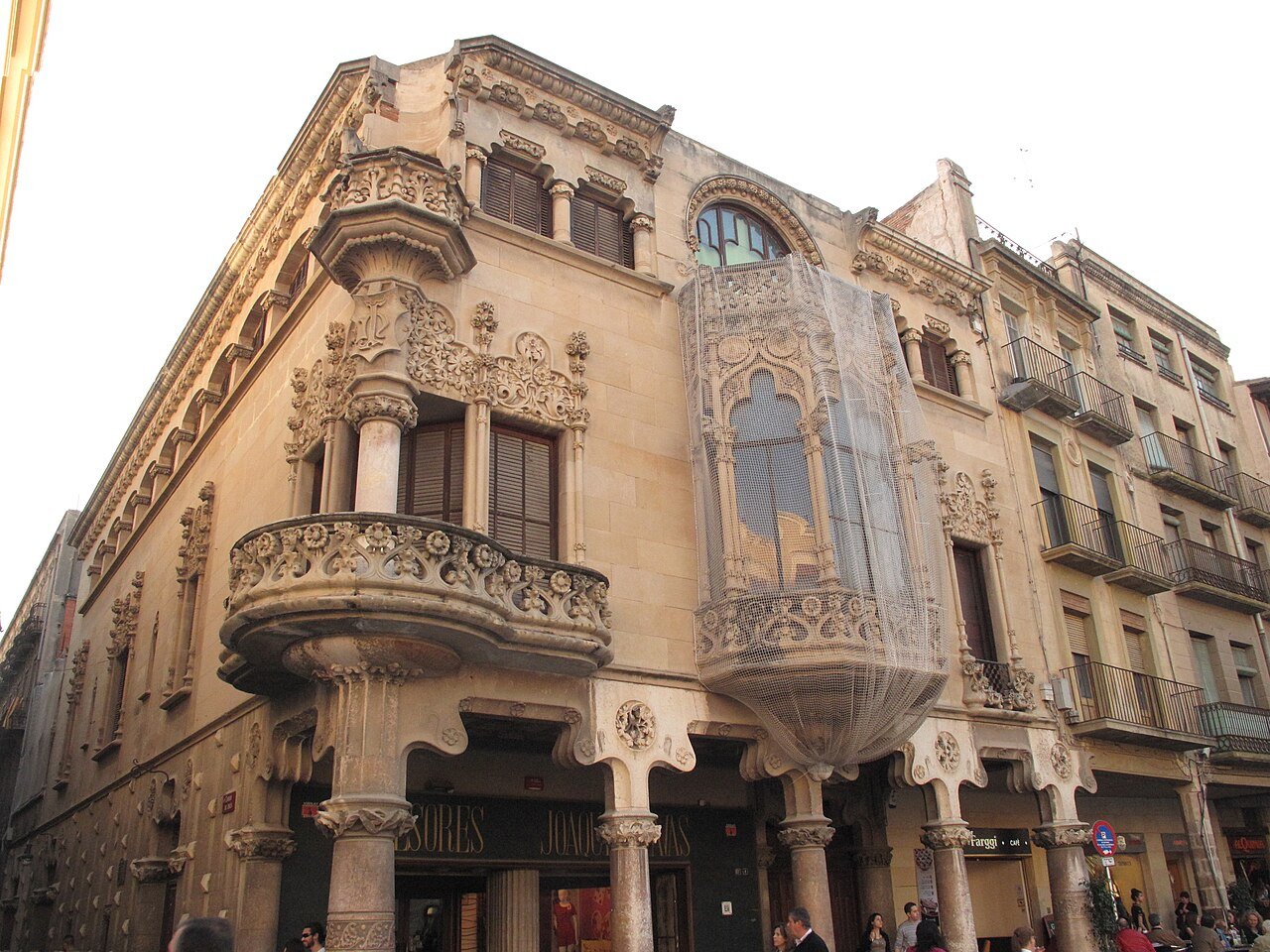
The second city of Catalan Modernisme after Barcelona, Reus carries the name of Antoni Gaudí and the buildings of Lluís Domènech i Montaner. Its Ruta del Modernisme threads workshops, a clinic and a merchant’s house into one walkable circuit.
At a glance
Reus sits in the Baix Camp, in the province of Tarragona, about 96 kilometres south-west of Barcelona. Antoni Gaudí was born in 1852 in the Reus area, and the city now markets itself as the birthplace of the architect even though it holds none of his buildings. What it does hold is one of the densest concentrations of Modernisme outside Barcelona, almost all of it by Lluís Domènech i Montaner (1849–1923) and the local architect Pere Caselles i Tarrats. The Ruta del Modernisme links these works across the old town, anchored by Casa Navàs and the pavilion clinic of the Institut Pere Mata. A nineteenth-century centre of vermouth and liquor production, Reus had the merchant wealth to commission ambitious architecture, and much of it survives intact.
Key facts
- Country: Spain (Catalonia)
- Key period: 1900–1912
- Key architect: Lluís Domènech i Montaner (1849–1923)
- Native son: Antoni Gaudí (born 1852)
- Essential sites: Casa Navàs, Institut Pere Mata, Gaudí Centre, Ruta del Modernisme
- Comarca: Baix Camp, province of Tarragona
History
Reus was repopulated around 1150 by Robert d’Aguiló, and the castellan Bernat de Bell-lloc granted it the title of town on 3 August 1183. The decisive period came much later. Through the eighteenth century Reus grew into the second city of Catalonia and a major centre of liquor production, ranked in trade documents alongside London and Paris. More than thirty vermouth producers once operated here, and that commercial wealth shaped the late nineteenth-century town.
By 1900 the prosperous merchant families of Reus were ready to spend on architecture, and they turned to the leading figure of Catalan Modernisme. Lluís Domènech i Montaner, born in Barcelona in 1849, was a professor and later director at the city’s school of architecture for some forty-five years, a position from which he helped define what Modernisme arquitectònic meant in Catalonia. His writing, including an 1878 article calling for a national architecture, set the intellectual frame; his buildings in Reus put it into stone, brick, ceramic and stained glass.
The Gaudí connection is more emblematic than physical. Antoni Gaudí was born in 1852 in the Reus area and baptised in the town the day after his birth, though the exact birthplace is disputed between Reus and the neighbouring village of Riudoms, his paternal family’s home. Most of his identity documents named Reus, while from 1915 he himself often claimed Riudoms. Either way, he left for Barcelona and built nothing here, so the city honours him through the Gaudí Centre rather than through his own work.
What you see
Casa Navàs, on the Plaça del Mercadal, is the set piece. Domènech i Montaner designed it between 1901 and 1908 for the textile merchant Joaquim Navàs Padró, treating house and contents as a single work: marble by Alfons Juyol i Bach, paintings by Tomàs Bergadà, furniture by Gaspar Homar, ceramics by Hipòlit Montseny. It is one of the most complete surviving Modernista interiors anywhere — the building remains, in the words of the record, the same as it was originally apart from a corner tower destroyed by bombing in the Spanish Civil War and never rebuilt. The interiors are accessible only by guided tour, which is what makes them so well preserved.
On the edge of town the Institut Pere Mata, built from 1897 to 1919, shows the other side of the same architect. It is a psychiatric clinic laid out as a campus of separate pavilions in landscaped grounds, designed so that architecture worked at the service of patients without sacrificing the aesthetic ambition Domènech brought to his grander commissions. One restored pavilion is open to visitors. Around both sites the local architect Pere Caselles i Tarrats left further Modernista work, including the Escoles Prat de la Riba of 1911, which the Ruta del Modernisme strings together into a single walking circuit.
Practical information
- Start at the Gaudí Centre on the Plaça del Mercadal, the museum to the architect and the main visitor and ticket point for the Ruta del Modernisme.
- Casa Navàs is visited by guided tour only; book ahead, as interior numbers are limited to protect the original furnishings.
- The Institut Pere Mata clinic remains in use; only the restored show pavilion is open, on its own ticket and schedule.
- Combined Ruta del Modernisme tickets bundle the main Domènech i Montaner sites and are sold through the Gaudí Centre.
- Allow a half to a full day to cover Casa Navàs, the Institut Pere Mata and the old-town circuit at an unhurried pace.
Getting there
Reus has its own airport (REU), served by low-cost Ryanair flights to European destinations, a few kilometres from the centre. By rail the town sits on the line built to Tarragona in 1856 and connects onward to Barcelona, roughly 96 kilometres away; frequent regional trains make a day trip from either city straightforward, and many visitors combine Reus with Tarragona on the same outing.
Related in CHO
- Barcelona — Gaudí and the Catalan Modernisme
- Valencia — Modernisme valencià and the Mercat de Colom
- Paris — Belle Époque, Art Nouveau & Modernism
Sources
Find it on the map
See this place and what’s around it →Record researched and written by Luigi De Marchi for Cultural Heritage Online, 2026.
📷 Become a Cultural Heritage Online photographer
Share your photos of places: they stay published under your name as the author. The more they're seen, the more you get noticed — and soon a contest will reward the most appreciated photos.
Log in or sign up free to add a photo