
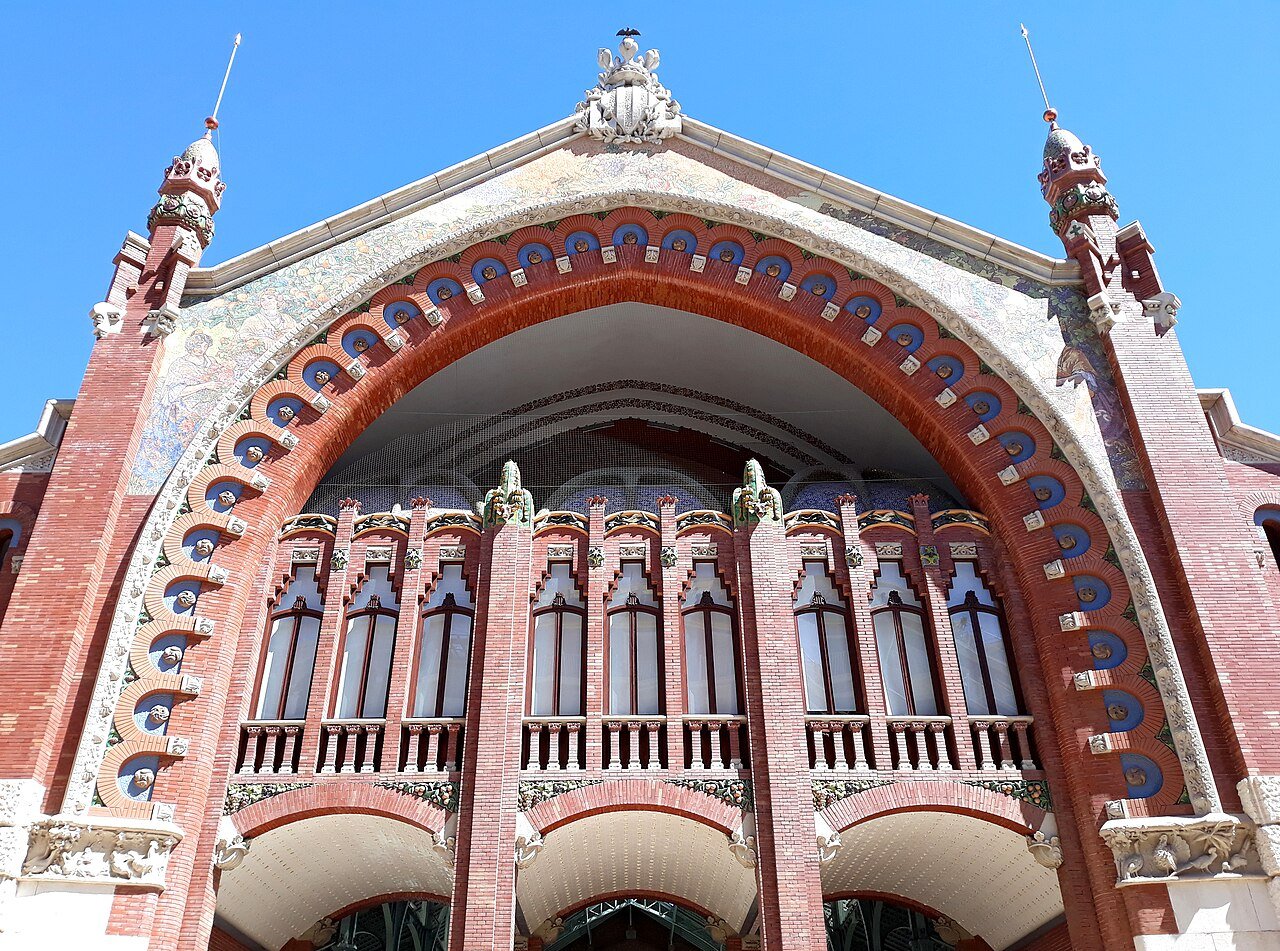
Between 1900 and 1917 Valencia rebuilt parts of itself in iron, glass and glazed ceramic. The result is one of Spain’s most concentrated displays of Art Nouveau outside Catalonia.
At a glance
Valencia is best known for its medieval silk exchange and its futuristic riverbed park, yet the decades around 1910 left the city a quieter, denser legacy. In the span of a single generation, local architects translated the international vocabulary of Art Nouveau into a regional idiom shaped by Valencia’s long tradition of glazed ceramics. The Mercado de Colón, the vast Central Market and the North railway station form the core of this Valencian Modernisme. They were conceived not as monuments but as working buildings — a covered shopping arcade, a food market and a passenger terminal — and they have remained in everyday use for more than a century, which is part of why they feel so unforced.
Key facts
- Country: Spain
- Region: Valencian Community
- Key period: c. 1900–1917 (Central Market completed 1928)
- Architects: Francisco Mora Berenguer (Mercado de Colón); Alexandre Soler March and Francesc Guàrdia Vidal, completed by Enrique Viedma Vidal (Central Market); North Station attributed to Demetrio Ribes
- Essential sites: Mercado de Colón, Central Market (Mercat Central), Estació del Nord (North Station)
History
The Mercado de Colón was the first of the trio to be completed. Designed by Francisco Mora Berenguer and built between 1914 and 1916, it replaced an open-air market in the prosperous Eixample district and was conceived as a covered space for a comfortable, expanding bourgeoisie. From the outset it was recognised as one of the principal works of Valencian Art Nouveau, and it was later declared a national monument.
The Central Market followed a longer path. The winning design, by the Catalan architects Alexandre Soler March and Francesc Guàrdia Vidal, was selected in 1910; construction ran from 1914 and was eventually completed under Enrique Viedma Vidal in 1928. The market rose beside the Gothic Llotja de la Seda and the church of Santos Juanes, and its planners deliberately echoed the scale and silhouette of those older neighbours while celebrating the new structural freedom that iron and glass allowed. At more than eight thousand square metres it remains one of the largest market halls in Europe.
The North Station belongs to the same moment. The railway terminal that stands on Carrer de Xàtiva opened in 1917, replacing an earlier station on a line that had served the city since 1852. It too is counted among the major works of Valencian Art Nouveau, and in 1987 it was protected as a Good of Cultural Heritage.
What you see
The three buildings share a structural confidence and a love of surface. The Central Market is the clearest demonstration of the new engineering: an interior of iron, wood, ceramics and polychromed tiles is roofed by a sequence of domes and sloping sections set at different heights, so that light falls unevenly across the stalls. The Mercado de Colón makes a more theatrical gesture, framing its open-sided hall between two ornate brick-and-ceramic end walls that face the street like proscenium arches. Both buildings rely on the same idea — that iron and glass can hold up a large, bright, column-light space — but dress it in very different costumes.
Ornament here is rarely abstract. Valencia’s centuries-old ceramic industry supplied glazed tiles, mosaic and modelled detail, and the architects used them freely: floral panels, lettering and figurative scenes worked into facades and interiors. To visit, start at the Mercado de Colón for its facade, walk fifteen minutes to the Central Market while the food stalls are open in the morning, and end at the North Station, whose decorated booking hall is open to anyone with a train to catch — or none at all.
Practical information
- The Central Market trades Monday to Saturday, mornings being the liveliest; it is closed Sundays.
- The Mercado de Colón now houses cafés and shops and stays open into the evening.
- The North Station is a working terminus, so its booking hall can be seen at any time during station hours.
- All three sites sit within the historic centre and are comfortably walkable from one another.
- Photography of the interiors is generally welcomed; respect traders and travellers.
Getting there
Valencia Airport (VLC) lies about eight kilometres west of the centre and is linked by Metrovalencia lines 3 and 5, which reach the city core in roughly twenty-five minutes. The North Station is itself a transport hub on the Metrovalencia network and within a short walk of the Central Market; the Mercado de Colón is served by the metro station of the same name. Long-distance trains use the adjacent Joaquín Sorolla station.
Related in CHO
- Barcelona — Gaudí and the Catalan Modernisme
- Reus — Catalan Modernisme and the Birthplace of Gaudí
- Paris — Belle Époque, Art Nouveau & Modernism
Sources

Find it on the map
See this place and what’s around it →Record researched and written by Luigi De Marchi for Cultural Heritage Online, 2026.
📷 Become a Cultural Heritage Online photographer
Share your photos of places: they stay published under your name as the author. The more they're seen, the more you get noticed — and soon a contest will reward the most appreciated photos.
Log in or sign up free to add a photo