
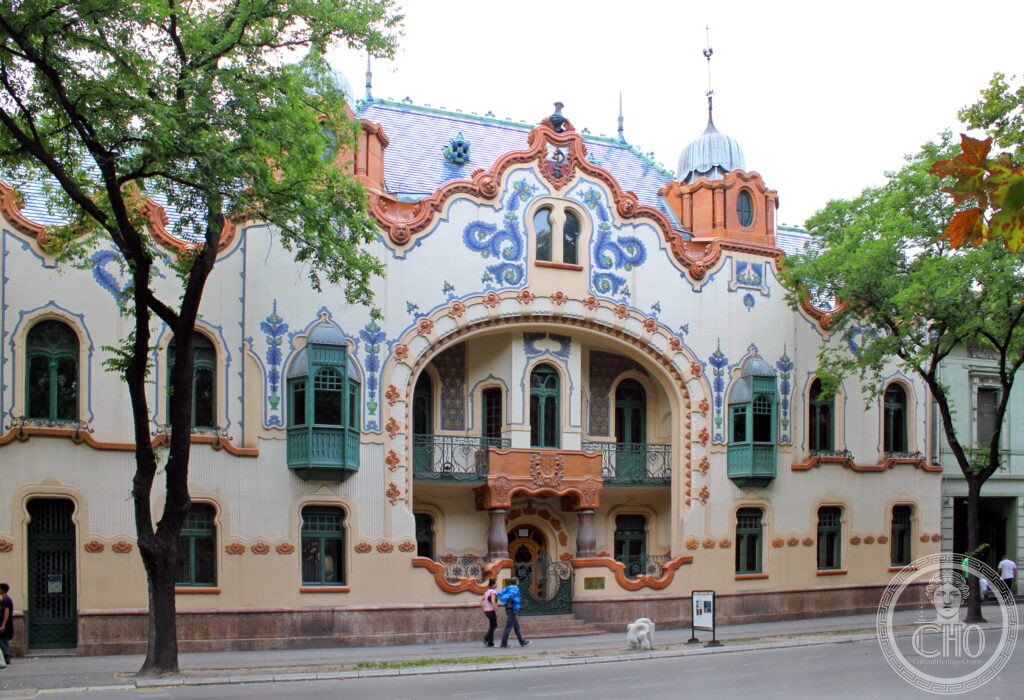
Raichle’s Palace
An architect’s declaration of artistic freedom: Ferenc Raichle built his personal residence in 1904 as a manifesto in Zsolnay ceramics, Murano mosaic, and a single obsessive motif — the heart — repeated in wrought iron, carved wood, and stucco across every surface.
At a glance
Raichle’s Palace (Palata Rajhl; Hungarian: Raichle-palota) is a historic building in central Subotica, designed by the architect Ferenc Raichle as a combined family residence, professional office, and rental property. Completed in 1904, it is considered Raichle’s masterpiece and one of the best-known examples of Hungarian Secessionist architecture in the wider region. The building now houses the Gallery of Contemporary Art (Galerija savremene umetnosti) and is listed as a Cultural Monument of Great Importance by the Serbian state.
Key facts
- Architect: Ferenc Raichle (Budapest-trained, based in Subotica)
- Designed: 1903; completed 1904
- Style: Hungarian Secessionism (Art Nouveau)
- Programme: Family residence + architectural office + rental apartments
- Signature motif: The heart, in wrought iron, ceramics, mosaic, carved wood, and stucco
- Materials: Zsolnay factory ceramics (Pécs, Hungary), Murano mosaic, Tuscan marble
- Heritage: Cultural Monument of Great Importance, Serbia
- Current use: Gallery of Contemporary Art (Galerija savremene umetnosti)
History
Ferenc Raichle trained as an architect in Budapest, then travelled European capitals before settling in Subotica after marrying Ilona Varga, daughter of a prominent local senator. Seeking a prominent site for his residence and office, Raichle chose a plot near the railway station — ensuring the building would be among the first landmarks seen by visitors arriving by rail. His first design was rejected by city authorities for lacking sufficient grandeur. The revised design, approved and built in 1904, became the definitive statement of his career.
The commission was entirely personal: Raichle designed without regard for the architectural conventions of the time, integrating his own artistic vision into every surface. The result was a building that went further than almost anything else in the region in its rejection of historical precedent and its embrace of the Secession’s principle of total artwork — the Gesamtkunstwerk in which architecture, decoration, and craft are inseparable.
What you see
The heart motif governs the palace. The stylized, inverted heart shape appears in the recessed main entrance, the wrought iron gate, the balcony railings, and throughout the ornamentation — rendered in ceramics from the Zsolnay factory in Pécs, Murano mosaic, wrought iron, carved wood, and stucco moldings. It is an obsessive, coherent decorative programme that makes the building immediately legible as the work of a single personality rather than a studio.
Flanking the entrance are two Tuscan marble columns supporting a closed loggia on the first floor, with balconies on each side. The lower rounded heart-shaped forms are framed with Zsolnay ceramics and include a floral wrought iron parapet. Above the building rises a tower 76 metres high with an observation deck and a clock — originally equipped with a mechanism that still marks time in the square below.
Practical information
- The Gallery of Contemporary Art is open to the public; check local listings for current exhibition hours
- The exterior, including the entrance heart-motif gate, can be viewed from the street at any time
- Located near Subotica railway station — a natural first stop for visitors arriving by train
- Best viewed close-up: the Zsolnay ceramic details reward careful inspection at eye level
Getting there
Raichle’s Palace stands near the Subotica railway station, making it practically the first landmark a visitor encounters arriving by rail. The station has direct services from Belgrade (approx. 3 hours) and Novi Sad. From the station, the palace is under five minutes on foot. The city hall and synagogue are ten minutes away through the pedestrian centre.
Nearby
- Subotica City Hall — Komor and Jakab, 1908–1912, ten minutes’ walk through the centre
- Subotica Synagogue — the second-largest synagogue in Europe, same architects as city hall
- Subotica city guide — Hungarian Secession in Vojvodina
Sources
- Wikipedia EN, “Raichle’s Palace” (architecture, biography of Raichle, heritage)
- Wikidata Q12639217 (GPS coordinates)
Find it on the map
See this place and what’s around it →📷 Diventa un fotografo di Cultural Heritage Online
Condividi le tue foto dei luoghi: restano pubblicate con la tua firma come autore. Più vengono viste, più ti fai conoscere — e presto un concorso premierà le foto più apprezzate.
Accedi o registrati gratis per aggiungere una fotoDo you manage this place?
This page is read by travellers and heritage enthusiasts who find it on Google. Keep it accurate — and make it work for you. Free for non-profit heritage institutions.