
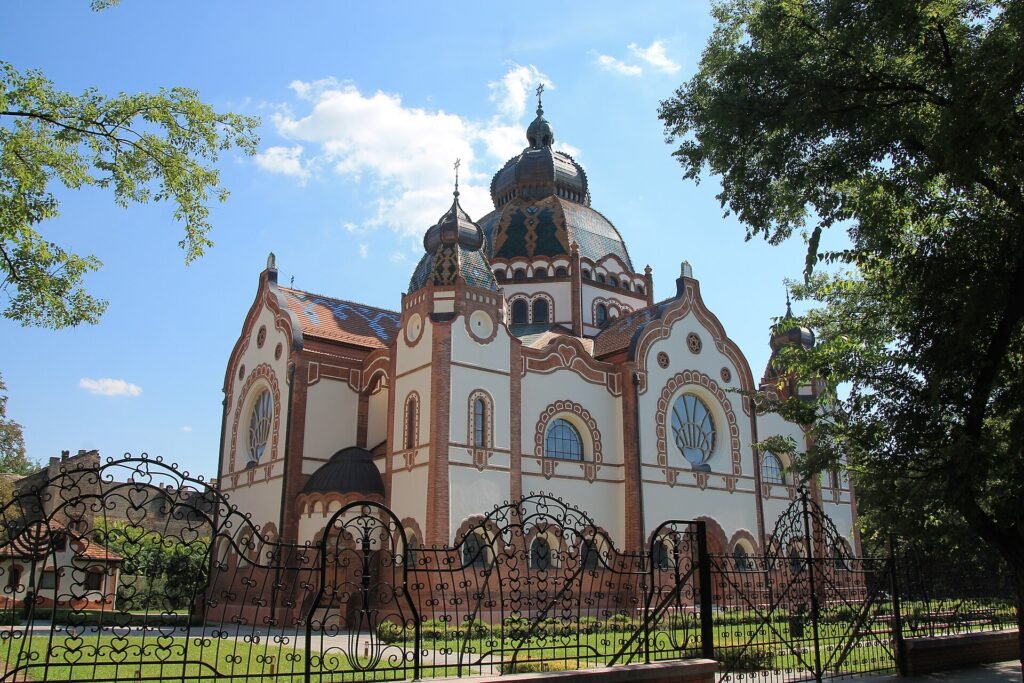
A synagogue built as a flower: dome, tiles and stained glass in the full bloom of Hungarian Secession.
At a glance
Officially the Jakab and Komor Square Synagogue, the Synagogue of Subotica is counted among the most beautiful Art Nouveau synagogues anywhere. Building work began in 1900 and the structure was finished in the autumn of 1902; the synagogue was formally handed over for use on 17 September 1903. Marcell Komor and Dezső Jakab designed it in the Hungarian Secession, with a great central dome, Zsolnay ceramic roof tiles and walls of floral stained glass and painted ornament. It serves the city’s small Jewish community and stands on the UNESCO tentative list.
Key facts
- Location: Trg Jakaba i Komora 6, 24000 Subotica
- Architects: Marcell Komor and Dezső Jakab
- Built: begun 1900, completed autumn 1902, handed over 17 September 1903
- Style: Hungarian Secession (Art Nouveau)
- Status: Cultural Property of Exceptional Importance (declared 1990; protected from 1987) · UNESCO World Heritage tentative list
History
Subotica’s Jewish community, prosperous and growing, commissioned a new synagogue and chose the young Komor and Jakab, fresh from their training in Budapest. They designed it as a single flowering composition rather than a historical pastiche.
Finished in 1902, it fell into decay in the later twentieth century after the community was devastated in the Holocaust. The building had no formal protection until 1987, and was declared a cultural property of exceptional importance in 1990. A long international restoration has since returned its colour and craft, and it is again in use.
What you see
A broad dome rises over an eight-sided hall, the roof patterned in green and gold Zsolnay tiles. Inside, every surface flowers: stained glass, painted tendrils and folk-derived ornament in rose, green and blue. It is Art Nouveau used not for a shop or a station but for a place of worship, and it shows.
Practical information
- Open: Tuesday to Friday 10:00–18:00, Saturday and Sunday 10:00–14:00; active synagogue
- Cost: small admission
- Best for: the dome, the tiled roof and the stained glass
- Time needed: 20–40 minutes
Getting there
The synagogue is in central Subotica, a few minutes’ walk from the City Hall and the main square.
Nearby
- Subotica City Hall — the Secession city hall nearby
- Trg slobode — the main square of Subotica
Sources
- Fondacija Subotička Sinagoga — history of the synagogue (official site of the foundation that manages the building)
- Wikipedia — Subotica Synagogue
- UNESCO World Heritage Centre (tentative list) — Subotica Synagogue
- Wikimedia Commons — image source and licence
Find it on the map
See this place and what’s around it →📷 Become a Cultural Heritage Online photographer
Share your photos of places: they stay published under your name as the author. The more they're seen, the more you get noticed — and soon a contest will reward the most appreciated photos.
Log in or sign up free to add a photoDo you manage this place?
This page is read by travellers and heritage enthusiasts who find it on Google. Keep it accurate — and make it work for you. Free for non-profit heritage institutions.