
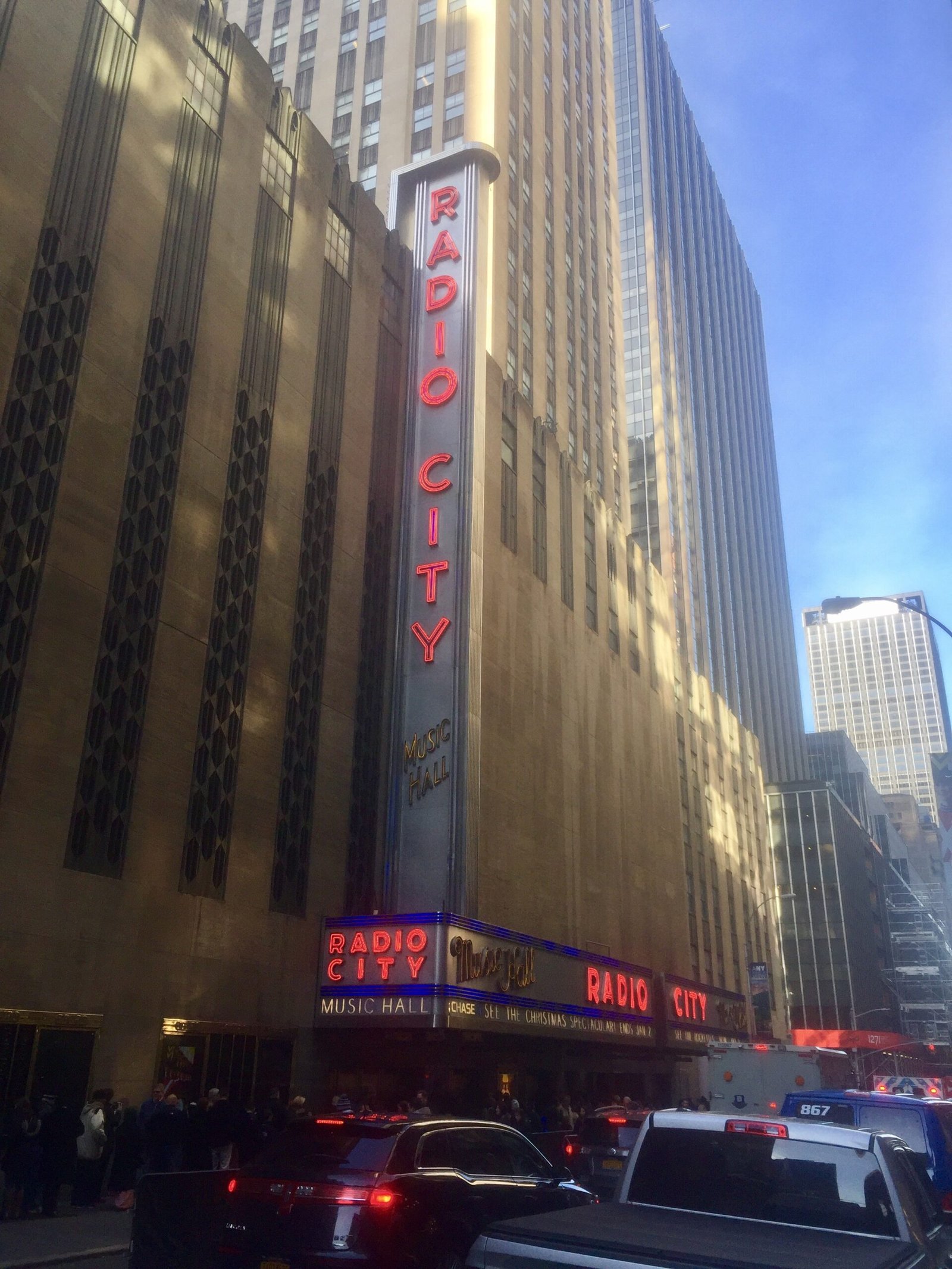
Donald Deskey’s interiors for the 6,000-seat theater at Rockefeller Center were described at opening as the most complete expression of Art Déco in America — a building where the lobby, the grand foyer, the auditorium, and every light fixture were conceived as a single designed object.
At a glance
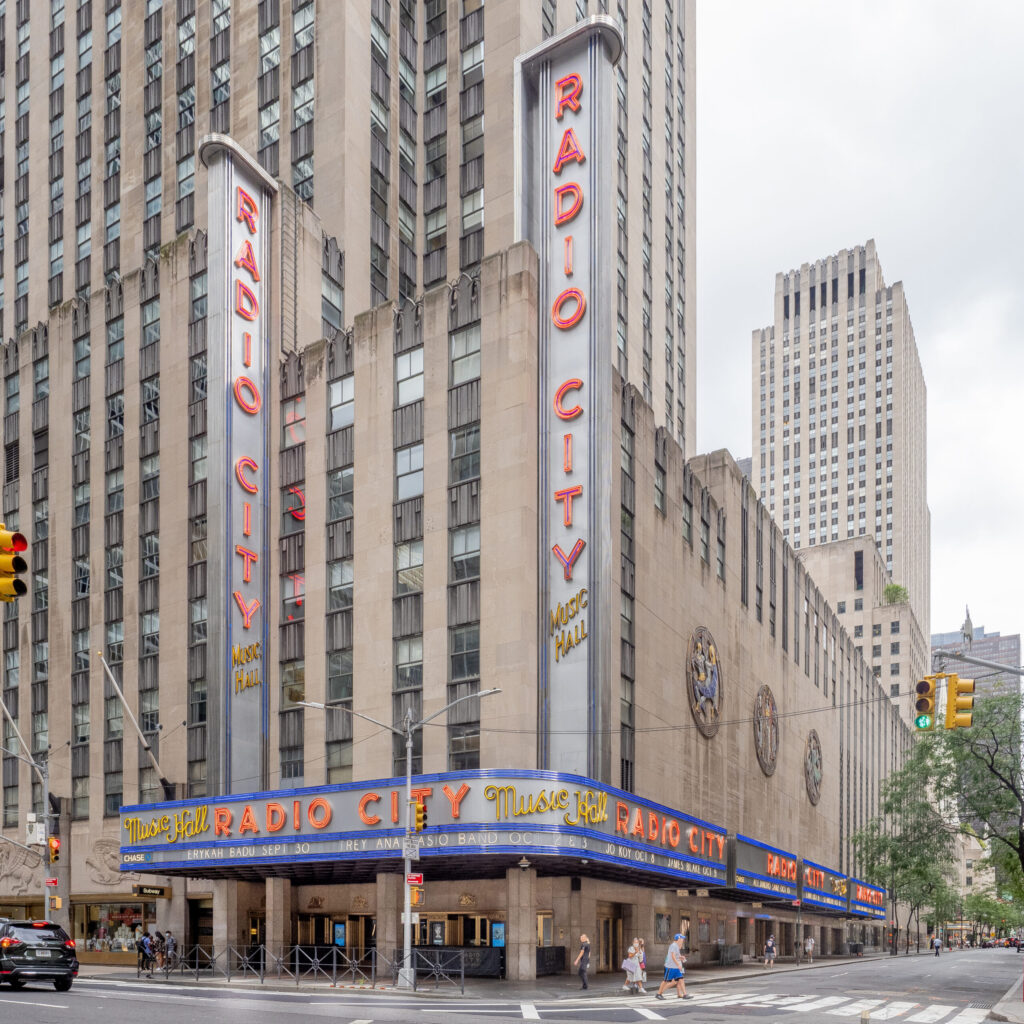
Radio City Music Hall opened on 27 December 1932 as part of the first phase of Rockefeller Center, on the corner of 6th Avenue and 50th Street. The exterior, designed by Edward Durell Stone, is a horizontal band of limestone and aluminum trim, the marquee sign and name canopy running the full length of the 6th Avenue facade. Inside, the auditorium seats approximately 6,000 people under a ceiling of gold and silver arcs radiating from the stage — a design that symbolised the rising sun and was intended to eliminate the visual weight of the overhead vault. The building’s impresario, Samuel “Roxy” Rothafel, conceived the venue as a total theatrical experience: architecture, lighting, film, and the Rockettes dance company all working together in a single spectacle. The concept struggled commercially in its first years; Radio City Music Hall survived by pivoting to a film-and-stage format that made it one of the most commercially successful entertainment venues in history.
Key facts
- Opened: 27 December 1932
- Exterior architect: Edward Durell Stone
- Interior designer: Donald Deskey
- Capacity: approximately 5,933 seats
- Style: Art Déco
- Address: 1260 Avenue of the Americas (6th Avenue) at 50th Street, Midtown Manhattan, New York City
- GPS: 40.759722, -73.979167 — Open in Google Maps
- Status: Active performance venue; guided tours available
History
Samuel Rothafel, the impresario known as Roxy, had made his name at the Roxy Theatre on 50th Street, producing lavish film-and-stage combinations for large audiences. When John D. Rockefeller Jr. hired him as consultant for the new Center, Rothafel proposed the largest indoor theater ever built — a hall that would dwarf any existing venue and allow productions of unprecedented scale. Donald Deskey won the interior design commission against twenty-nine other designers and produced a total Gesamtkunstwerk in Art Déco: murals by Stuart Davis, Yasuo Kuniyoshi, and others; carpets, light fixtures, furniture, and hardware all designed by Deskey’s office specifically for this building.
The opening night on 27 December 1932 was a six-hour spectacle that critics called exhausting. Within weeks the format had to be rethought: Rothafel fell ill, the live-show-plus-film hybrid was replaced by a simpler film-and-stage revue, and the building’s economics stabilised. The Rockettes — originally the Missouri Rockets, reorganised by Rothafel — became the resident company and remain so today.
In 1978, when the venue’s owners announced plans for demolition, public outcry led to a last-minute designation as a New York City landmark. The building was subsequently added to the National Register of Historic Places. A major interior restoration was completed in 1999 under the direction of Hardy Holzman Pfeiffer Associates, restoring Deskey’s original color schemes and furnishings.
What you see
The Great Hall foyer immediately inside the 6th Avenue entrance is the first spatial statement: two and a half storeys high, its walls covered in gold-leaf murals, the curved ceiling descending in arcs toward the floor. The auditorium beyond opens in three tiers of balconies beneath a ceiling of concentric gold and silver ellipses — approximately 25 arcs diminishing toward the stage, their inside faces painted alternating gold, silver, and warm bronze. The effect is of standing inside a rising sun, or a vast shell, with the stage as its focal point.
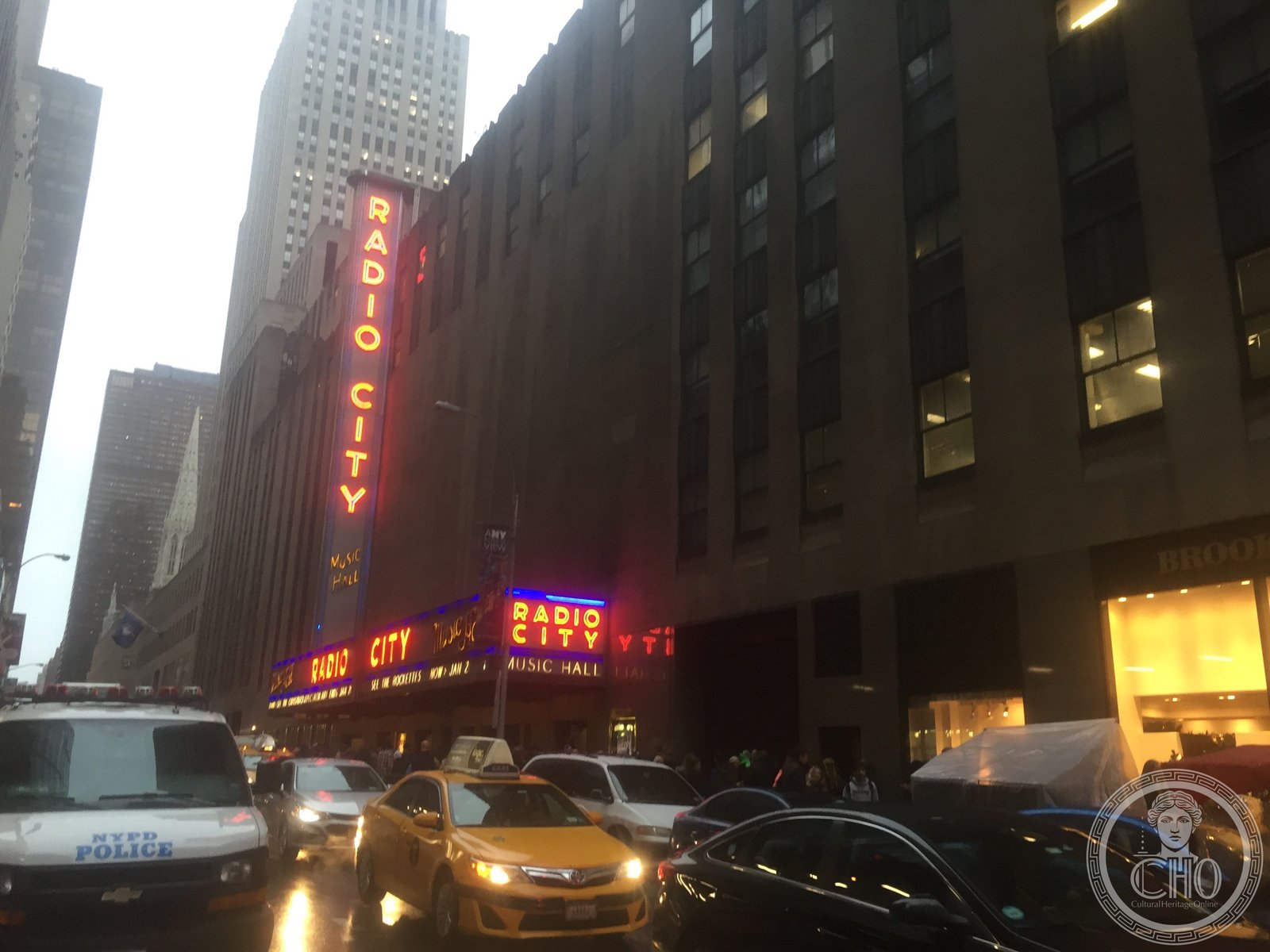
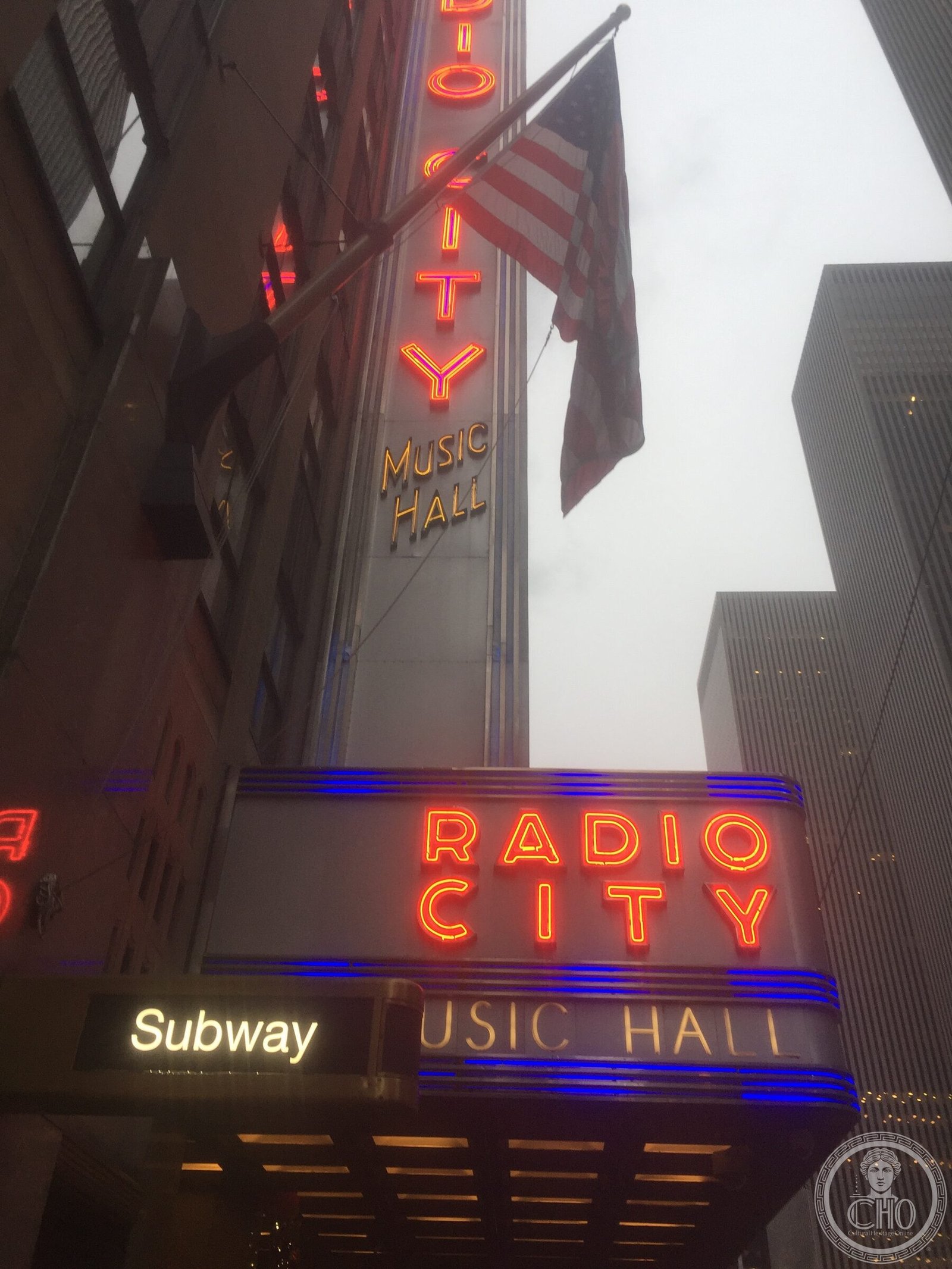
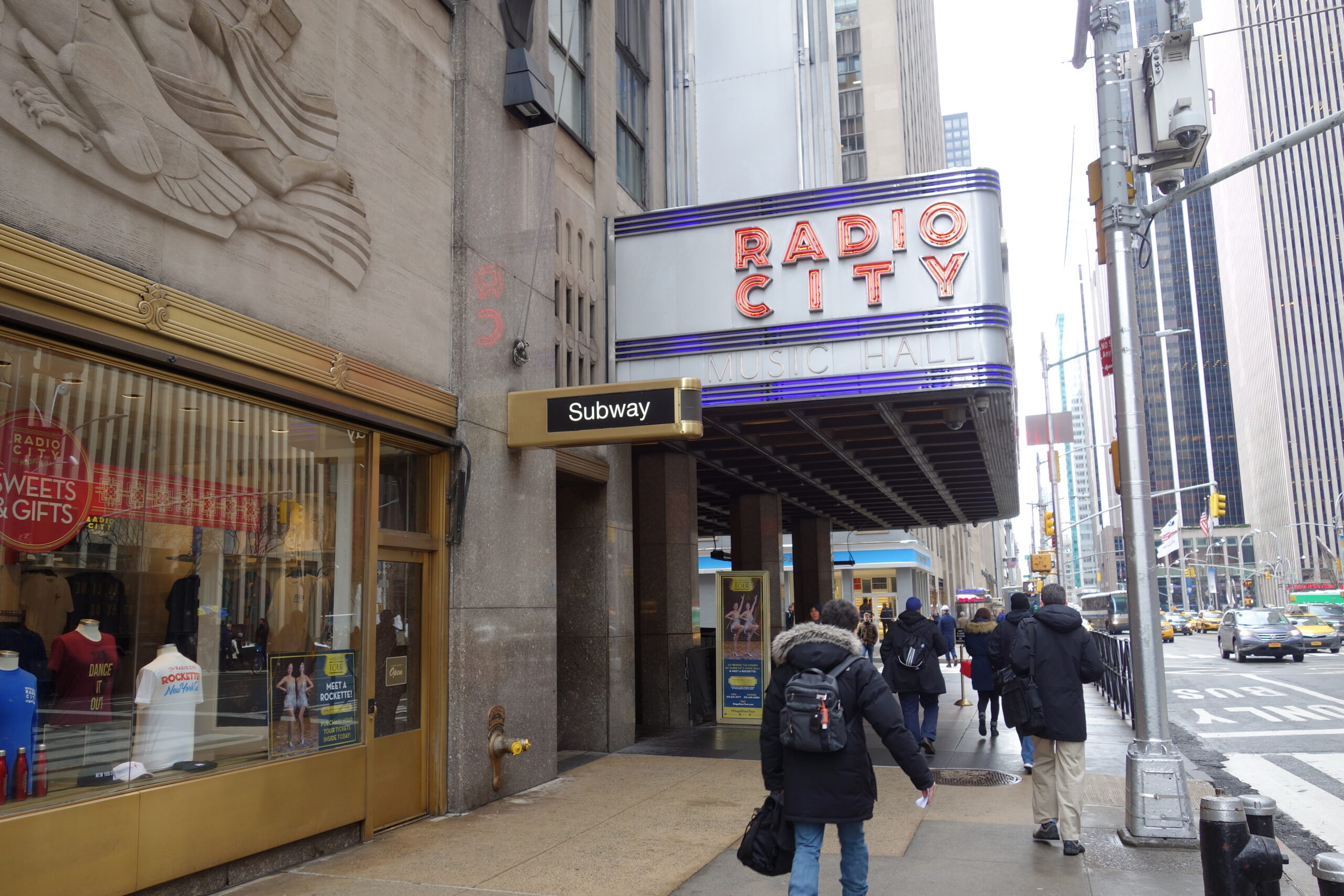
Deskey’s detail work is extraordinary: the men’s lounge on the mezzanine level has Stuart Davis’s mural Men Without Women; the grand staircase is lit by fixtures Deskey designed as geometric plant forms in bronze and glass. The exterior aluminum marquee sign and the floodlit facade visible from 6th Avenue at night remain among the defining images of Art Déco New York.
Practical information
- Stage Door Tours: Guided tours of the interior available most mornings when no matinée is scheduled; ticketed; book at radiocity.com
- Performances: Active venue year-round; the Rockettes’ Christmas Spectacular runs November–January; check radiocity.com for schedule
- Exterior: Freely visible from 6th Avenue; the marquee illumination is best after dark
- Time needed: 75–90 minutes for the guided interior tour
Getting there
Radio City Music Hall is at 1260 Avenue of the Americas (6th Avenue) at 50th Street, part of the Rockefeller Center complex. The nearest subway is 47th–50th Streets–Rockefeller Center (B/D/F/M), exit at 50th Street; the building is immediately at street level. 30 Rockefeller Plaza is one block east on 50th Street, making the two buildings a natural pairing. From Times Square, walk four blocks east along 49th or 50th Street (approximately ten minutes).
Nearby
- 30 Rockefeller Plaza — Art Déco tower with Top of the Rock observation deck, one block east
- Museum of Modern Art (MoMA) — major collection including Déco and modernism works, 4 min walk north on 53rd Street
- Chrysler Building — Art Déco skyscraper (1930), 15 min walk southeast at Lexington and 42nd Street
Sources
- New York City Landmarks Preservation Commission: Radio City Music Hall designation report (1978)
- National Register of Historic Places: listing for Radio City Music Hall
- Radio City Music Hall official site: history and tour information at radiocity.com
- Museum of the City of New York: Donald Deskey archive and Radio City opening documentation
Gallery
Photographs by Luigi De Marchi.
Gallery
Find it on the map
See this place and what’s around it →Record researched and written by Luigi De Marchi for Cultural Heritage Online, 2026.
📷 Become a Cultural Heritage Online photographer
Share your photos of places: they stay published under your name as the author. The more they're seen, the more you get noticed — and soon a contest will reward the most appreciated photos.
Log in or sign up free to add a photoIs this page about you?
This page is read by travellers and heritage enthusiasts who find it on Google. Tell us how you are connected to this place and we will take it from there.