

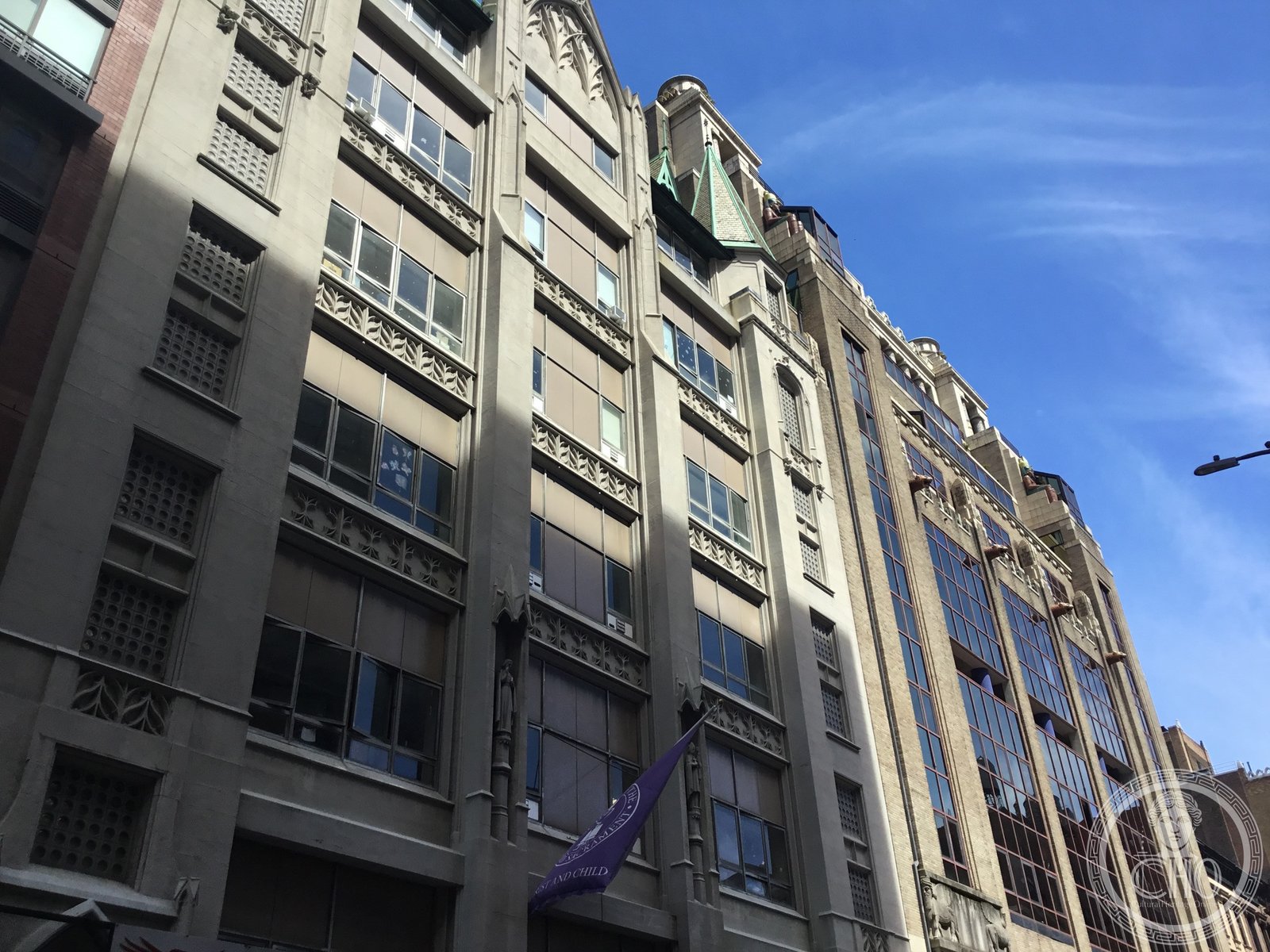
A polychrome explosion of Egyptian Revival ornament on West 70th Street, the Pythian Temple was built as the New York castle of the Knights of Pythias — and Thomas Lamb’s most extravagant architectural commission outside the movie theater circuit.
At a glance
The Pythian Temple at 135 West 70th Street was completed in 1927 as the New York City headquarters of the Knights of Pythias, one of the oldest fraternal orders in the United States. Designed by Thomas W. Lamb — best known for his theatrical commissions across the city and country — the building wears its purpose in its facade: a polychrome program of terra cotta in red, gold, and blue that draws on Egyptian Revival imagery to project the Pythian brotherhood’s ideals of fidelity, friendship, and charity. The building was converted to luxury condominiums in 1986 and is now known simply as “The Pythian,” but its extraordinary facade survives intact, a singular object among the apartment houses and brownstones of the Upper West Side.
Key facts
- Address: 135 West 70th Street, Manhattan (between Columbus Avenue and Broadway), New York City
- Completed: 1927
- Architect: Thomas W. Lamb
- Style: Egyptian Revival with Art Deco elements
- Original client: Knights of Pythias
- Current use: Residential (The Pythian condominiums, converted 1986)
- Historic designation: New York City Landmark
History
The Knights of Pythias was founded in 1864 by Justus H. Rathbone in Washington, D.C., inspired by the classical story of Damon and Pythias — the two Greek friends whose bond of mutual loyalty and self-sacrifice became the foundation of the order’s values. It was the first fraternal organization to receive a congressional charter, and by the early twentieth century it had lodges (called “castles”) in every major American city. New York was the logical location for an ambitious lodge building, and by the 1920s the organization was prosperous enough to commission a permanent presence on the Upper West Side.
Thomas W. Lamb (1871–1942), the Scottish-born architect who had built his reputation designing movie palaces and entertainment venues, brought an unexpected theatrical sensibility to the commission. The building he produced for the Pythians was unlike anything else in New York: a layered facade of polychrome terra cotta that draws on Egyptian pharaonic imagery — hieroglyph-derived ornament, standing figures in ceremonial dress, richly colored bands of blue, red, and gold running the full height of the building. The Egyptian Revival was fashionable in the 1920s (the discovery of Tutankhamun’s tomb in 1922 had sent the style into a new peak of popularity), and for a fraternal order that prided itself on classical precedent, the aesthetic was symbolically apt.
The building served the Knights of Pythias for decades before being sold and eventually converted in 1986 to residential use by developer David Gura. The exterior was preserved as a condition of the conversion, and the building received New York City Landmark designation. Today “The Pythian” is one of the more distinctive addresses in the Lincoln Center neighborhood — a building that surprises visitors who encounter it for the first time between the standard Upper West Side apartment blocks.
What you see
The facade’s polychrome terra cotta is the building’s defining feature: a sustained program of color and ornament that covers the full exterior in a way no other building in New York replicates. Figures in Egyptian-style ceremonial dress stand at the entrance and at upper levels, interspersed with geometric and floral patterns derived from pharaonic sources. The color palette — reds and golds against a lighter ground, with accents of blue — is applied to the ornamental program in a way that reads as deliberately exotic, an announcement that this building is not a residential block or an office tower but a place apart.
Lamb organized the building with a projecting entrance bay and a tower-like upper section that gives the facade vertical emphasis. The surrounding street context — brownstones and apartment buildings typical of the Upper West Side — makes the Pythian Temple’s chromatic program even more striking by contrast. The best view is from directly across West 70th Street, where the full extent of the ornamental program can be read against the building’s relatively compact footprint.
Practical information
- Status: Residential building (The Pythian condominiums); lobby not publicly accessible
- Exterior: Freely visible from West 70th Street sidewalk
- Historic designation: New York City Landmark
- Best views: From the opposite sidewalk on West 70th Street, looking at the full facade width
Getting there
The Pythian Temple is on West 70th Street between Columbus Avenue and Broadway, in the Lincoln Center neighborhood of the Upper West Side. The nearest subway stations are 72nd Street (1, 2, 3 lines at Broadway and 72nd Street, two blocks north) and 66th Street–Lincoln Center (1 line, four blocks south). The building is five blocks north of Lincoln Center for the Performing Arts and about four blocks west of Central Park. From the West 72nd Street station, the walk south on Broadway to West 70th Street takes about three minutes.
Nearby
- Lincoln Center for the Performing Arts — the campus of the Metropolitan Opera, New York Philharmonic, and New York City Ballet, five blocks south at Broadway and 65th Street
- American Museum of Natural History — the natural history museum occupying an entire city block at Central Park West and 77th–81st Streets, about eight blocks north of the Pythian
- Central Park — the 843-acre park begins at Central Park West, about two blocks east of the building
- The Dakota (1884) — the landmark residential building at Central Park West and 72nd Street, associated with John Lennon, two blocks north and east
Sources
- Wikipedia: Pythian Temple (New York City)
- New York City Landmarks Preservation Commission designation report
- White, Norval & Willensky, Elliot, AIA Guide to New York City (4th edition)
- Stern, Mellins & Fishman, New York 1930 (Rizzoli, 1994)
Find it on the map
See this place and what’s around it →Record researched and written by Luigi De Marchi for Cultural Heritage Online, 2026.
📷 Become a Cultural Heritage Online photographer
Share your photos of places: they stay published under your name as the author. The more they're seen, the more you get noticed — and soon a contest will reward the most appreciated photos.
Log in or sign up free to add a photoIs this page about you?
This page is read by travellers and heritage enthusiasts who find it on Google. Tell us how you are connected to this place and we will take it from there.