

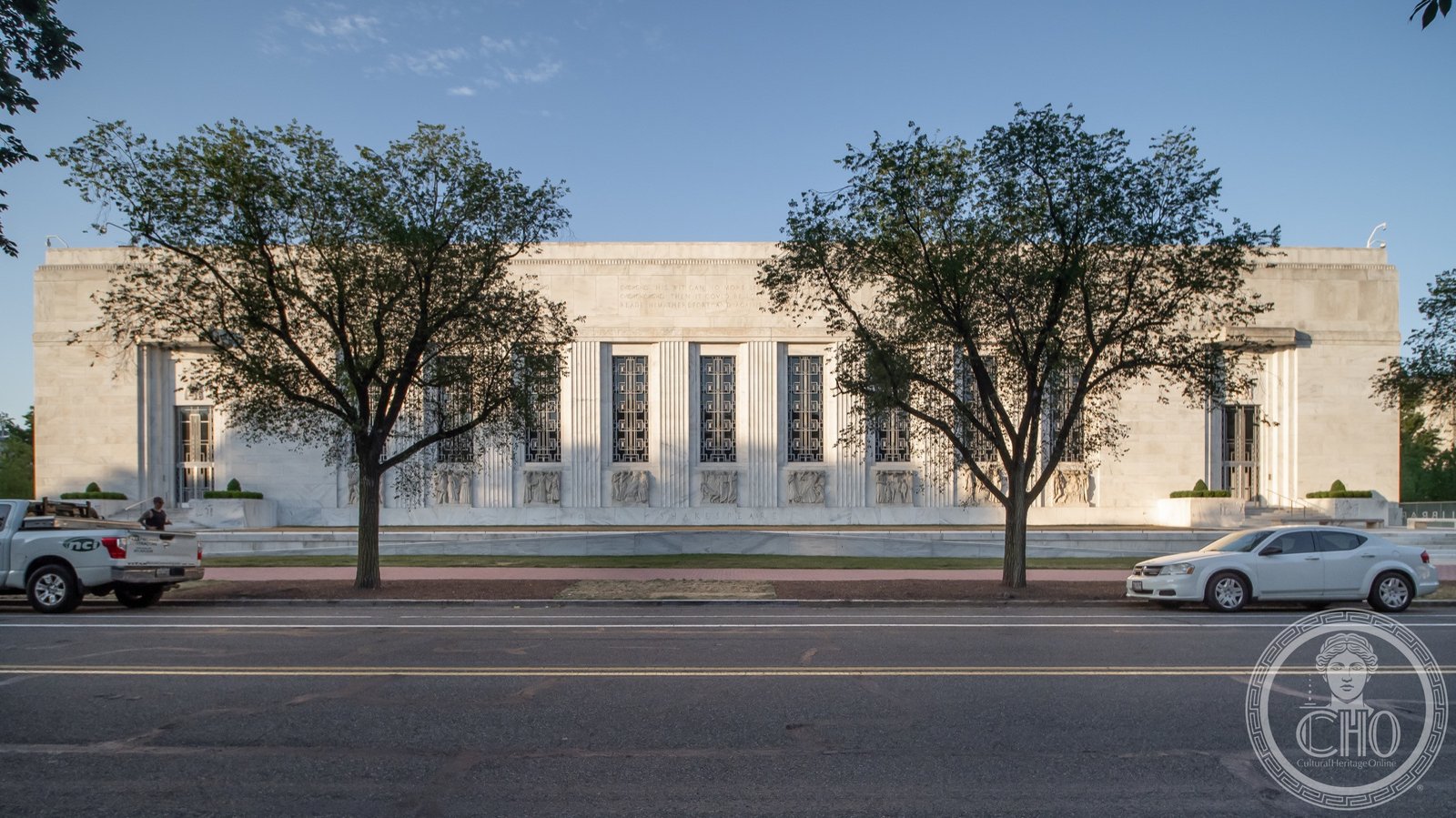
One block east of the United States Capitol, Paul Philippe Cret’s white marble building houses the largest collection of Shakespeare’s printed works in the world — wrapped in an Art Deco skin of bas-relief panels that turn the sidewalk of East Capitol Street into a visual essay on Elizabethan drama.
At a glance
The Folger Shakespeare Library at 201 East Capitol Street SE was completed in 1932 as the permanent home for the collection assembled by Henry Clay Folger (1857–1930), a Standard Oil executive who spent decades acquiring Shakespeare First Folios and related materials. At the time of his death, Folger held the largest collection of Shakespeareana in private hands — a collection that he and his wife Emily Jordan Folger arranged to donate to the United States as a public institution. The building that houses it was designed by Paul Philippe Cret, a French-born Philadelphia architect whose career spanned the shift from Beaux-Arts classicism to Art Deco. The result is one of Washington’s most distinctive buildings: a white marble exterior that reads at a distance as classical but reveals, on closer inspection, a fully Art Deco ornamental program.
Key facts
- Address: 201 East Capitol Street SE, Capitol Hill, Washington DC.
- Completed: 1932.
- Architect: Paul Philippe Cret.
- Style: Art Deco with neoclassical elements.
- Founded by: Henry Clay Folger and Emily Jordan Folger.
- Holdings: World’s largest collection of Shakespeare’s printed works, including 82 of the approximately 235 known surviving First Folios.
- Historic designation: National Register of Historic Places.
History
Henry Clay Folger began collecting Shakespeare in the 1880s as a young man, acquiring his first First Folio at age 22 and continuing to build his collection through four decades of competitive acquisition. By the early twentieth century he had outpaced every rival collector in the country, accumulating not only First Folios but Quartos, Second, Third, and Fourth Folios, early editions in multiple languages, and an extensive related library of Elizabethan and Jacobean literature. The collection was held in warehouses in Brooklyn for much of its existence, as Folger was reluctant to show his hand to other collectors.
Folger chose Washington DC as the site for his permanent library after negotiations with Harvard University and other institutions, and he secured a location on Capitol Hill, immediately adjacent to the Library of Congress. He died in 1930, two years before the building was completed, and never saw the institution open. His wife Emily Jordan Folger oversaw the final construction and the 1932 dedication. The institution was funded and is governed by Amherst College, Folger’s alma mater.
The architect Paul Philippe Cret (1876–1945) brought a Beaux-Arts training from Paris to bear on a commission that required classical dignity while permitting the then-fashionable Art Deco vocabulary. His solution was to use white Georgia marble in a stripped classical form — without the columns and pediments of traditional Neoclassicism — and to apply a program of Art Deco bas-relief panels by sculptor John Gregory to the building’s exterior. The nine panels depict scenes from Shakespeare’s plays, turning the building’s exterior walls into a public gallery of Elizabethan drama. Cret used the same hybrid approach at other major commissions, including the Federal Reserve Building in Washington DC (1937).
What you see
The exterior presents a long, low horizontal mass of white Georgia marble along East Capitol Street, punctuated by nine bas-relief panels by John Gregory. The panels run along the base of the building at street level, depicting scenes from nine of Shakespeare’s plays in a style that bridges Renaissance iconography and Art Deco formal reduction. The figures are recognizably influenced by classical sculpture but treated with the flattened, rhythmic quality characteristic of 1930s Art Deco relief work. The building’s windows are set in slightly recessed bays, giving the facade a modeled quality that reads as both classical and modern depending on the angle and light.
Inside, the Great Hall is a long paneled room in Tudor Revival style, its hammerbeam-inspired ceiling and carved oak wainscoting providing a deliberately medieval-English atmosphere for Folger’s Elizabethan collection. The Elizabethan Theatre at the center of the building — modeled loosely on open-air Elizabethan stage conventions — hosts the library’s active performance program. The reading room, accessible to scholars by appointment, contains the research collection.
Practical information
- Visitor access: The Folger reopened to the public following an extensive renovation program; check the library’s website for current hours and admission details.
- Public spaces: The Great Hall and exhibitions are open to visitors; the reading room requires a researcher registration.
- Events: The Elizabethan Theatre hosts lectures, performances, and public programs throughout the year.
- Exterior: Freely visible from the sidewalk on East Capitol Street at all times; the bas-relief panels can be examined at close range.
- Historic designation: National Register of Historic Places.
Getting there
The Folger Shakespeare Library is at 201 East Capitol Street SE on Capitol Hill, one block east of the United States Capitol. The nearest Metro station is Capitol South (Blue, Orange, Silver lines) on First Street SE, about two blocks south and west. Union Station (Red Line) is about a ten-minute walk north. By car, the Capitol Hill neighborhood is accessible from the I-295 interchange at East Capitol Street; street parking is available in the surrounding residential blocks. The Library of Congress Thomas Jefferson Building is directly adjacent to the west, and the United States Supreme Court is one block north on First Street NE.
Nearby
- Library of Congress Thomas Jefferson Building (1897) — the main Library of Congress building directly adjacent to the west, with one of Washington’s most elaborate Beaux-Arts interiors, including the Great Hall and the Main Reading Room.
- United States Supreme Court (1935) — the Cass Gilbert neoclassical building housing the Court, one block north on First Street NE.
- United States Capitol (1800 and later) — the Capitol building and its grounds immediately to the west, a short walk from the Folger.
- Eastern Market (1873) — the public market on Seventh Street SE, the neighborhood commercial hub of Capitol Hill, a few blocks southeast.
Sources
- Wikipedia: Folger Shakespeare Library.
- Folger Shakespeare Library official website (folger.edu).
- Kohler, Sue A., The Commission of Fine Arts: A Brief History 1910–1995 (Washington DC, 1996).
- National Register of Historic Places nomination documentation.
Find it on the map
See this place and what’s around it →Record researched and written by Luigi De Marchi for Cultural Heritage Online, 2026.
📷 Become a Cultural Heritage Online photographer
Share your photos of places: they stay published under your name as the author. The more they're seen, the more you get noticed — and soon a contest will reward the most appreciated photos.
Log in or sign up free to add a photoIs this page about you?
This page is read by travellers and heritage enthusiasts who find it on Google. Tell us how you are connected to this place and we will take it from there.