

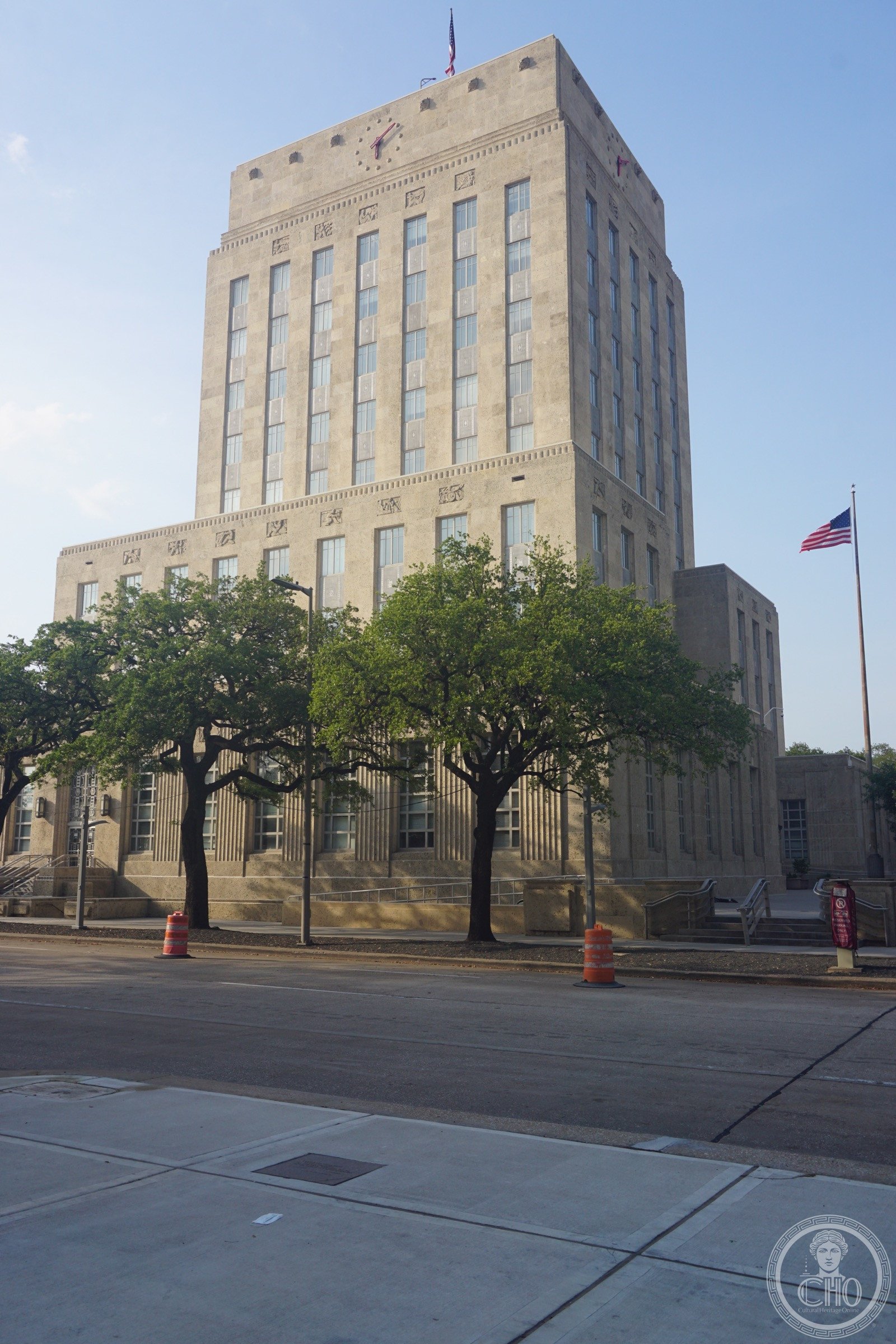
Built in 1939 as part of Houston’s New Deal–era civic center expansion, Houston City Hall is a clean, confident example of PWA Moderne — its limestone-clad facade and formal plaza presiding over the western edge of downtown from a site that has housed Houston’s municipal government for over eighty years.
At a glance
Houston City Hall, completed in 1939 at 901 Bagby Street, is the most visible monument of Houston’s interwar civic ambitions. Designed in the PWA Moderne style — a streamlined variant of Art Deco developed for federal and municipal projects under the Public Works Administration — the building presents a formal limestone facade with minimal ornament, vertical window groupings, and a symmetrical composition that reflects the New Deal aesthetic of civic authority: restrained but permanent. The building anchors the western end of Houston’s theater and civic district and is framed by a reflecting pool plaza that amplifies its formal presence. It has served as the seat of Houston’s city government continuously since its completion.
Key facts
- Address: 901 Bagby Street, Houston, Texas
- Completed: 1939
- Architect: Joseph Finger
- Style: PWA Moderne (Art Deco variant)
- Current use: Houston city government headquarters (continuously since 1939)
- Historic designation: National Register of Historic Places
History
By 1939, Houston was one of the fastest-growing cities in the American South, its economy driven by the oil industry and the development of the Houston Ship Channel. The city’s existing municipal facilities were inadequate for the scale of Houston’s ambitions, and the late New Deal period provided both the political will and — through the Public Works Administration — some of the financing necessary for a new civic complex. The building was designed by Joseph Finger, the German-born architect who had already shaped much of Houston’s built environment in the 1920s and 1930s, including hotels, commercial buildings, and civic structures across the city.
The PWA Moderne style that Finger used for the City Hall was the standard idiom for federal and civic construction in the late New Deal period: stripped of historical ornament, organized by symmetry and vertical emphasis, and detailed in aluminum and stone rather than elaborate terra cotta. The style was a deliberate response to the perceived excess of the more ornate Art Deco of the 1920s, retaining the modern vocabulary of the period while projecting an image of austere civic competence. The City Hall’s reflecting pool plaza, a standard feature of civic center composition in this period, adds a formal water element that expands the building’s apparent size and provides a gathering space for public events.
The building has served continuously as Houston’s city hall since 1939, though Houston has grown from a large regional city to one of the most populous in the United States. City Hall was listed on the National Register of Historic Places, recognizing its significance as an example of New Deal–era civic architecture in Texas and its unbroken record of public service.
What you see
The building’s principal facade, facing the reflecting pool on the city hall plaza, is organized around a central entrance bay framed by full-height pilasters and topped by a shallow decorative frieze. The window arrangement alternates single windows with grouped vertical bands, creating a rhythm that gives the otherwise austere limestone surface a measured complexity. Aluminum ornamental details appear at the entrance surround and at the window spandrels, providing the building’s primary decorative accent in a register characteristic of PWA Moderne work: more refined than elaborate, more restrained than expressive.
The plaza and reflecting pool in front of the building provide one of downtown Houston’s few genuinely formal civic spaces. The pool’s still surface mirrors the facade on clear days, creating a visual symmetry that strengthens the building’s civic presence beyond what its scale alone would produce. The surrounding civic center landscape — which includes the Jesse H. Jones Hall for the Performing Arts and the Wortham Theater Center — gives the City Hall a coherent urban context of mid-twentieth-century civic investment.
Practical information
- Status: Active government building; lobby accessible during business hours
- Plaza: The reflecting pool plaza is publicly accessible and is the site of public events
- Tours: Free guided tours are periodically available through the City of Houston
- Historic designation: National Register of Historic Places
Getting there
Houston City Hall is at 901 Bagby Street, at the western edge of downtown Houston near the Theater District. The nearest METRORail station is Bell Street on the Red Line, about three blocks east. By car, downtown Houston is reached via I-45 or I-10 to downtown Houston exits. The building is approximately two miles from Houston’s central convention center and within walking distance of Minute Maid Park (the Houston Astros stadium) and the Theater District, including Jones Hall and the Wortham Theater Center.
Nearby
- Jesse H. Jones Hall for the Performing Arts — the home of the Houston Symphony, one block east on Louisiana Street, part of the civic center ensemble
- Wortham Theater Center — the home of the Houston Grand Opera and Houston Ballet, two blocks east
- Tranquility Park — the public park on Bagby Street adjacent to City Hall, named for the Sea of Tranquility on the moon in honor of Houston’s role in the Apollo missions
- Houston Museum of Natural Science — one of the largest natural science museums in the country, in Hermann Park, about two miles south of City Hall
Sources
- Wikipedia: Houston City Hall
- National Register of Historic Places nomination documentation
- City of Houston Planning & Development Department, historic records
- Houston Architectural Survey, Volumes I–IV
Find it on the map
See this place and what’s around it →Record researched and written by Luigi De Marchi for Cultural Heritage Online, 2026.
📷 Become a Cultural Heritage Online photographer
Share your photos of places: they stay published under your name as the author. The more they're seen, the more you get noticed — and soon a contest will reward the most appreciated photos.
Log in or sign up free to add a photoIs this page about you?
This page is read by travellers and heritage enthusiasts who find it on Google. Tell us how you are connected to this place and we will take it from there.