
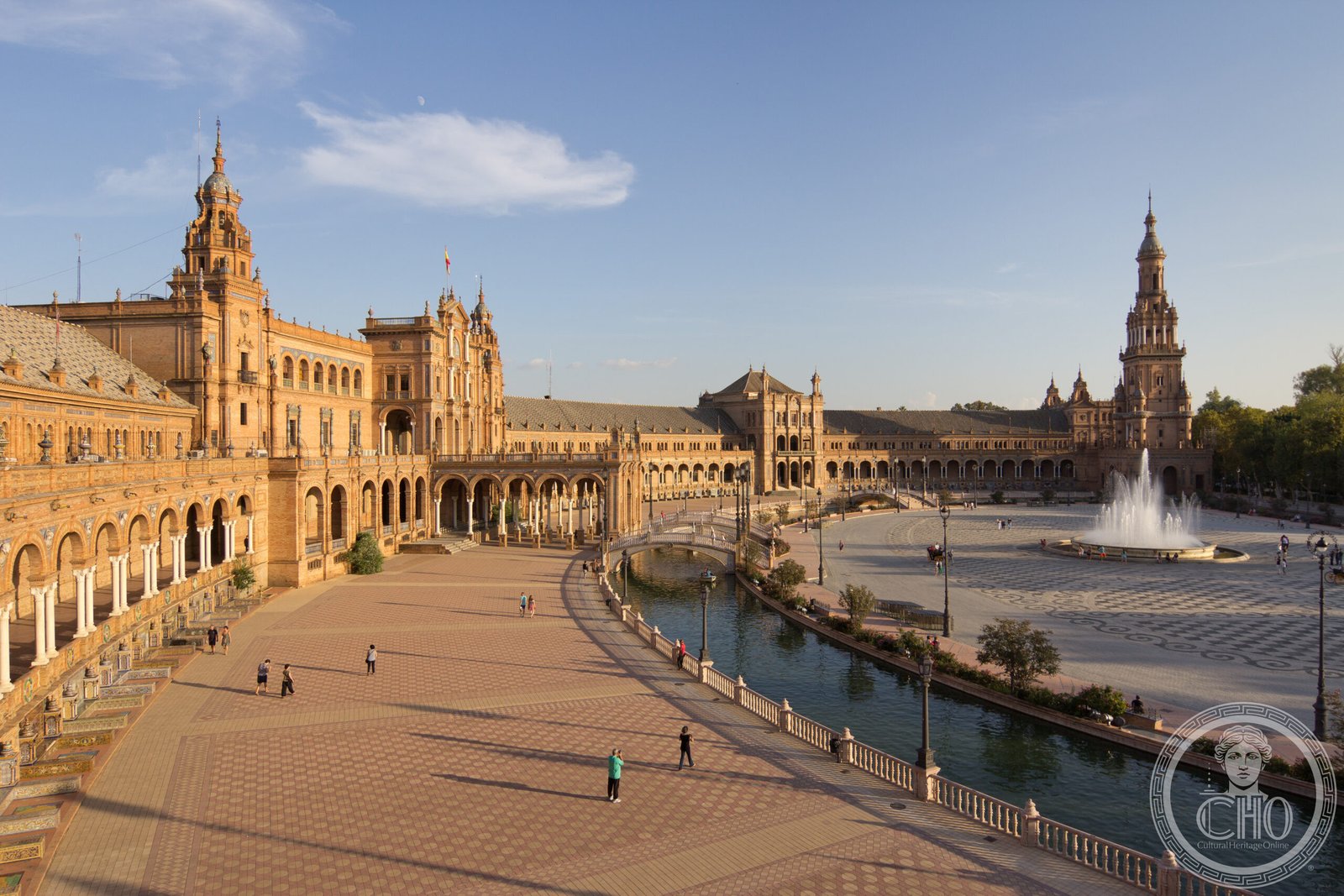
Few public spaces in Europe can match the sheer theatrical ambition of Plaza de España. Built in 1928 as the centrepiece of Seville’s Ibero-American Exposition of 1929, this vast semicircular complex stretches nearly 200 metres in a sweeping arc, enclosing a canal crossed by four ornate bridges and fronted by a continuous facade of towers, arcades, and ceramic tilework that synthesises baroque, Renaissance, and Moorish strands of Spanish architectural history. Architect Aníbal González conceived it as a declaration of Spain’s cultural richness and its historical relationship with the Americas, and the scale of the ambition remains staggering nearly a century later. Each of the 52 alcoves along the curved building is dedicated to a different Spanish province, fitted with hand-painted azulejo tile panels depicting its coat of arms, its map, and a key moment from its history. The result is a building that functions simultaneously as architecture, landscape, cartography, and collective memory — one of the most photographed spaces in Spain and a genuine masterpiece of the Regionalist movement.
At a glance
- Type
- Public plaza and exhibition complex
- Period
- Completed 1928; exposition opened 1929
- Style
- Regionalism Architecture (Baroque Revival, Renaissance Revival, Neo-Mudejar)
- Location
- Parque de María Luisa, Seville, Spain
- Coordinates
- 37.377° N, 5.987° W
- Architect(s)
- Aníbal González
Overview
Plaza de España occupies the eastern edge of the Parque de María Luisa and was designed as the Spanish national pavilion for the 1929 Ibero-American Exposition — an event intended to project Spain’s prestige and strengthen cultural bonds with its former colonies in Latin America. The complex consists of the semicircular main building, a central fountain, a canal with gondola hire, and four bridges named after the medieval kingdoms of Castile, Aragon, Navarre, and Leon. Its seamless blend of architectural vocabularies, coherent at every scale from the panoramic sweep of the facade to the intricate glaze of individual tiles, made it one of the defining achievements of early twentieth-century Spanish architecture.
History
Aníbal González began work on the complex in 1914, more than a decade before the exposition opened, and oversaw an extraordinarily complex construction that involved thousands of workers and the production of vast quantities of hand-painted ceramic tile. He resigned from the project in 1926 due to disputes with the exposition organisers, and the finishing work was completed by other architects — a fact that left him with complicated feelings about the building he had effectively created. After the 1929 exposition, the space transitioned to civic use; it housed military offices for decades and was later adapted into government and cultural functions. Restoration works in the late twentieth and early twenty-first centuries have preserved the tilework and structural fabric.
Architecture & Design
The building’s defining feature is its integration of three distinct Andalusian architectural traditions: the baroque drama of the twin towers at each end of the semicircle; the Renaissance loggia and arcade running the full length of the facade; and the Mudejar ornamental language of the tile panels, decorative brickwork, and horseshoe arches at the bridges. The 52 provincial alcoves are the most visited element, each presenting a unique composition of hand-painted azulejos illustrating the province’s geography and history. The canal, designed to reflect the facade and bridge the space between the building and the central plaza, was an engineering achievement in its own right and remains a popular feature for visitors who hire rowboats.
Cultural significance
Plaza de España has accumulated cultural weight far beyond its origins as an exposition pavilion. It has served as a filming location for Lawrence of Arabia, Star Wars Episode II, and numerous other productions drawn by the scale and drama of its spaces. For Spaniards it functions as a condensed national symbol, its provincial alcoves representing a pre-democratic idea of unified Spain that has since taken on new layers of meaning. For Sevillanos it is simply one of the most beloved public spaces in a city rich with them, used for walking, cycling, and quiet contemplation in the shade of its arcades.
Visiting today
The plaza is open and free to enter at all hours. The main building houses government offices that are not publicly accessible, but the arcades, provincial alcoves, canal, and bridges can be explored freely. Rowboat hire on the canal operates during daytime hours. The space is best visited in the early morning or late afternoon to avoid the intensity of the Andalusian midday sun and the largest crowds. Adjacent Parque de María Luisa provides shaded walking and is also free to enter.
Getting there
Plaza de España is in the Parque de María Luisa district of Seville, about 1.5 kilometres south of the Cathedral. Bus lines C1 and C2 (circular tourist routes) stop nearby. The nearest metro station is Puerta de Jerez, approximately 20 minutes on foot. Cycling is an excellent option given Seville’s extensive bike lane network; rental stations are available across the city. From Seville Santa Justa railway station, a taxi takes approximately 10 minutes.
Sources & resources
See this location in context: Set-Jetting: Six Famous Film & TV Locations You Can Actually Visit.
Frequently asked questions
Was Star Wars filmed at the Plaza de Espana?
Yes. The plaza appears as the city of Theed on the planet Naboo in Star Wars: Episode II – Attack of the Clones (2002).
What films were shot at the Plaza de Espana in Seville?
Lawrence of Arabia (1962) used it as a British army headquarters in Cairo, and Star Wars: Episode II used it as a Naboo palace exterior. Many other productions have filmed here.
Can you visit the Plaza de Espana?
Yes. It is a free, open public square on the eastern edge of the Parque de Maria Luisa in Seville.
When was the Plaza de Espana built?
It was built in 1928 as the centrepiece of Seville's Ibero-American Exposition of 1929.
Where is the Plaza de Espana in Seville?
It stands on the eastern edge of the Parque de Maria Luisa, a short walk south of Seville's historic centre.
Find it on the map
See this place and what’s around it →Record researched and written by Luigi De Marchi for Cultural Heritage Online, 2026.
📷 Become a Cultural Heritage Online photographer
Share your photos of places: they stay published under your name as the author. The more they're seen, the more you get noticed — and soon a contest will reward the most appreciated photos.
Log in or sign up free to add a photoIs this page about you?
This page is read by travellers and heritage enthusiasts who find it on Google. Tell us how you are connected to this place and we will take it from there.