
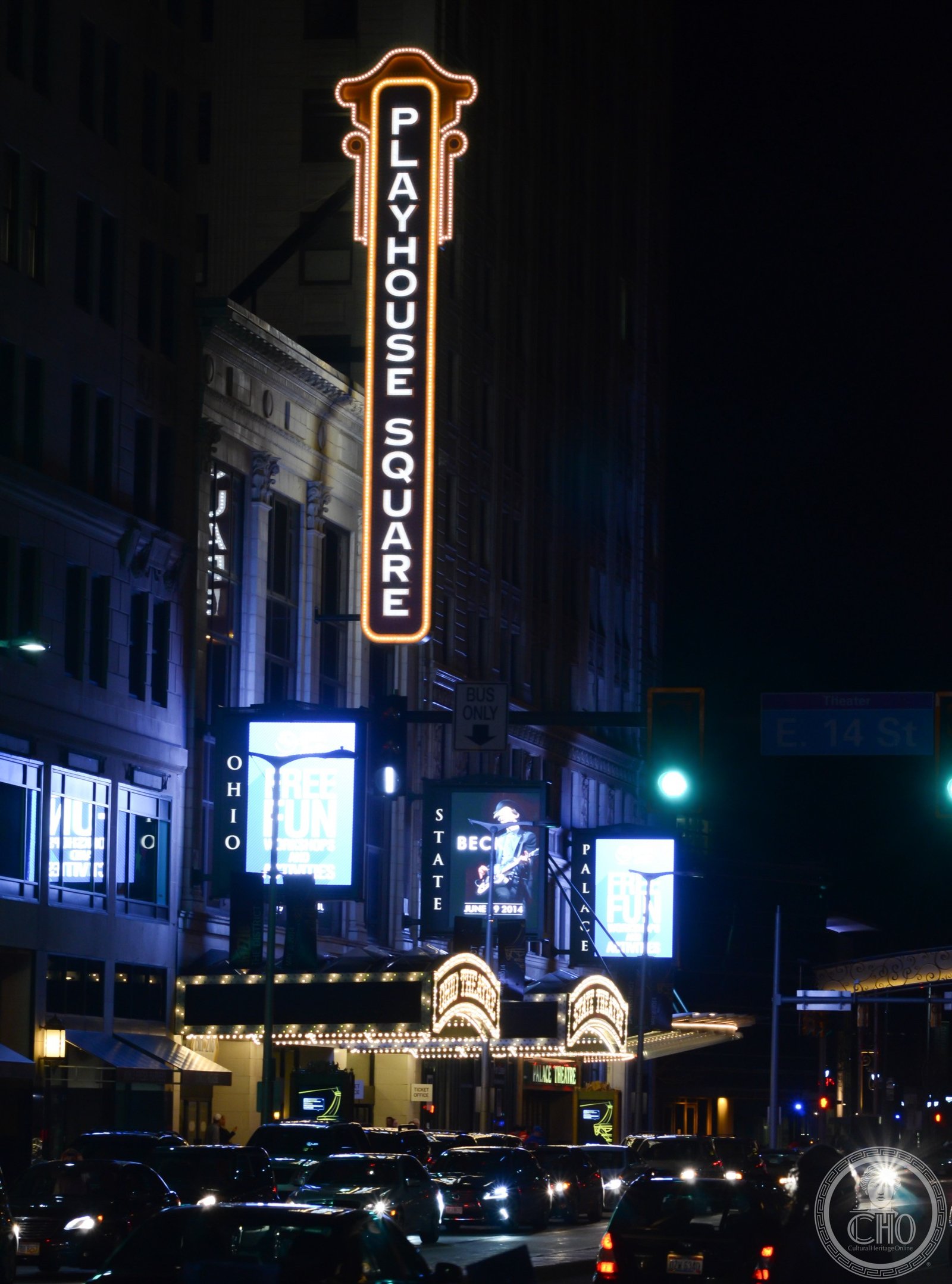
The largest theatre restoration project in American history, Playhouse Square on Euclid Avenue is a cluster of five historic palaces saved from demolition to become the second-largest performing arts complex outside New York City.
At a glance
Playhouse Square is a district of five historic theatres on Euclid Avenue in downtown Cleveland: the State (1921), Ohio (1921), Palace (1922), Allen (1921), and Hanna (1921) theatres. All opened within roughly eighteen months during the peak of the movie palace era, making Euclid Avenue one of the densest concentrations of picture palace architecture in the country. By the late 1960s all five had closed; a community-led preservation campaign saved them from demolition, and a decades-long restoration effort has returned them to full operation as one of the premier performing arts destinations in the United States. The State Theatre, the largest of the five at approximately 2,800 seats, is the flagship venue for Broadway touring productions.
Key facts
- Address: Playhouse Square, Euclid Avenue, Cleveland, OH 44115
- State Theatre opened: 1921
- Style: Baroque Revival / atmospheric interiors; Art Deco detailing in renovation-era lobbies
- Status: NRHP Listed; active performing arts complex
- Complex capacity: five theatres totaling more than 10,000 seats
- Notable: largest theatre restoration project in the United States; signature outdoor chandelier installation
- Theme: Art Deco USA
History
The opening of the State Theatre in 1921 signaled the maturation of a commercial entertainment district that had been building on Euclid Avenue since the early years of moving pictures. The Loew’s theatrical organization, which developed the Ohio and State theatres as companion venues on adjacent lots, conceived the pairing as a combined 5,000-seat operation that could absorb the demand of a metropolitan area of over 900,000. The Palace and Allen, built independently, completed the cluster that made Euclid Avenue between East 14th and East 17th Streets the busiest theatrical block in the Midwest.
The theatres flourished through the studio era, surviving the transition from silent films to sound and from vaudeville to the touring Broadway model. By the 1950s, however, the suburban migration of Cleveland’s middle class, combined with the rise of television and multiplex competition, eroded the downtown entertainment economy. One by one the theatres closed: the Hanna in 1962, the Ohio in 1969, the State and Palace in 1969. The Allen held on until 1968. By the early 1970s, all five sat vacant and the block faced demolition for a surface parking lot.
The Playhouse Square Foundation, established in 1973, mounted one of the most ambitious urban preservation campaigns in American history. Working with the City of Cleveland, private donors, and federal historic tax credits, the Foundation raised the funds to restore each theatre sequentially over three decades. The Palace reopened in 1988; the State in 1984; the Ohio in 1982; the Allen in 2011. Today Playhouse Square operates as a non-profit performing arts center hosting more than 1,000 events per year, including resident companies for ballet, opera, and concert music.
What you see
From Euclid Avenue, the theatres present a continuous wall of early-twentieth-century commercial facades — brick and terracotta fronts in varying heights and widths, unified by their shared scale and by the vertical marquee signs that project over the sidewalk at each entrance. The outdoor chandelier installation — a towering LED crystal fixture suspended above Playhouse Square at the Euclid Avenue intersection — was added to the complex in 2012 and has become one of the most photographed civic objects in Cleveland, a contemporary landmark layered over the 1920s streetscape.
Inside the State Theatre, the Baroque interior features a grand staircase lobby with ornate plasterwork, gilded details, and tiered balconies that rise to the steeply raked upper gallery. The scale is impressive without being overwhelming: the room was designed for opera, drama, and film with equal seriousness, and its acoustics — refined during the restoration — serve all three. The Ohio Theatre, smaller and more intimate, was originally an atmospheric palace; its painted ceiling sky and romanticized wall niches survive largely intact.
Practical information
- Access: Euclid Avenue between East 14th and East 17th Streets, downtown Cleveland; paid garages within one block
- Programming: Broadway touring productions, opera, ballet, concerts; check Playhouse Square schedule for current calendar
- Time needed: 2–3 hours for a full performance; tours of the theatres also available by appointment
- Best season: year-round indoor venues; the outdoor chandelier is particularly striking in winter evenings
Getting there
Cleveland Hopkins International Airport (CLE) is approximately 15 miles southwest of downtown, with connections to major hubs. The Greater Cleveland RTA Red Line connects Hopkins Airport directly to downtown Cleveland; the Playhouse Square stop on the HealthLine BRT on Euclid Avenue is steps from the theatre entrances. Amtrak’s Lake Shore Limited and Capitol Limited routes stop at Cleveland Lakefront Station, approximately 1.5 miles north of Playhouse Square — a short taxi or ride-share ride through the downtown core.
Nearby
- Cleveland Museum of Art — one of the major encyclopedic art museums in the country, with free general admission; in University Circle, approximately 3.5 miles east via the HealthLine
- Rock and Roll Hall of Fame — I. M. Pei–designed waterfront museum, approximately 1.5 miles north at the lakefront
- Cleveland Public Library Main Branch — a 1925 Neoclassical building with an extraordinary special collections room, approximately 0.3 miles west on Superior Avenue
Sources
- Playhouse Square Foundation — institutional history and restoration documentation
- National Register of Historic Places — Playhouse Square Historic District listing
- Theatre Historical Society of America — Ohio, State, and Palace Theatre records
- Wikimedia Commons — Cleveland Playhouse Square (13917560487).jpg, CC BY 2.0
Find it on the map
See this place and what’s around it →📷 Become a Cultural Heritage Online photographer
Share your photos of places: they stay published under your name as the author. The more they're seen, the more you get noticed — and soon a contest will reward the most appreciated photos.
Log in or sign up free to add a photoDo you manage this place?
This page is read by travellers and heritage enthusiasts who find it on Google. Keep it accurate — and make it work for you. Free for non-profit heritage institutions.