
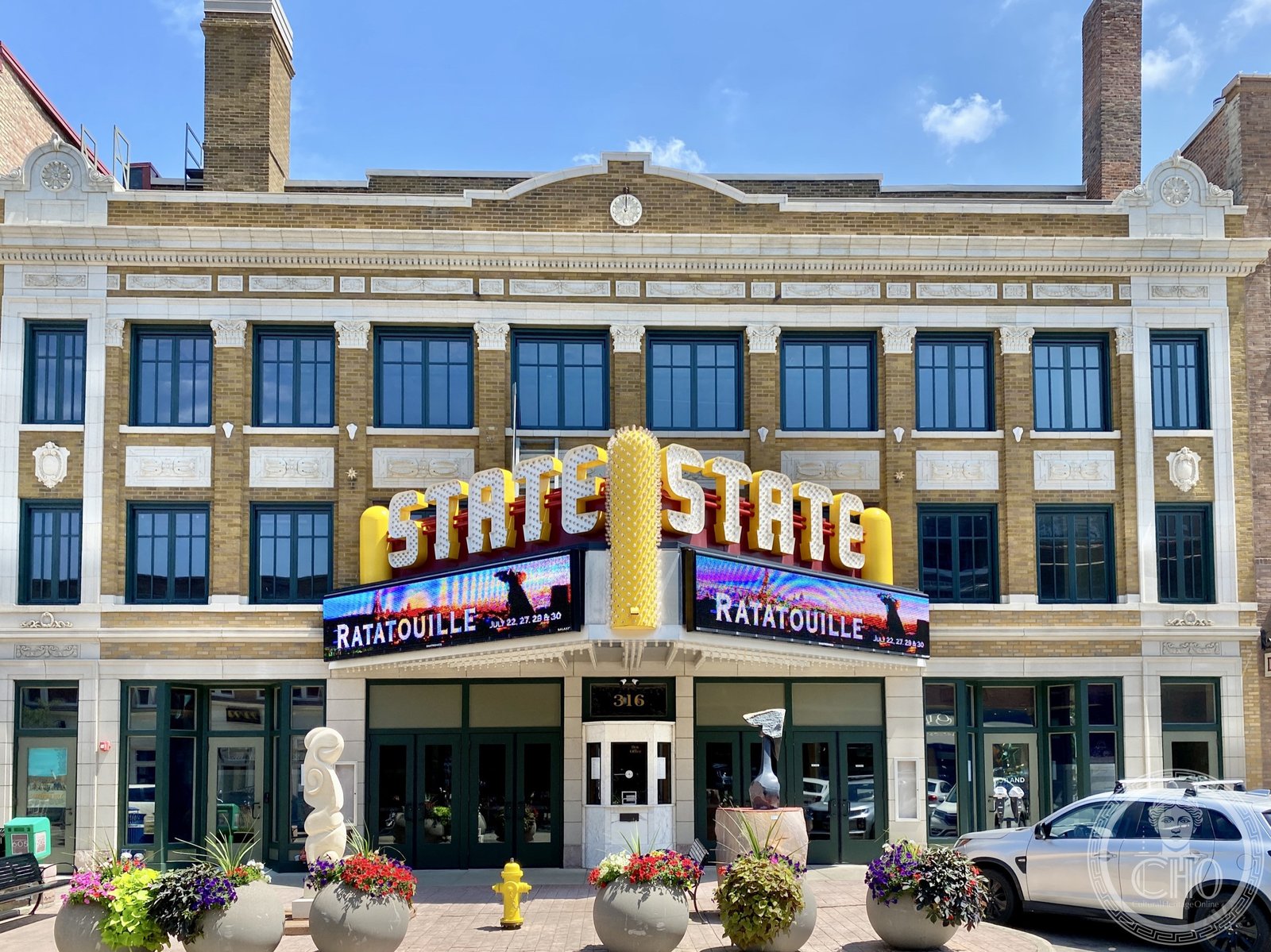
Standing on Phillips Avenue since 1926, the State Theatre is one of the finest surviving Art Deco cinema facades in the Northern Plains — a testament to the cultural ambitions of a prairie city at the height of the Jazz Age.
At a glance
The State Theatre occupies a prime position on Phillips Avenue, the historic commercial spine of downtown Sioux Falls and the largest city in South Dakota. Opened in 1926 during the peak of American picture-palace construction, the building combines Spanish Colonial Revival ornament with early Art Deco geometry in a composition that still anchors the south end of the downtown shopping district. Listed on the National Register of Historic Places, the State Theatre has been the subject of preservation efforts aimed at returning it to active cultural use.
Key facts
- Address: Phillips Avenue, downtown Sioux Falls, SD 57104
- Opened: 1926
- Style: Spanish Colonial Revival / Art Deco
- Status: NRHP Listed; preservation project
- Setting: Phillips Avenue historic commercial district, Sioux Falls city center
- Theme: Art Deco USA
History
Sioux Falls in the mid-1920s was the commercial hub of a vast agricultural region extending across eastern South Dakota, southwestern Minnesota, and northwestern Iowa. Its population of roughly 25,000 supported a downtown economy built on grain trading, meat-packing, and retail, and Phillips Avenue served as the region’s main shopping and entertainment corridor. The State Theatre was built to serve this regional audience — a venue designed to bring first-run Hollywood productions to the Northern Plains in an architectural setting that signaled metropolitan ambition.
The building’s Spanish Colonial ornament — characteristic of the period’s preference for theatrical, escapist styling — was selected not for regional relevance but for the same reason that Moorish and Italian Renaissance motifs appeared in picture palaces from Los Angeles to Boston: to create an interior environment sufficiently exotic to transport its audience away from the windswept Dakota plains. The combination of ornate plasterwork, a richly decorated lobby, and a generous auditorium established the State as the dominant entertainment venue in the Sioux Falls market for decades.
Like most single-screen movie palaces, the State faced structural challenges in the era of multiplex competition and urban commercial decline. Preservation advocates in Sioux Falls recognized the building’s architectural and historical significance, leading to its NRHP listing and ongoing efforts to stabilize and restore the structure. The theatre has become a symbol of the broader revitalization of the Phillips Avenue corridor, which has seen significant investment in historic rehabilitation since the early 2000s.
What you see
The State Theatre’s Phillips Avenue facade is a layered composition of warm-toned masonry and decorative terracotta, organized around a central entrance bay flanked by pilasters with ornamental capitals. The cornice line steps up at the center to emphasize the marquee zone, while the upper facade employs geometric patterning — a characteristic Art Deco device that bridges the organic ornament of the Spanish Colonial vocabulary with the rationalized geometry of the emerging modernist aesthetic.
The proportions are those of a mid-scale picture palace, designed for a city whose ambitions outpaced its population at the time of construction. The streetscape relationship — the building set flush with the sidewalk, its entrance framing a passage directly from the commercial street into the controlled fantasy of the auditorium — is characteristic of the movie palace type and remains legible even in the building’s current partially restored state.
Practical information
- Access: Phillips Avenue, downtown Sioux Falls; street parking and surface lots available nearby
- Current status: preservation project; check local heritage organizations for current access or event programming
- Time needed: 30–60 minutes for exterior architectural observation; interior access subject to restoration schedule
- Best season: summer and fall; Sioux Falls winters are severe, but the downtown streetscape is best appreciated in dry-weather months
Getting there
Sioux Falls Regional Airport (FSD) is approximately 3 miles north of downtown, with direct connections to major hubs including Chicago, Denver, Minneapolis, and Dallas. The State Theatre on Phillips Avenue is at the heart of the compact downtown core, walkable from most downtown hotels. Amtrak does not serve Sioux Falls; the nearest stations are in Minneapolis (~240 miles north, Empire Builder route) and Winona, MN (~210 miles northeast). Interstate 29 and I-90 intersect at Sioux Falls, making it a natural stop on cross-country road itineraries.
Nearby
- Washington Pavilion of Arts and Science — a 1908 Romanesque Revival former high school converted into a cultural complex with performing arts, visual arts, and science museum spaces, approximately 0.4 miles northwest on Washington Square
- Pettigrew Home and Museum — 1889 Queen Anne house of South Dakota’s first senator, now a municipal history museum, approximately 0.5 miles northwest
- Falls Park — the quartzite falls of the Big Sioux River that gave the city its name, approximately 0.8 miles north; a geological and recreational anchor of the downtown open-space system
Sources
- National Register of Historic Places — State Theatre listing, South Dakota State Historical Society
- City of Sioux Falls Historic Preservation Commission records
- Wikimedia Commons — State Theatre, Phillips Street, Sioux Falls, SD.jpg, CC BY-SA 2.0
Find it on the map
See this place and what’s around it →📷 Become a Cultural Heritage Online photographer
Share your photos of places: they stay published under your name as the author. The more they're seen, the more you get noticed — and soon a contest will reward the most appreciated photos.
Log in or sign up free to add a photoIs this page about you?
This page is read by travellers and heritage enthusiasts who find it on Google. Tell us how you are connected to this place and we will take it from there.