
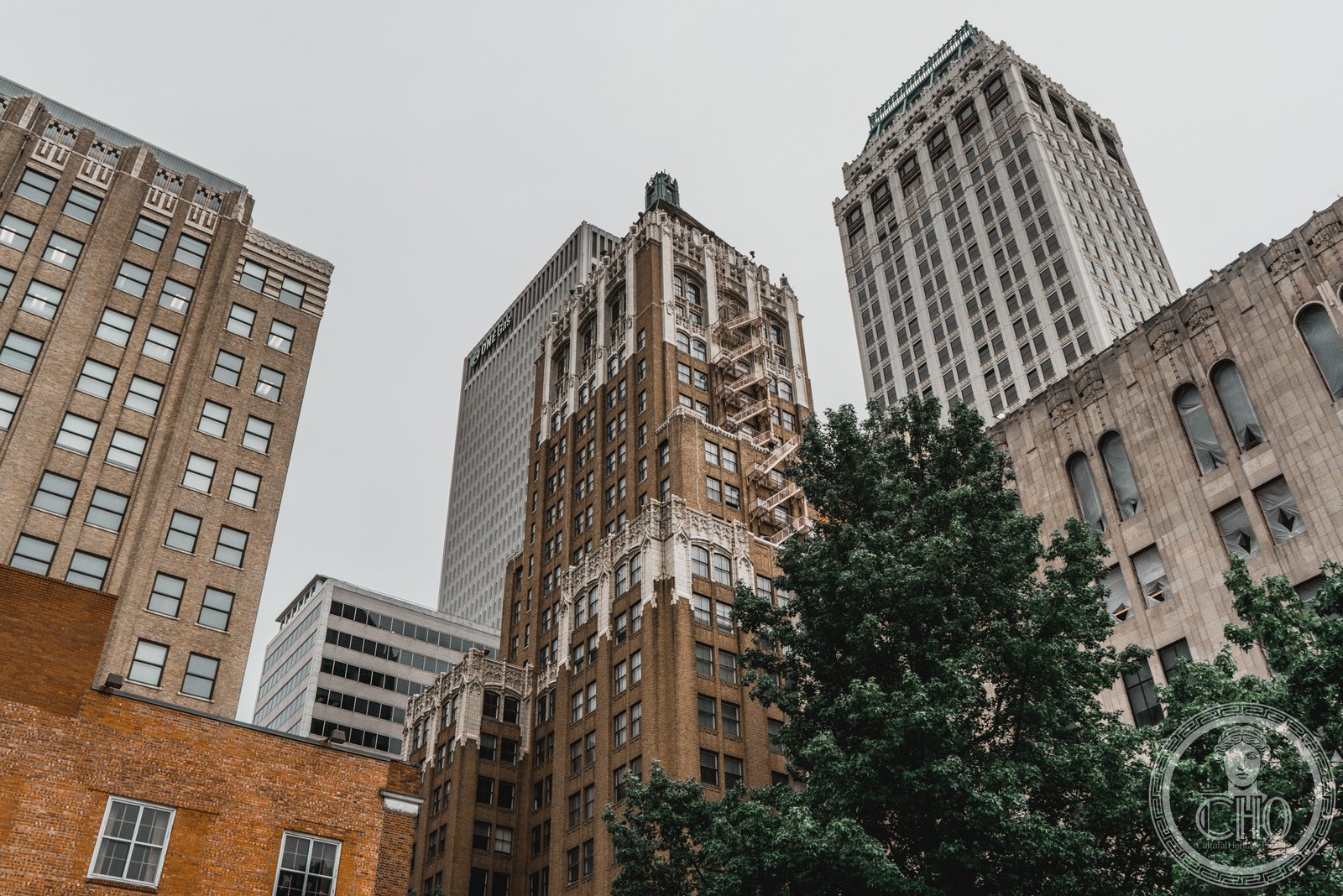
Built by oil magnate Waite Phillips at the height of Tulsa’s oil-boom prosperity, the Philtower has anchored the Boston Avenue streetscape since 1928 — its Gothic-crowned profile one of the defining features of the city’s Art Deco skyline.
At a glance
The Philtower Building at 427 South Boston Avenue in downtown Tulsa was completed in 1928 for Waite Phillips, an oil magnate who had accumulated one of the largest fortunes in Oklahoma during the 1920s oil boom. Designed by architect Edward Buehler Delk, the building combines Art Deco massing and ornament with a neo-Gothic crown — a characteristic choice of the period, when skyscraper architects often capped modern steel-frame towers with the pointed spires and carved stone of medieval cathedrals. The Philtower is listed on the National Register of Historic Places and remains an office building in active use.
Key facts
- Address: 427 South Boston Avenue, Tulsa, OK 74103
- Completed: 1928
- Architect: Edward Buehler Delk
- Style: Art Deco with Gothic Revival crown
- Developer: Waite Phillips (oil magnate)
- NRHP: Yes
- Current use: Commercial offices
History
Tulsa in the 1920s was one of the most prosperous cities in the United States, its wealth built almost entirely on oil. Waite Phillips — brother of Frank Phillips, founder of Phillips Petroleum — had sold his oil interests to Cities Service Company in 1925 and used the proceeds to invest in real estate. The Philtower Building was one of the major commercial projects he developed in downtown Tulsa, alongside the nearby Philcade Building. Phillips named the tower after himself; the “Phil” prefix appears across several of his Tulsa developments.
Architect Edward Buehler Delk gave the tower a profile that was by then becoming standard for the ambitious commercial skyscraper: a setback shaft in Art Deco vocabulary, transitioning at the top to a more explicitly Gothic arrangement of pinnacles and carved stone. This Gothic crown served not just as decoration but as a skyline marker, making the Philtower identifiable from across the city. The building’s base features carved ornamental detail appropriate to a monument to oil-era wealth — restrained but rich, the terracotta panels announcing the prosperity of its builder.
Phillips later donated Villa Philmonte, his New Mexico estate, to the Boy Scouts of America — one of the largest philanthropic gifts in the organization’s history. The Philtower Building he retained as a commercial property; it has remained an office building through successive owners and stands today as a reminder of the remarkable concentration of wealth that Tulsa’s oil boom produced in the 1920s.
What you see
The Philtower’s facade is clad in limestone and terracotta, with Art Deco ornamental detail at the entrance and the lower floors that transitions to more Gothic-inflected carved stone as the building rises. The entrance portal features the kind of sculptural detail common to Art Deco commercial buildings of the period — geometric relief, stylized flora, and the kind of surface richness that distinguished these buildings from the plainer curtain-wall towers that would follow in the 1950s.
At the crown, the building breaks into a cluster of Gothic pinnacles — pointed, carved stone forms that project against the Oklahoma sky and serve as the building’s primary skyline identifier. Standing on Boston Avenue and looking up, you see a building that is squarely of its moment — the point where American commercial architecture was still negotiating between the Gothic inheritance and the Art Deco future, and producing some of its most inventive buildings in the process.
Practical information
- Lobby: Accessible during business hours; the building is in active commercial use
- Exterior: Viewable at all times from Boston Avenue
- Tulsa Art Deco district: Boston Avenue has several significant 1920s–30s buildings within walking distance, including the Boston Avenue Methodist Church one block north
- Photography: Best light on the facade in the morning
Getting there
The Philtower Building is in downtown Tulsa on South Boston Avenue. Tulsa International Airport (TUL) is about 7 miles north-east via US-11. Downtown Tulsa is compact; most Art Deco landmarks are within a 10-minute walk of Boston Avenue. The Tulsa Arts District is two blocks west.
Nearby
- Boston Avenue Methodist Church (1929) — Adah Robinson’s extraordinary Art Deco church, one block north
- Philcade Building (1931) — another Waite Phillips Art Deco commercial building, adjacent to the Philtower
- Tulsa Club Building (1927) — Art Deco club building two blocks north
- Mayo Hotel (1925) — restored historic hotel three blocks east
Sources
- Wikipedia, “Philtower Building” — architect, date, NRHP listing, Phillips biography
- Tulsa Preservation Commission — local landmark context and documentation
- Oklahoma Historical Society — Waite Phillips biography and Tulsa oil-boom history
- National Register of Historic Places — nomination and significance statement
Find it on the map
See this place and what’s around it →📷 Become a Cultural Heritage Online photographer
Share your photos of places: they stay published under your name as the author. The more they're seen, the more you get noticed — and soon a contest will reward the most appreciated photos.
Log in or sign up free to add a photoIs this page about you?
This page is read by travellers and heritage enthusiasts who find it on Google. Tell us how you are connected to this place and we will take it from there.