
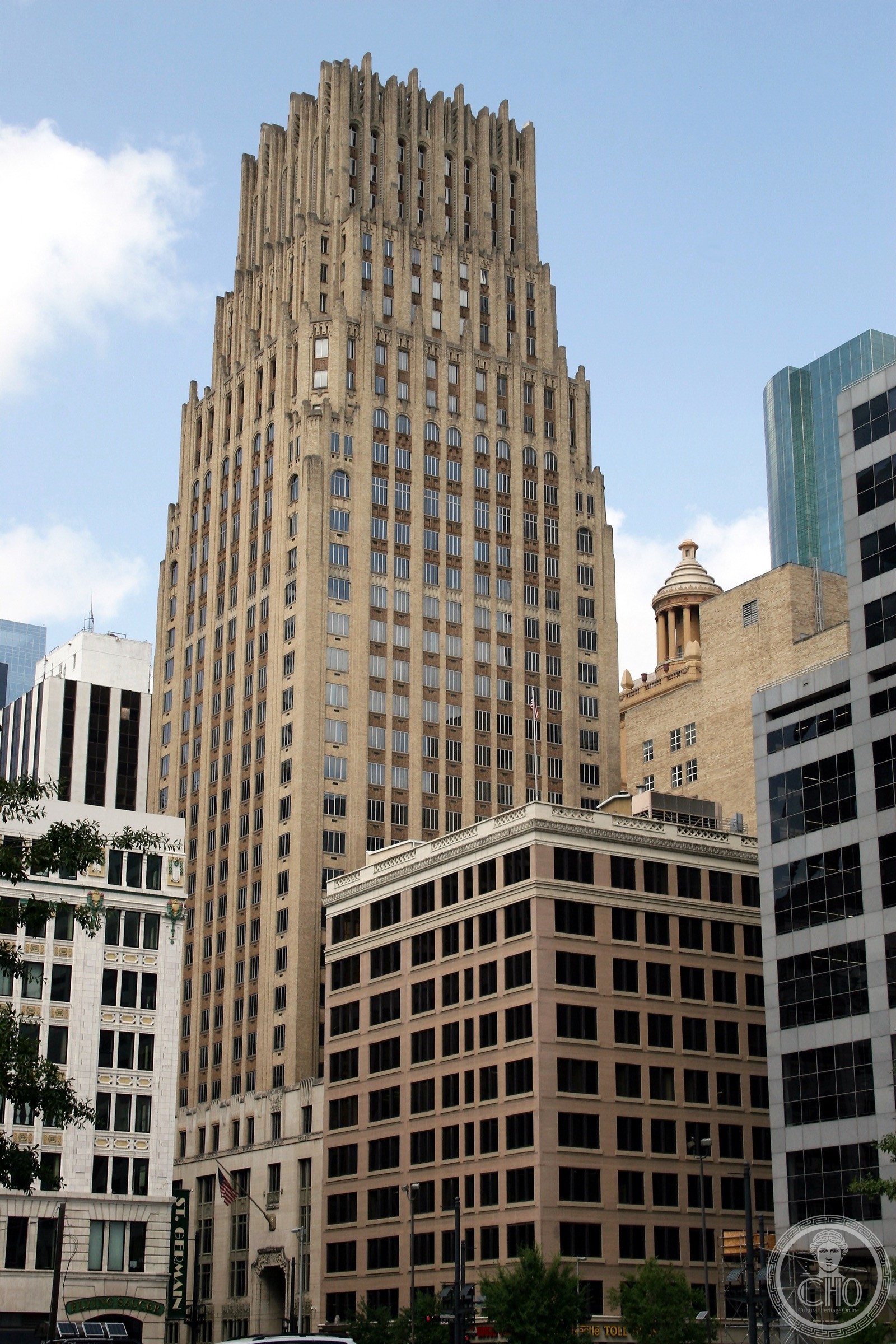
Gulf Building
At 428 feet and 37 stories, the Gulf Building was the tallest skyscraper in the American South when it opened in 1929 — a landmark of the oil boom era that defined Houston’s skyline for a generation.
At a glance
The Gulf Building at 712 Main Street in downtown Houston was completed in 1929 as the headquarters of Gulf Oil Corporation. Designed by Alfred C. Finn, the building combined Art Deco setback massing with a neo-Gothic crown — a combination common to the period’s most ambitious towers, which sought both the verticality of Gothic cathedrals and the decorative vocabulary of modernist Art Deco. At 37 stories and 428 feet it was, upon completion, the tallest building south of the Mason-Dixon line and remained so for years. It is now a National Historic Landmark.
Key facts
- Address: 712 Main Street, Houston, TX 77002
- Height: 37 stories, 428 ft (130 m)
- Completed: 1929
- Architects: Alfred C. Finn
- Style: Art Deco with Gothic-inspired crown
- National Historic Landmark: Yes
- Original tenant: Gulf Oil Corporation headquarters
History
The 1920s oil boom transformed Houston from a regional port into a city of national commercial significance. Gulf Oil, one of the largest American oil companies of the era, chose the city’s Main Street for its flagship office tower as part of a broader expansion of its Gulf Coast operations. The brief called for a building that would announce the company’s ambitions visibly and unambiguously — which the 37-story tower did, rising 200 feet above its nearest competitor in the Houston skyline.
Alfred C. Finn was Houston’s leading architect of the period. Working with Mackenzie and Franzheim, he produced a building that adopted the New York model of stepped setbacks while adding a crown of neo-Gothic stonework — octagonal in plan, rising to a lantern — that referenced the Gothic cathedrals implicit in the verticality of all American skyscrapers of the 1920s. The building’s exterior is clad in limestone and terracotta, with Art Deco ornamental detail at the base and upper floors.
The Gulf Building was designated a National Historic Landmark in recognition of its architectural significance and its role in the economic and architectural history of the American South. It has since been integrated into the JPMorgan Chase Tower complex that now occupies the surrounding block.
What you see
From Main Street, the Gulf Building reads as a classic Art Deco setback tower — its limestone-clad lower floors stepping back progressively as the shaft rises, with the ornamental detail concentrated at the entrance, the spandrels, and the crown. The neo-Gothic lantern at the top is the building’s most distinctive element: an eight-sided stone structure that functions as a transition between the rectangular shaft below and the open sky, lit at night to make the building visible from across the city.
The lobby, accessed from Main Street, preserves elements of its original Art Deco character — marble floors, bronze metalwork, and the kind of spatial grandeur that oil companies of the 1920s understood to be necessary for impressing clients and reassuring investors. The building has been modified over the decades, but its primary architectural identity remains intact.
Practical information
- Lobby access: Weekdays during business hours; the building is integrated into a larger commercial complex
- Exterior: Viewable at all times from Main Street; best light in the morning from the west side
- Photography: Best full tower shot from the intersection of Main and Rusk Streets looking north
- Metro: Houston METRORail Main Street Square stop is directly adjacent
Getting there
The Gulf Building is on Main Street in downtown Houston, directly adjacent to the METRORail Main Street Square station. Houston’s light-rail network connects downtown to the Museum District and Medical Center to the south. George Bush Intercontinental Airport (IAH) is about 23 miles north; William P. Hobby Airport (HOU) is 12 miles southeast.
Nearby
- JPMorgan Chase Tower (1982) — I.M. Pei’s 75-story postmodern skyscraper adjacent to the Gulf Building
- Houston City Hall (1939) — Art Deco civic building three blocks south on Bagby Street
- Market Square Park — historic downtown square with surrounding 19th-century commercial buildings
Sources
- Wikipedia, “Gulf Building (Houston)” — height, architects, NHL designation, Gulf Oil history
- National Park Service, National Historic Landmark nomination — architectural significance
- Houston Preservation Alliance — building history and context in Houston’s commercial district
- Texas Historical Commission — architectural survey records
Find it on the map
See this place and what’s around it →📷 Diventa un fotografo di Cultural Heritage Online
Condividi le tue foto dei luoghi: restano pubblicate con la tua firma come autore. Più vengono viste, più ti fai conoscere — e presto un concorso premierà le foto più apprezzate.
Accedi o registrati gratis per aggiungere una fotoDo you manage this place?
This page is read by travellers and heritage enthusiasts who find it on Google. Keep it accurate — and make it work for you. Free for non-profit heritage institutions.