
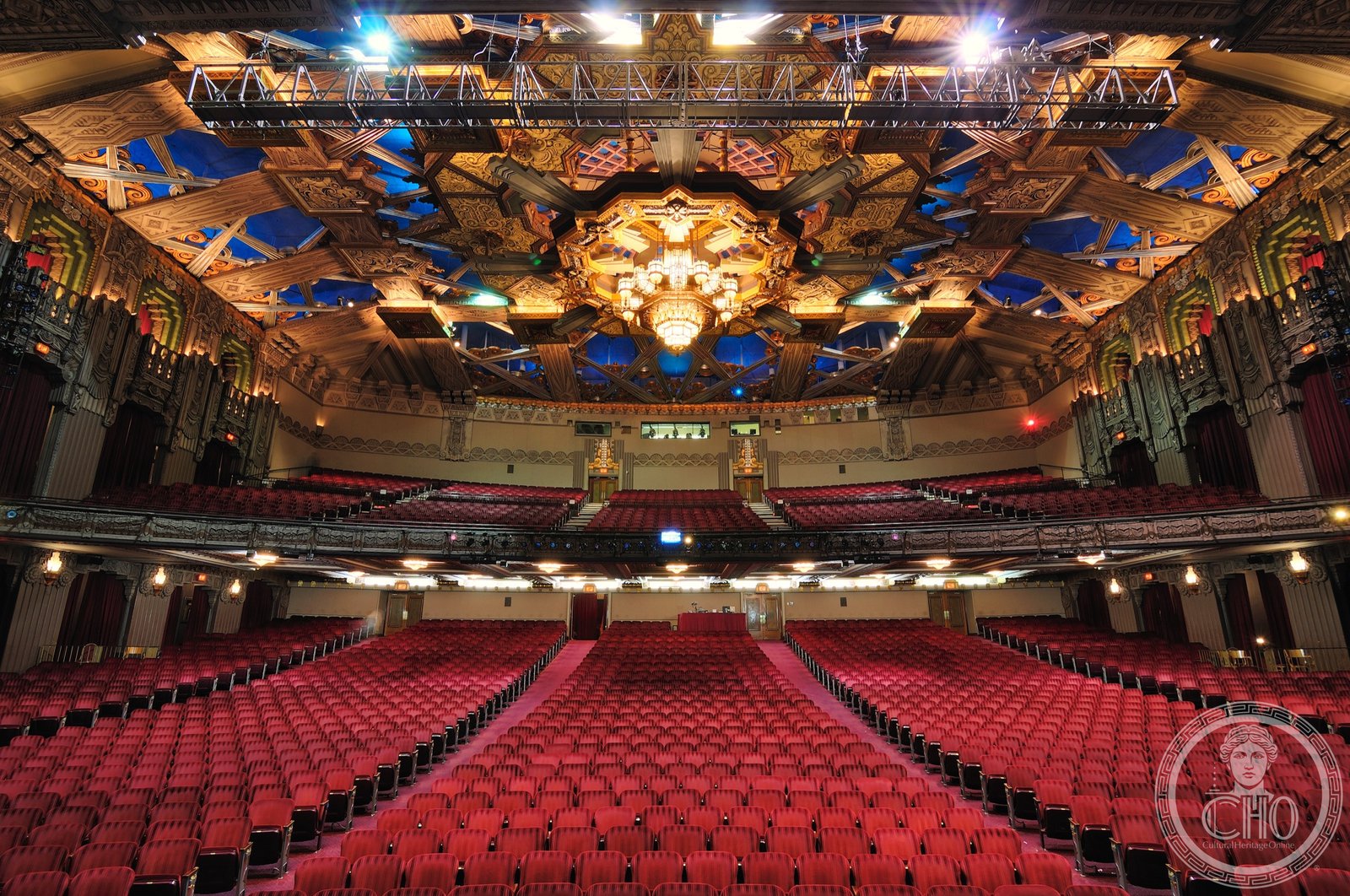
Hollywood Pantages Theatre
Opened in 1930 on Hollywood Boulevard, the Pantages Theatre hosted the Academy Awards for a decade and remains one of the most spectacular surviving examples of Art Deco theatre design in the United States.
At a glance
The Hollywood Pantages Theatre at 6233 Hollywood Boulevard opened on June 4, 1930, as the flagship venue of vaudeville impresario Alexander Pantages. Designed by B. Marcus Priteca in the Art Deco style, the theatre seats approximately 2,800 patrons in an interior of astonishing decorative richness — gold, bronze, and polychrome plasterwork covering every surface from the grand foyer to the proscenium arch. From 1950 to 1959 it was the site of the Academy Awards ceremony. It is a National Historic Landmark and continues to operate as a live-performance venue under the Nederlander theatrical organization.
Key facts
- Address: 6233 Hollywood Boulevard, Hollywood, CA 90028
- Opened: June 4, 1930
- Architect: B. Marcus Priteca
- Style: Art Deco
- Seating capacity: approximately 2,800
- National Historic Landmark: Yes
- Academy Awards: Hosted 1950–1959 (22nd through 31st ceremonies)
- Current operator: Nederlander Organization
History
Alexander Pantages was one of the most powerful figures in early 20th-century American entertainment, his chain of vaudeville houses extending from Canada to California. The Hollywood theatre, his last major project, was conceived as a monument to his empire — and to the new medium of sound film that was already making vaudeville obsolete. Priteca, who had designed most of the Pantages circuit’s theatres, produced his most elaborate work here: a building that was simultaneously a temple of popular entertainment and a declaration of the Art Deco aesthetic at its most exuberant.
The theatre opened in June 1930 with a film program. The timing was difficult: Alexander Pantages had been convicted of rape in 1929 and would spend years fighting the charges (he was eventually acquitted in a retrial). He sold his theatre chain to RKO Pictures in 1929, and the Hollywood venue operated under the RKO banner for years after the sale.
Howard Hughes purchased the theatre in 1949 and leased it to the Academy of Motion Picture Arts and Sciences, which held the Oscar ceremonies there from 1950 through 1959. The Pantages’s Art Deco interior became the backdrop for some of the most memorable moments in Hollywood history during this period. After the Academy departed, the theatre continued as a first-run cinema and later as a live performance venue. It is designated a National Historic Landmark.
What you see
The exterior presents a narrow Hollywood Boulevard frontage dominated by a vertical marquee and blade sign — the defining visual element of the classic American movie palace on a dense commercial street. The facade is faced in polished granite and terracotta, with Art Deco relief ornament that signals the interior’s decorative richness without overstating it.
Inside, the theatre is one of the most complete surviving Art Deco interiors in the country. The foyer moves through a sequence of increasingly elaborate spaces before the auditorium itself opens up: a volume of approximately 2,800 seats under a vaulted ceiling covered in gold and polychrome plasterwork, its every surface — the balcony faces, the proscenium, the side wall panels — alive with carved and molded Art Deco ornament. The ornamental program runs from geometric abstraction to stylized plant forms, all subordinated to the gold-and-bronze palette that Priteca maintained throughout.
Practical information
- Active venue: The Pantages hosts Broadway touring productions and concerts; tickets required for performances
- Lobby access: The entrance foyer is visible from Hollywood Boulevard; tours are occasionally offered
- Photography: The vertical blade sign and marquee are best photographed from across Hollywood Boulevard at dusk
- Transit: Metro Red Line Hollywood/Vine station is two blocks east
Getting there
The Hollywood Pantages Theatre is on Hollywood Boulevard between Vine Street and Argyle Avenue. Metro Red Line (Hollywood/Vine station) is the easiest approach from downtown Los Angeles — about a 20-minute ride. By car, the Hollywood Freeway (US-101) exits at Vine Street, two blocks east. Los Angeles International Airport (LAX) is about 20 miles south-west.
Nearby
- Capitol Records Building (1956) — Welton Becket’s iconic circular tower, one block north on Vine Street
- Hollywood Walk of Fame — the terrazzo star plaques run along both sides of Hollywood Boulevard in front of the theatre
- Avalon Hollywood (formerly The Palace) — 1927 Spanish Colonial Revival nightclub building two blocks west
Sources
- Wikipedia, “Hollywood Pantages Theatre” — opening date, architect, seating capacity, NHL designation, Academy Awards history
- National Park Service, NHL nomination — architectural and cultural significance
- Academy of Motion Picture Arts and Sciences — Academy Award ceremony history
- Los Angeles Conservancy — theatre history and preservation context
Find it on the map
See this place and what’s around it →📷 Diventa un fotografo di Cultural Heritage Online
Condividi le tue foto dei luoghi: restano pubblicate con la tua firma come autore. Più vengono viste, più ti fai conoscere — e presto un concorso premierà le foto più apprezzate.
Accedi o registrati gratis per aggiungere una fotoDo you manage this place?
This page is read by travellers and heritage enthusiasts who find it on Google. Keep it accurate — and make it work for you. Free for non-profit heritage institutions.