
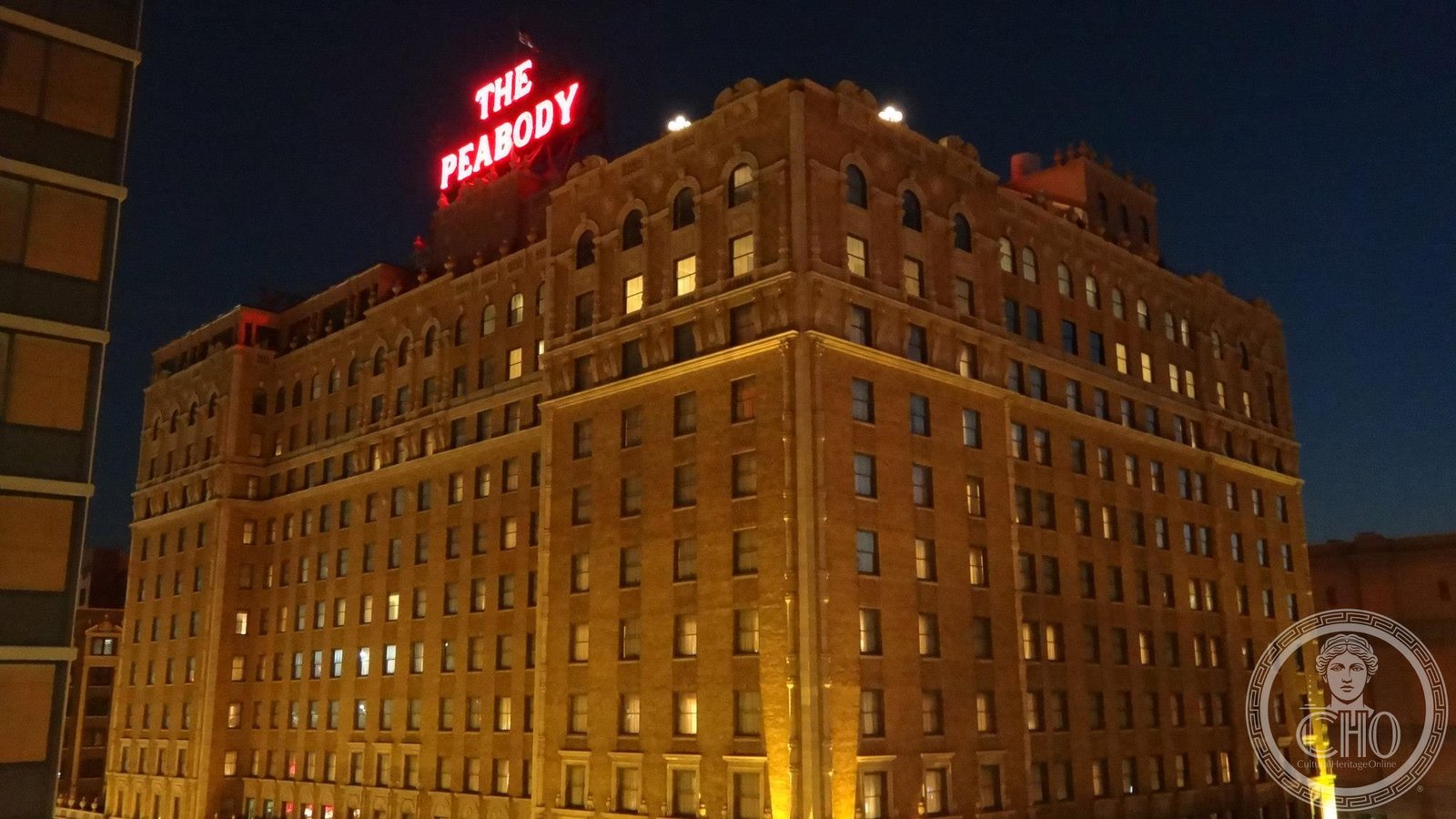
The Peabody Hotel at 149 Union Avenue has been the social heart of Memphis since its 1925 reconstruction — a 13-story Italian Renaissance Revival tower whose marble lobby, ornamental ironwork and twice-daily Duck March have made it the most iconic address in the American South for a century.
At a glance
The Peabody Hotel stands at 149 Union Avenue in the heart of downtown Memphis, one block east of Main Street and two blocks from the Mississippi riverfront. The current building, opened in 1925, was the second Peabody Hotel to occupy a Memphis address: the original Peabody, built in 1869 and demolished in the late nineteenth century, had been the grand social center of post-Civil War Memphis. The 1925 building restored that tradition with a 13-story Italian Renaissance Revival tower whose lobby — a vast two-story room of Tennessee marble, ornamental plasterwork, and an elaborate coffered ceiling — became the meeting place, deal-making venue, and social hub of the Mid-South. The Peabody is listed on the National Register of Historic Places. It is known internationally for the Duck March, a daily ceremony in which a family of five Mallard ducks descends from a penthouse suite, rides the elevator to the lobby, waddles along a red carpet to the Renaissance Revival travertine fountain in the center of the lobby, and spends the day swimming in it — reversing the parade each evening at 5 p.m.
Key facts
- Opened: 1925 (current building; original Peabody Hotel 1869)
- Style: Italian Renaissance Revival with Art Deco ornamental details
- Stories: 13
- Address: 149 Union Avenue, Memphis, TN 38103
- GPS: 35.1449°N, 90.0507°W
- Status: National Register of Historic Places; active luxury hotel
- Duck March: daily at 11:00 a.m. and 5:00 p.m. (tradition since 1933)
History
Memphis in the 1920s was the commercial capital of the Mid-South — the largest city on the Mississippi River between St. Louis and New Orleans, a center of cotton trading, hardwood lumber, and the nascent blues music industry that was transforming American popular music. The Union Avenue commercial corridor, running east from the river through the downtown grid, was the address of the city’s banks, hotels, and department stores. When the rebuilt Peabody opened in 1925 with its Italian Renaissance Revival lobby of Tennessee marble and ornamental bronze, it became immediately what the original Peabody had been: the hotel where Memphis society met, where cotton merchants closed their deals, where politicians made their arrangements, and where visiting artists and celebrities stayed.
The Duck March began in the 1930s as a prank by the hotel’s general manager and a group of hunting companions who had one night too many and thought it would be amusing to put live ducks in the lobby fountain. The ducks stayed. The ritual evolved, over the following decades, into a formal ceremony with a dedicated Duckmaster, a red carpet rolled out by the Duckmaster from the elevator to the fountain, and crowds of hundreds gathering in the lobby at 11:00 a.m. and 5:00 p.m. to watch the procession. The five Mallards who serve as the Peabody ducks at any one time are selected from farms in the region, stay at the hotel for three months, and are then retired and replaced — a rotation that has continued without interruption since the ceremony was formalized in 1940.
The Peabody closed in 1975 during the worst period of downtown Memphis disinvestment and reopened in 1981 after a major restoration that returned the lobby and public rooms to their 1925 character. The 1981 reopening was a landmark event in downtown Memphis’s revival, and the Peabody has operated continuously since then as the city’s most prestigious hotel address.
What you see
The Union Avenue facade is a 13-story composition in brick with limestone trim, its lower three stories forming a formal base in the Italian Renaissance palazzo tradition: the ground floor arcade, the piano nobile with paired windows under arched heads, and the second floor with ornamental stone balcony rails. Above the base, the tower rises in standard brick curtain wall to the cornice, whose ornamental plaster brackets and dentil course frame the roofline. The entrance canopy and vertical Peabody Hotel sign — in neon on a metal frame — project over the Union Avenue sidewalk, signaling the building’s hotel function and preserving the nighttime presence that hotel signage of the 1920s was designed to maintain.
The lobby is the building’s architectural centerpiece: a two-story room of Tennessee marble floor and wainscoting, whose coffered ceiling carries gilded plaster ornament above the level of the mezzanine balcony. The central fountain — a travertine basin approximately three feet in diameter and eighteen inches deep — is the architectural focus of the lobby floor, surrounded by seating arranged for the Duck March audience. The ornamental ironwork of the mezzanine railings, the original chandeliers, and the marble pilasters along the lobby walls give the space a quality of formal grandeur that has not been compromised by subsequent renovations.
Practical information
- Access: 149 Union Avenue, Memphis TN 38103; lobby open to non-guests; Duck March daily at 11:00 a.m. and 5:00 p.m. (free, no ticket required)
- Highlights: the Duck March (11 a.m. and 5 p.m.); the lobby bar (Lobby Bar, open daily); the Chez Philippe restaurant (dinner service); the rooftop Capriccio bar
- Transit: MATA trolley on Main Street, one block west; trolley connects to AutoZone Park, the Pyramid Arena, and the Mississippi riverfront
- Time needed: 30 minutes for Duck March + lobby visit; 2–3 hours for a meal
Getting there
The Peabody Hotel is on Union Avenue in downtown Memphis, one block east of Main Street and approximately three blocks from the Mississippi River. Memphis International Airport (MEM) is approximately 12 miles south — 20–25 minutes by car via I-240 north and Danny Thomas Boulevard to Union Avenue. MATA bus routes serve downtown from the airport, but the journey takes approximately 45 minutes. Amtrak serves Memphis (Central Station) via the City of New Orleans line, at Calhoun and South Main Street, approximately 10 minutes’ walk south. From the Pyramid Arena on the waterfront, Union Avenue runs east approximately 4 blocks to the Peabody. Beale Street, Memphis’s historic blues district, is two blocks south on Main Street.
Nearby
- Beale Street Historic District — the two-block blues music entertainment district at the intersection of Beale and Main Streets, two blocks south — the birthplace of the Memphis blues, with live music nightly at clubs along the pedestrianized street.
- Stax Museum of American Soul Music — the museum at 926 E McLemore Avenue built on the site of the original Stax Records studio, three miles south — one of the essential American music museums.
- Orpheum Theatre (1928) — Memphis’s great French Baroque movie palace at 203 S Main Street, six blocks south, with a full Broadway and concert season. See the CHO guide.
- National Civil Rights Museum at the Lorraine Motel — the museum at 450 Mulberry Street, seven blocks south — at the site of Dr. Martin Luther King Jr.’s assassination; one of the most important American civil rights heritage sites.
Sources
- National Register of Historic Places nomination, Peabody Hotel, Memphis
- Commercial Appeal archives — 1925 opening and 1981 reopening coverage
- Peabody Hotel official history — Duck March tradition documentation
- Gerald W. Johnson, “The South Takes the Cure,” Scribner’s Magazine (1930) — the Peabody as social center of the Mid-South
- David Wharton, The Soul of Memphis — Union Avenue corridor history
Find it on the map
See this place and what’s around it →📷 Become a Cultural Heritage Online photographer
Share your photos of places: they stay published under your name as the author. The more they're seen, the more you get noticed — and soon a contest will reward the most appreciated photos.
Log in or sign up free to add a photoIs this page about you?
This page is read by travellers and heritage enthusiasts who find it on Google. Tell us how you are connected to this place and we will take it from there.