
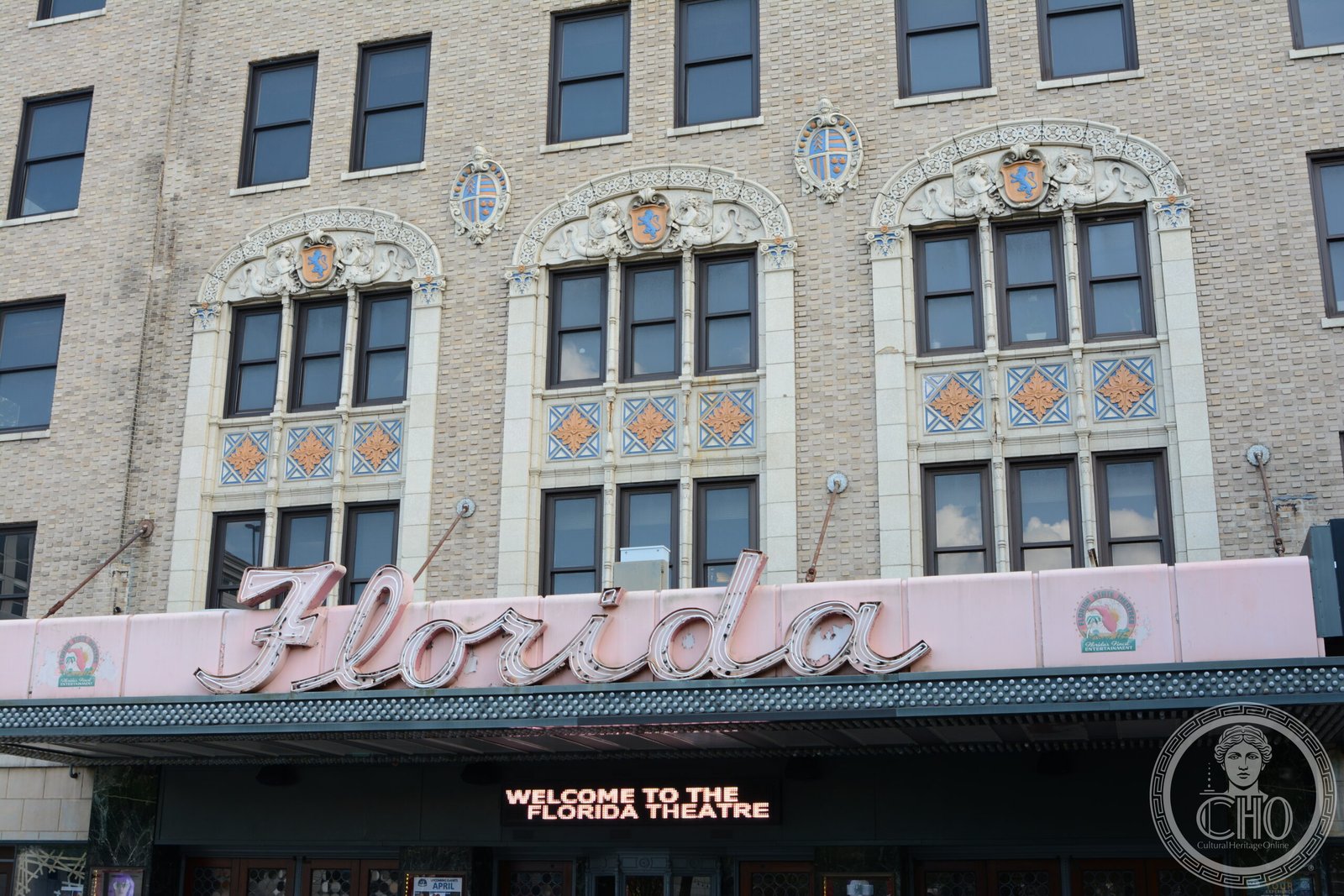
Built in 1927 as a Paramount-Publix atmospheric picture palace at 128 E Forsyth Street, the Florida Theatre is Jacksonville’s most ornate surviving entertainment building — a Mediterranean Revival interior of painted sky, stucco towers and wrought-iron balconies that has hosted Elvis Presley, the Beatles, and nearly a century of Florida’s cultural life.
At a glance
The Florida Theatre at 128 E Forsyth Street, Jacksonville, opened in 1927 as part of the Paramount-Publix circuit’s expansion into the Southeast. Built in the “atmospheric” style then sweeping American movie palace construction, the Florida Theatre gave Jacksonville audiences an interior designed to suggest an outdoor Mediterranean evening: a painted sky ceiling above a simulated village of stucco towers, wrought-iron balconies, and arched niches, creating an environment of fantasy and escape that distinguished the atmospheric palace from the conventional hall. Listed on the National Register of Historic Places since 1982, the building has operated for nearly a century of continuous performance, and its current incarnation as the Florida Theatre Performing Arts Center makes it one of the Southeast’s most active heritage performing arts venues.
Key facts
- Opened: 1927 (Paramount-Publix circuit)
- Style: Mediterranean Revival / Atmospheric Theatre — simulated night sky, stucco village walls, wrought-iron balconies
- Capacity: approximately 1,970 seats
- Address: 128 E Forsyth Street, Jacksonville, FL 32202
- GPS: 30.3240°N, 81.6564°W
- Status: National Register of Historic Places (1982); active performing arts venue
History
Jacksonville in the 1920s was Florida’s largest and most commercially important city, a railroad hub and port at the mouth of the St. Johns River whose population and economy were growing rapidly in the state’s first great boom decade. The Paramount-Publix circuit, one of the major movie palace operators of the period, identified the city as a prime market for a large-format first-run picture palace and commissioned the Florida Theatre as a flagship for the regional circuit. The atmospheric style, popularized by theatre designer John Eberson in the early 1920s, was at the height of its commercial popularity when the Florida Theatre was built: the illusion of sitting outdoors in a Mediterranean courtyard, watching stars twinkle above simulated towers and balconies, was the most technically ambitious and emotionally transporting experience that American entertainment architecture had yet achieved.
The Florida Theatre opened in 1927 to audiences who experienced for the first time a Jacksonville entertainment venue of national-circuit caliber. Through the silent film era and the transition to sound, the theatre remained one of the most prominent first-run houses in the Southeast. The building’s cultural history extends beyond cinema: in 1956, Elvis Presley performed concerts at the Florida Theatre that were filmed for television broadcast, with city authorities famously ordering that he perform without gyrating — the camera was instructed to film only from the waist up. The Beatles performed at the Florida Theatre in September 1964, during their first American tour.
The theatre transitioned from cinema exhibition to live performance in the mid-twentieth century, and the Performing Arts Center organization that now operates it has sustained its role as Jacksonville’s premier heritage entertainment venue through to the present. Restoration and renovation work has maintained the atmospheric interior in a condition that preserves the character of the 1927 design, with the simulated sky and Mediterranean ornament as the defining features of the auditorium.
What you see
The Forsyth Street facade is a compressed formal composition in stucco and terra cotta, with the entrance canopy and vertical marquee sign projecting over the sidewalk. The facade’s modesty — two stories of decorative stonework between the entrance and the streetline above — follows the pattern of most atmospheric theatres: the building’s theatrical ambition is deployed inside, not outside. A lobby of tile and ornamental plaster transitions visitors from the street to the auditorium vestibule, where the Mediterranean village effect begins.
The auditorium itself is the building’s reason for existing: a large room whose ceiling is a painted sky in deep Mediterranean blue, set with electric stars and cloud effects, rising over two levels of seating. The side walls carry tiered stucco constructions that simulate the facades of a Mediterranean hill village — windows and balconies of wrought iron in the Spanish Colonial style, with decorative panels of Baroque plasterwork between the openings. The proscenium arch is a full Baroque composition in painted plaster, and the box seats are set into niches of arched plasterwork on the lower walls. The accumulated visual effect — the simulated outdoor setting, the painted sky, the ornamental richness of the side walls — remains what it was designed to be: an immersive environment that removes the audience from the ordinary world for the duration of the performance.
Practical information
- Access: 128 E Forsyth Street, Jacksonville FL 32202; tickets via Florida Theatre box office and online
- Programming: concerts, Broadway touring productions, film series, comedy, and community events; see the Florida Theatre website for the current schedule
- Transit: Jacksonville Skyway Monorail — Convention Center station two blocks south; JTA bus service on Laura Street
- Parking: St. Johns Town Center garage and city surface lots within two blocks; evening parking widely available downtown
- Time needed: 2–3 hours for an evening performance; 15 minutes for exterior
Getting there
The Florida Theatre is in downtown Jacksonville at 128 E Forsyth Street, between Laura and Hogan Streets. Jacksonville International Airport (JAX) is approximately 15 miles north — 25 minutes by car via I-95 south and the downtown interchange, or approximately 40–50 minutes by JTA bus. Amtrak serves Jacksonville station (2301 Clifford Lane, 3 miles north of downtown); taxi or rideshare to the theatre is approximately 15 minutes. I-95 crosses downtown Jacksonville north-south; I-10 begins at I-95 and runs west toward Tallahassee. The Times-Union Center for the Performing Arts is two blocks south at 300 W Water Street. The Cummer Museum of Art is 2 miles south along the St. Johns River.
Nearby
- Museum of Contemporary Art Jacksonville (MOCA) — at 333 N Laura Street, three blocks north — the contemporary art museum in a converted 1931 Art Deco Western Union Building, free admission on Thursdays.
- Cummer Museum of Art and Gardens — 829 Riverside Avenue, two miles south along the St. Johns River — the principal encyclopedic art museum of northeast Florida, with riverside gardens.
- Friendship Fountain and Friendship Park — the St. Johns Riverwalk waterfront, five blocks south via Main Street — the focal point of the downtown riverside with views of the Acosta and Main Street Bridges.
- Times-Union Center for the Performing Arts — the multiplex performing arts center two blocks south at 300 W Water Street, with the Moran Theater (2,700 seats) and Jacoby Symphony Hall.
Sources
- National Register of Historic Places nomination, Florida Theatre, Jacksonville (1982)
- Florida Theatre Performing Arts Center — official site, history section
- Jacksonville Historical Society — Florida Theatre archive documentation
- Florida Times-Union archives — 1927 opening coverage; Elvis 1956 and Beatles 1964 reviews
- Ben M. Hall, The Best Remaining Seats — atmospheric theatre design and the Paramount-Publix circuit
Find it on the map
See this place and what’s around it →📷 Become a Cultural Heritage Online photographer
Share your photos of places: they stay published under your name as the author. The more they're seen, the more you get noticed — and soon a contest will reward the most appreciated photos.
Log in or sign up free to add a photoIs this page about you?
This page is read by travellers and heritage enthusiasts who find it on Google. Tell us how you are connected to this place and we will take it from there.