
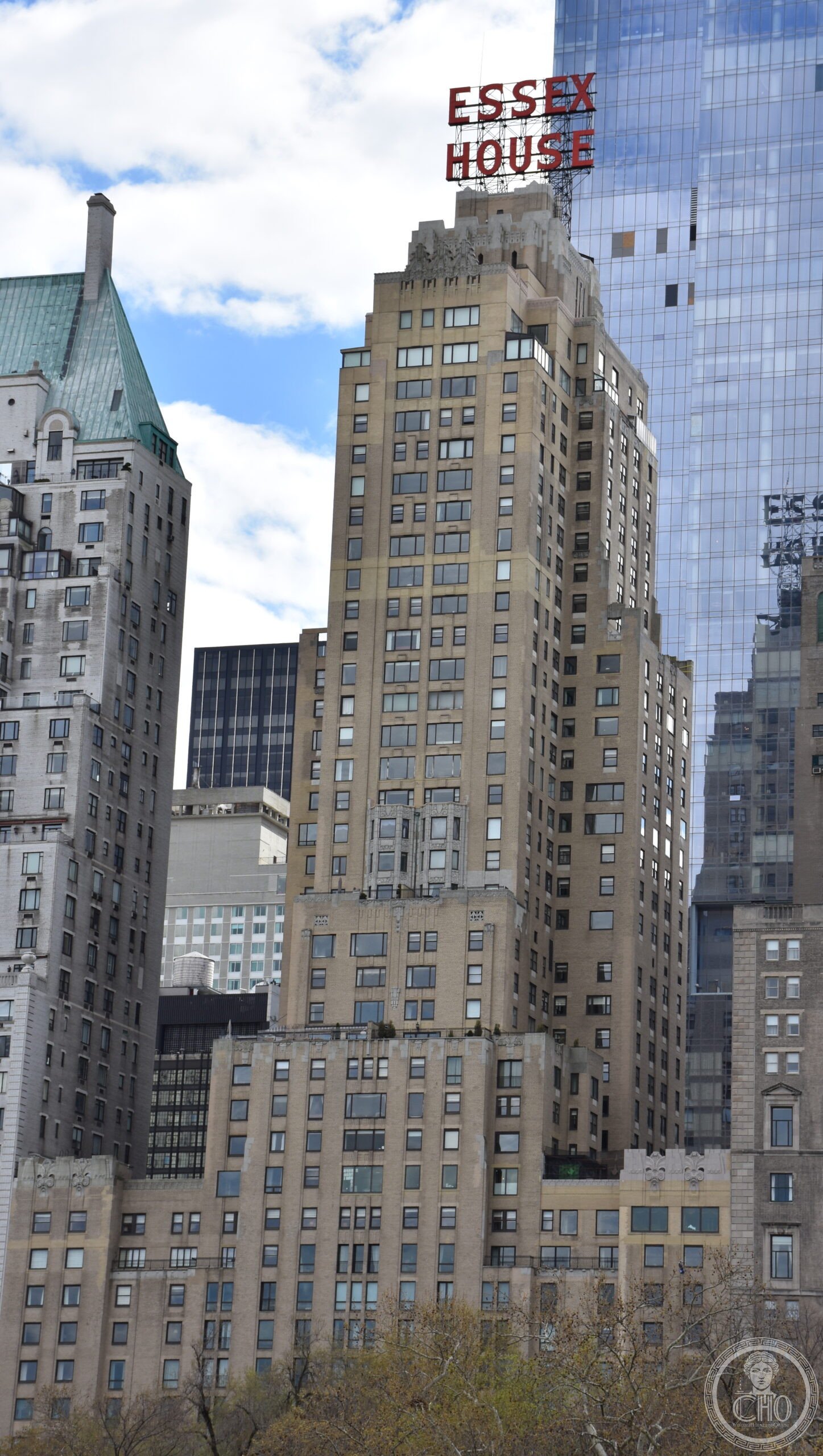
The red neon “Essex House” sign has faced Central Park since 1931, a vertical declaration in capitals that anchors the southern skyline of the park on a stepped Art Deco tower designed by Schultz & Weaver.
At a glance
Opened in 1931 at 160 Central Park South, the Essex House rises thirty-three stories above the southwestern corner of Central Park in a composition that steps back twice as it gains height, gathering the stone cornice lines into the kind of disciplined verticality that distinguishes New York Art Deco from its more ornamented European contemporaries. The architects Schultz & Weaver — responsible in the same years for the Waldorf Astoria and several other large Manhattan commissions — deployed a facade of cream and gray stone offset by the hotel’s signature steel lettering and neon sign, which has remained lit across the park for nearly a century. Now operated as the JW Marriott Essex House, the building retains its original massing and exterior character while its interiors have been renovated across successive ownerships.
Key facts
- Opened: 1931
- Address: 160 Central Park South, Midtown Manhattan, New York City
- Architects: Schultz & Weaver
- Height: 33 stories
- Style: Art Deco — stepped massing, stone cladding, neon crown signage
- Current use: JW Marriott Essex House hotel
- Designation: New York City Landmarks Preservation Commission
History
The Essex House opened in September 1931, thirteen months after its steel frame rose from the footprint of an earlier residential structure on the south side of Central Park. Its debut came at the height of the economic depression that was already beginning to strain the hotel industry, yet the building had been designed during the boom years of the late 1920s and the developer pushed through to completion. The name derived from Essex County, an aspirational European reference common in New York hotel naming of the period, and the stepped tower’s profile joined those of the Navarro Apartments, the New York Athletic Club, and Hampshire House on the same block to create an ensemble that remains one of the most architecturally coherent sequences on any single Manhattan street.
Through the mid-century the hotel attracted a standard clientele of corporate guests, entertainers, and visiting dignitaries drawn by the Central Park address. Changes of ownership in the 1960s, 1970s, and 1980s brought successive renovations and rebranding; the property operated as the Westin Essex House for a period before its acquisition by the Jumeirah Group and eventual conversion to the JW Marriott brand. Despite interior transformations, the exterior’s stepped crown and the illuminated sign — visible from well within Central Park on clear nights — have remained a constant reference point on the southern edge of the park.
Schultz & Weaver, who completed the Waldorf Astoria in the same season, were among the most prolific designers of large-scale hospitality architecture in New York during the 1920s and early 1930s. Their approach to the Essex House was more restrained than the Waldorf’s elaborate interiors, emphasizing the clean geometry of the stepped profile over surface ornament, a characteristic move in late Art Deco where massing becomes the primary decorative act.
What you see
From Central Park, the Essex House reads as a cream-and-gray vertical progression punctuated at street level by a canopy and at the crown by the red neon sign that has spelled out the hotel’s name in large capitals since the building opened. The setbacks occur at the ninth and nineteenth floors, each reducing the floor plate as the tower rises in a convention borrowed from New York’s 1916 zoning resolution, here used not just to comply with light requirements but to give the building its characteristic silhouette against the Park South skyline. Stone pilasters between windows emphasize the vertical at every floor, pulling the eye upward in the manner typical of Schultz & Weaver’s commercial work.
At street level the entrance sequence uses a restrained Deco vocabulary: stylized bronze metalwork, terrazzo in geometric patterns, and the kind of low-relief geometric carving on the door surrounds that signals wealth without excess ornament. The main lobby, though updated across successive renovations, retains something of its original proportions — a double-height reception space that mediates between the street and the tower above. From upper floors facing north, views extend across Central Park toward the Upper West Side twin-tower residential line along Central Park West, giving guests a direct line of sight to the 1930s Art Deco ensemble — San Remo, Majestic, Eldorado — that forms the park’s western urban frame.
Practical information
- Access: Hotel lobby open to guests; restaurants and bar accessible to the public during operating hours
- Rooms: 511 guest rooms and suites, ranging from Central Park-view rooms to larger suites on upper floors
- Dining: Lobby bar and restaurant on premises; the hotel is within walking distance of Midtown dining
- Best view: The illuminated Essex House sign is best photographed from inside Central Park, from the paths near the Pond (southeast corner), in late afternoon or at dusk
- Time needed: 30 minutes to photograph the exterior and enter the lobby; allow more time to explore the Central Park South streetscape
Getting there
The Essex House is at 160 Central Park South, between Sixth and Seventh Avenues in Midtown Manhattan. The nearest subway stations are Columbus Circle (A/B/C/D/1 trains, about four minutes’ walk west) and 57th Street–7th Avenue (N/Q/R/W trains, about five minutes south). Carnegie Hall is two blocks south at Seventh Avenue and 57th Street. From Penn Station (Amtrak, NJ Transit, LIRR), the hotel is approximately fifteen minutes by taxi or a twenty-five-minute walk north through Midtown. JFK Airport is accessible by AirTrain to Jamaica and E train to Lexington/53rd, then walking north — approximately seventy minutes total from Terminal 4.
Nearby
- Carnegie Hall — the landmark concert venue two blocks south at 881 Seventh Avenue (57th & 7th), open for concerts year-round and for daytime tours
- The Museum of Arts and Design — at Columbus Circle (2 Columbus Circle), about four minutes’ walk west; the building itself dates from 1964 and was significantly redesigned in 2008
- Hampshire House (1937) — the late Art Deco residential tower immediately adjacent at 150 Central Park South, completed six years after the Essex House by the same developer and forming part of the Central Park South historic ensemble
- Central Park Conservatory Pond and Strawberry Fields — both accessible from the 72nd Street entrance to Central Park, about twelve minutes’ walk north along the park perimeter
Sources
- New York City Landmarks Preservation Commission designation report, Central Park South Historic District
- White, Norval, and Elliot Willensky. AIA Guide to New York City, 5th ed. Oxford University Press, 2010.
- New York City Department of Buildings records, 160 Central Park South
- Schultz & Weaver firm archive citations in hotel industry publications, 1929–1932
Find it on the map
See this place and what’s around it →📷 Become a Cultural Heritage Online photographer
Share your photos of places: they stay published under your name as the author. The more they're seen, the more you get noticed — and soon a contest will reward the most appreciated photos.
Log in or sign up free to add a photoIs this page about you?
This page is read by travellers and heritage enthusiasts who find it on Google. Tell us how you are connected to this place and we will take it from there.