
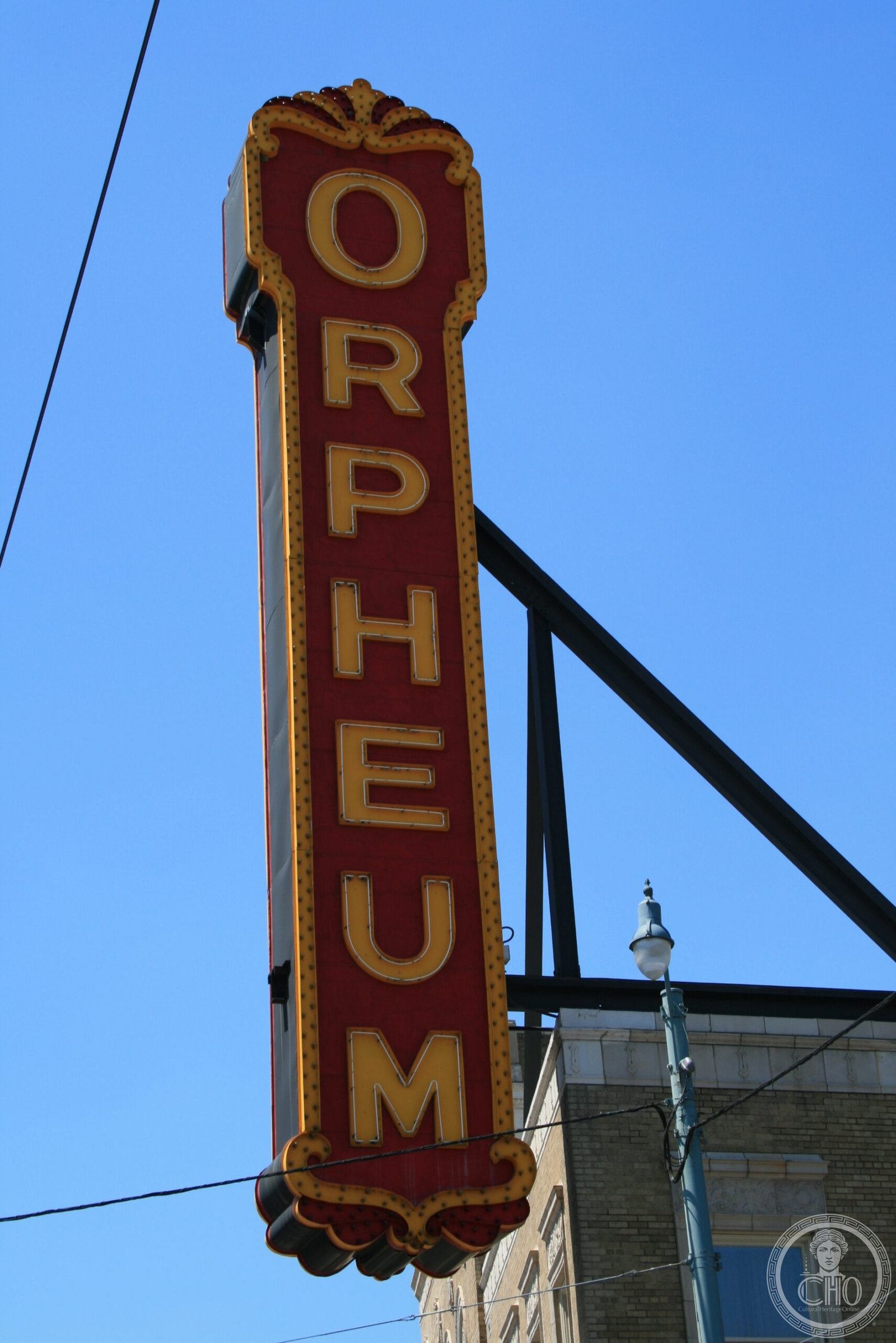
Memphis’s grandest surviving movie palace opened in 1928 on South Main Street, replacing an earlier Orpheum destroyed by fire, and has functioned—through colourful ownership changes, near-demolition, and a ghost that refuses to leave—as a mirror of the city’s cultural history for nearly a century.
At a glance
The Orpheum Theatre at 203 South Main Street opened in November 1928 as the flagship of the Orpheum circuit in the Mid-South. Designed in the Spanish Baroque style with Atmospheric influences, the building seats approximately 2,800 across its orchestra floor, mezzanine, and balcony. The auditorium—with its painted sky ceiling, ornate plasterwork side walls, and a massive French crystal chandelier suspended above the stalls—was conceived as an escape from the humid Memphis summer into the cool fantasy of a Mediterranean palace. After closing as a cinema in 1977 and narrowly escaping demolition, the Orpheum was restored and reopened as a performing arts venue, and was listed on the National Register of Historic Places in recognition of its architectural and cultural significance.
Key facts
- Address: 203 South Main Street, Memphis, TN 38103
- Opened: November 1928 (current building; original Orpheum 1890)
- Style: Spanish Baroque / Atmospheric Movie Palace
- Original capacity: approximately 2,800 seats
- Chandelier: French crystal chandelier, 1,600 pounds, centerpiece of the auditorium
- Heritage listing: National Register of Historic Places
- Current use: Broadway touring productions and concerts, operated by the Orpheum Theatre Group
History
The first Orpheum Theatre in Memphis opened in 1890, one node in the emerging Orpheum circuit of vaudeville houses that stretched from coast to coast. By the early twentieth century the circuit was among the most powerful entertainment networks in the country. The original 1890 building burned in 1923, prompting the circuit to commission an entirely new house on the same downtown site. The replacement opened in November 1928 at a cost of approximately $1.6 million, its Spanish Baroque ornament and atmospheric sky ceiling representing the apogee of American movie-palace design.
The theatre thrived through the Depression—Memphis was a regional centre for Delta commerce and culture—and became the preferred venue for performances by touring artists who could not be seen in the city’s segregated smaller clubs. In the post-war era, declining downtown attendance and the multiplex revolution gradually reduced the Orpheum’s viability as a cinema. Malco Theatres closed it in 1977. Civic leaders formed the Memphis Development Foundation to prevent demolition, raising funds to restore the building over several years; it reopened as a performing arts venue in 1984.
Since restoration, the Orpheum has anchored the South Main Arts District—a neighbourhood that now houses galleries, studios, and live music venues near Beale Street. The theatre hosts Memphis’s Broadway touring season and serves as a summer film series venue. It was listed on the National Register of Historic Places in recognition of its role in the cultural history of the American South.
What you see
The exterior presents a two-storey terracotta facade with a horizontal marquee that has been updated repeatedly over the decades but retains its original massing. The entrance lobby is dressed in marble and painted plaster in warm Mediterranean tones, with ornate door surrounds and coved ceilings that build expectation for the auditorium beyond.
The auditorium’s sky ceiling—blue-painted plaster with artificial stars and subtle cloud effects—creates the Atmospheric illusion of sitting outdoors under a warm night sky. Along the side walls, illuminated arched niches house painted garden scenes between ornamental pilasters. The central chandelier—a French crystal fixture weighing approximately 1,600 pounds and measuring some eight feet in diameter—is the focal point of the room when the house lights are raised. It descends for cleaning twice annually, an event that has become a local tradition. The brass and velvet seating, the painted proscenium arch, and the preserved pipe organ complete the impression of a theatre built at the exact moment when Hollywood’s ambitions and the movie palace formula reached their shared peak.
Practical information
- Season: Year-round; Broadway series runs autumn through spring; Summer Film Series June–August
- Tours: Group tours available by arrangement with the Orpheum Theatre Group
- Ghost: The theatre’s resident ghost “Mary” — reportedly a young girl who died near the theatre in the 1920s — is a well-established Memphis urban legend; staff regularly report phenomena in the mezzanine and balcony areas
- Access: Fully accessible; designated seating available
Getting there
The Orpheum Theatre is on South Main Street at the intersection with Beale Street, in Memphis’s historic downtown entertainment district. Memphis International Airport (MEM) is approximately 15 minutes by car. The Main Street Trolley, when operating, stops directly outside; the trolley network connects South Main to the Central Station and the Medical District. The Orpheum is within walking distance of the National Civil Rights Museum at the Lorraine Motel and the Stax Museum of American Soul Music, making it part of a walkable circuit of Memphis cultural landmarks.
Nearby
- National Civil Rights Museum at the Lorraine Motel (1991) — The site of Dr. Martin Luther King Jr.’s assassination on April 4, 1968, two blocks south; the museum traces the American civil rights movement from slavery to the present.
- Beale Street Historic District — The birthplace of the Memphis blues, one block north, with live music clubs, barbecue restaurants, and the W.C. Handy Park operating nightly.
- Stax Museum of American Soul Music (2003) — Built on the site of the original Stax recording studio where Otis Redding, Booker T. & the MGs, and Isaac Hayes recorded, three miles east.
- Peabody Hotel (1925) — Memphis’s grandest hotel, four blocks north, home of the daily Peabody Duck March in which five live mallards promenade to the lobby fountain at 11:00 a.m.
Sources
- National Register of Historic Places nomination, Orpheum Theatre, Memphis, Tennessee
- Orpheum Theatre Group, institutional history documentation
- Naylor, David. American Picture Palaces: The Architecture of Fantasy. Van Nostrand Reinhold, 1981
- Bonds, John B. Beale Street and the Blues. Memphis Heritage, 2002
- Tennessee Historical Commission records
Find it on the map
See this place and what’s around it →Record researched and written by Luigi De Marchi for Cultural Heritage Online, 2026.
📷 Become a Cultural Heritage Online photographer
Share your photos of places: they stay published under your name as the author. The more they're seen, the more you get noticed — and soon a contest will reward the most appreciated photos.
Log in or sign up free to add a photoIs this page about you?
This page is read by travellers and heritage enthusiasts who find it on Google. Tell us how you are connected to this place and we will take it from there.