
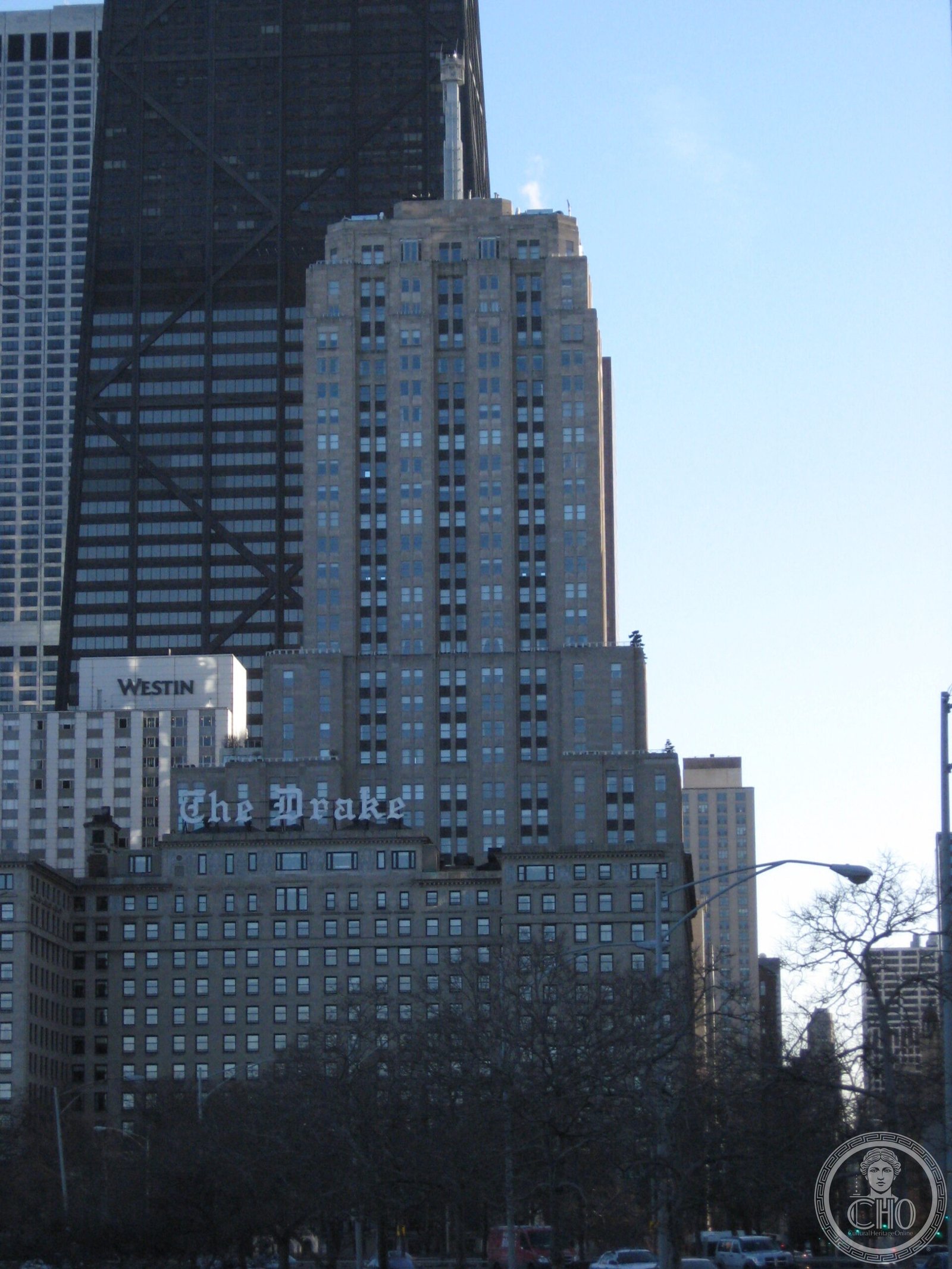
The Palmolive Building is a 37-storey Art Déco tower at 919 North Michigan Avenue in Chicago, Illinois, completed in 1929 to designs by Holabird & Root. Originally erected as the headquarters of the Colgate-Palmolive-Peet Company, the building represents a landmark moment in the development of the Magnificent Mile as Chicago’s premier commercial corridor. Its slender limestone silhouette, bold setbacks, and rooftop Lindbergh Beacon — added in 1930 to guide aircraft to Midway Airport — made it instantly iconic on the city skyline. A Chicago Landmark since 2000 and listed on the National Register of Historic Places since 2003, the building was converted to luxury residential use in 2001 and remains one of the most distinguished addresses on North Michigan Avenue.
At a glance
- Type
- Art Déco office tower, converted to residential
- Period
- 1929
- Style
- Art Déco
- Location
- 919 N Michigan Avenue, Chicago, IL 60611, USA
- Coordinates
- 41.8998° N, 87.6239° W
- Architect(s)
- Holabird & Root
Overview
When the Palmolive Building rose on North Michigan Avenue in 1929, it helped transform what had been a modest residential street into one of the world’s great retail and commercial boulevards. Holabird & Root, the preeminent Chicago modernist firm of the era, produced a design of refined verticality — its setback massing climbing toward a tapered crown distinguished by clean limestone surfaces and subtle Art Déco ornament. The building’s position near the northern end of the Magnificent Mile, just south of the Chicago River, ensured its prominence in the evolving skyline. For decades it served leading corporate tenants before Playboy Enterprises made it their editorial home from 1965 to 1989, adding a period of cultural notoriety to its commercial history.
History
Construction of the Palmolive Building was completed in 1929 as the corporate flagship for the Colgate-Palmolive-Peet Company. In 1930 a rotating aviation beacon was installed atop the tower, intended to help aircraft navigate safely to Midway Airport — the beacon became a beloved Chicago landmark in its own right before ceasing operation in 1981 following complaints from residents. Between 1965 and 1989, Playboy Enterprises leased the building, renaming it the Playboy Building and spelling out the brand name in nine-foot illuminated rooftop letters; editorial operations remained until 1989. In 2001, developers Draper and Kramer undertook a conversion of the upper floors to luxury condominiums, restoring the building’s original name. Designated a Chicago Landmark in 2000 and added to the National Register of Historic Places in 2003.
Architecture & Design
Holabird & Root designed the Palmolive Building as an exercise in disciplined Art Déco verticality, a counterpoint to the more flamboyant ornamental towers of New York. The facade is clad in Indiana limestone, with setbacks at the upper stories creating a tapering profile that emphasises height without resorting to excessive decoration. Spandrels and piers are articulated with restrained geometric carving, while the crown terminates in a clean geometric form. The building’s massing follows the step-back principles that Chicago architects pioneered, and it demonstrates the firm’s mastery of proportion and surface modulation. Interior public spaces feature the polished stone and metalwork typical of high-quality Art Déco commercial construction of the late 1920s.
Cultural significance
The Palmolive Building occupies a pivotal place in the architectural and cultural history of Chicago. As an early anchor of the Magnificent Mile, it helped establish the design standard for the avenue’s subsequent development. Its Lindbergh Beacon linked the building to the heroic age of American aviation, and its later association with Playboy Enterprises gave it a second, very different cultural identity during the mid-twentieth century. Today it is recognised as a Chicago Landmark and a National Register property, acknowledged for its architectural quality and its role in shaping the commercial character of one of America’s most celebrated urban corridors. The building continues to be regarded as among Holabird & Root’s finest works.
Visiting today
The Palmolive Building is now a private luxury residential building and is not open to the public for tours. Its ground-floor retail and office spaces on lower floors are accessible during business hours. The exterior is fully visible from North Michigan Avenue and from the adjacent sidewalks, making it an excellent subject for architectural photography. The building is best appreciated as part of a self-guided walk along the Magnificent Mile, which passes numerous other significant twentieth-century buildings. Chicago Architecture Center offers guided tours of the area that include the Palmolive Building.
Getting there
The Palmolive Building stands at 919 North Michigan Avenue, in the Streeterville neighbourhood of Chicago. The nearest CTA Red Line station is Chicago (800 N), approximately three blocks south. Multiple CTA bus routes serve Michigan Avenue, including Routes 3, 143, 145, 146, 147, and 151. The building is an easy walk from the Magnificent Mile shopping district and from the Museum of Contemporary Art. O’Hare International Airport (ORD) is roughly 17 miles northwest via the CTA Blue Line, and Midway Airport (MDW) is approximately 13 miles southwest.
Sources & resources
Find it on the map
See this place and what’s around it →Record researched and written by Luigi De Marchi for Cultural Heritage Online, 2026.
📷 Become a Cultural Heritage Online photographer
Share your photos of places: they stay published under your name as the author. The more they're seen, the more you get noticed — and soon a contest will reward the most appreciated photos.
Log in or sign up free to add a photoIs this page about you?
This page is read by travellers and heritage enthusiasts who find it on Google. Tell us how you are connected to this place and we will take it from there.