
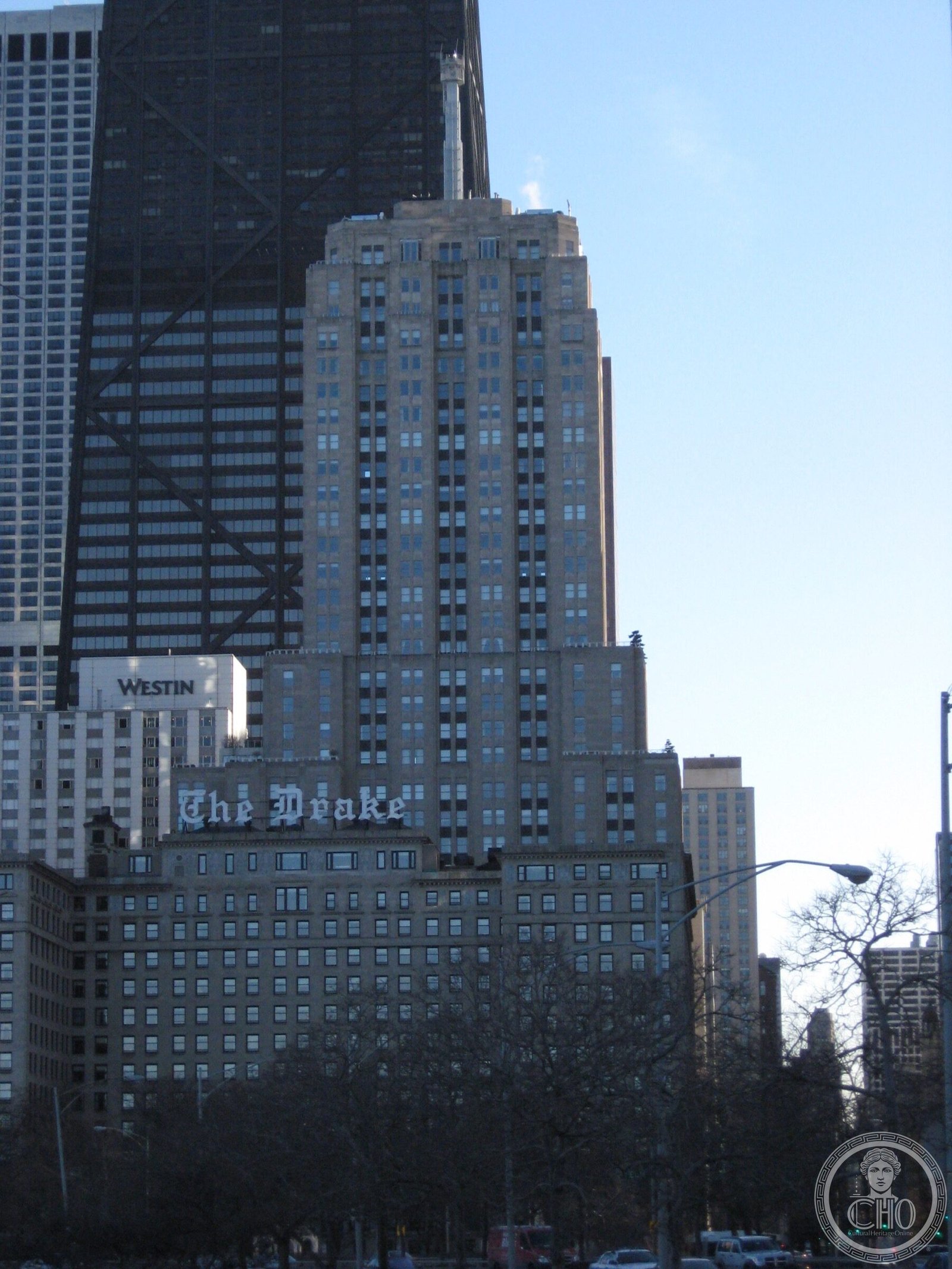
Anchoring the north end of the Magnificent Mile since 1929, the Palmolive Building once carried a rotating searchlight at its crown that pilots used to navigate by — a lighthouse for aviators over the flat midwestern dark.
At a glance
The Palmolive Building at 919 North Michigan Avenue was completed in 1929 as the Chicago headquarters of Colgate-Palmolive-Peet Company, one of the principal consumer goods corporations of the interwar era. Designed by Holabird & Root, the 37-story tower is one of the finest examples of Art Deco commercial architecture on the Magnificent Mile — Chicago’s premier shopping and commercial boulevard along North Michigan Avenue. The building is perhaps best known for the Lindbergh Beacon, a powerful rotating searchlight installed at its summit that served as a navigation aid for aviators flying over the Chicago region. The building is listed on the National Register of Historic Places.
Key facts
- Address: 919 North Michigan Avenue, Gold Coast, Chicago, Illinois.
- Completed: 1929.
- Architects: Holabird & Root.
- Style: Art Deco.
- Floors: 37 stories.
- Historic designation: National Register of Historic Places; Chicago Landmark.
History
The Palmolive Building was commissioned to give Colgate-Palmolive-Peet a prestige Chicago address appropriate to a major national corporation. By the late 1920s, North Michigan Avenue was being developed as the city’s new commercial spine north of the Chicago River, and the Palmolive site at the corner of Walton Place offered a prominent position on the boulevard. Holabird & Root, fresh from the acclaim they had received for their work on the Chicago Board of Trade Building and other major commissions, gave the building an Art Deco profile that draws the eye upward from a richly ornamented base to a setback tower and a distinctive crown.
The Lindbergh Beacon was installed at the building’s summit and named in honor of Charles Lindbergh, whose solo trans-Atlantic flight of 1927 had made him the most celebrated aviator in the world. The beacon projected a powerful beam of light that rotated continuously, making the Palmolive Building a navigation landmark for pilots flying over the flat Chicago hinterland at night. The beacon became part of the building’s identity for decades, though it was eventually turned off as air traffic procedures changed. For a generation of Chicagoans, the sweep of the Lindbergh Beacon across the nighttime sky was a feature of the city as recognizable as the Loop.
In later decades the building became associated with Hugh Hefner and Playboy Enterprises, which occupied offices there and gave it an informal second name, the Playboy Building. It has since been converted to luxury residential use. The original Art Deco fabric of the building, including the ornamental metalwork and carved stonework of the facade, is substantially preserved.
What you see
The Palmolive Building presents a classic Art Deco setback profile on North Michigan Avenue: a broad base with a richly detailed entry treatment, followed by successive setbacks as the tower rises, culminating in a narrow upper section that gives the building its characteristic silhouette. The ornamental program on the lower floors includes carved geometric and foliate motifs in the Art Deco vocabulary of the 1920s — stylized foliage, geometric bands, and chevron details that tie the building to its contemporaries on the Magnificent Mile and in the broader landscape of late-1920s American commercial architecture.
The building is most impressive from a distance, where its proportions and setbacks read clearly against the sky. From Michigan Avenue, the view northward takes in the building’s full height, with the crown where the Lindbergh Beacon once rotated still present as a distinctive architectural termination. The street-level experience of the entrance treatment and lower facade ornament rewards close attention: the metalwork of the doors, the carved limestone bands above the ground floor, and the progression of horizontal accents that structure the base of the tower are all characteristic examples of the Chicago Art Deco idiom.
Practical information
- Status: Private residential building; exterior freely visible from Michigan Avenue.
- Best view: From North Michigan Avenue looking north, or from Walton Place looking toward the building’s base; the full tower reads best from a block or two south on Michigan Avenue.
- Historic designation: National Register of Historic Places; Chicago Landmark.
Getting there
The Palmolive Building is at 919 North Michigan Avenue in Chicago’s Gold Coast neighborhood, on the Magnificent Mile just north of the Chicago Water Tower. The nearest CTA Red Line station is Chicago (North/Clybourn), approximately four blocks west on Chicago Avenue. From Millennium Park, the walk north along Michigan Avenue takes about 20 minutes and passes the Chicago Cultural Center, Tribune Tower, and the Water Tower along the way. The building is at the convergence of Chicago’s most prominent north-south commercial boulevard with the transition from the Loop to the Gold Coast residential district.
Nearby
- Chicago Water Tower (1869) — the Gothic Revival limestone water tower on Michigan Avenue, one of the few buildings to survive the Great Chicago Fire of 1871, a block south of the Palmolive Building.
- Tribune Tower (1925) — the Gothic skyscraper at 435 North Michigan Avenue, competitive entry of the 1922 Tribune Tower design competition, about six blocks south.
- Fourth Presbyterian Church of Chicago (1914) — the Gothic Revival church at 126 East Chestnut Street, half a block west, whose courtyard is one of the city’s most serene public spaces.
- Newberry Library (1893) — one of the premier independent humanities research libraries in North America, at 60 West Walton Street, two blocks west.
Sources
- Wikipedia: Palmolive Building.
- National Register of Historic Places nomination documentation.
- Chicago Architecture Center building records.
- Bruegmann, Robert, The Architects and the City (University of Chicago Press, 1997).
Find it on the map
See this place and what’s around it →Record researched and written by Luigi De Marchi for Cultural Heritage Online, 2026.
📷 Become a Cultural Heritage Online photographer
Share your photos of places: they stay published under your name as the author. The more they're seen, the more you get noticed — and soon a contest will reward the most appreciated photos.
Log in or sign up free to add a photoIs this page about you?
This page is read by travellers and heritage enthusiasts who find it on Google. Tell us how you are connected to this place and we will take it from there.