
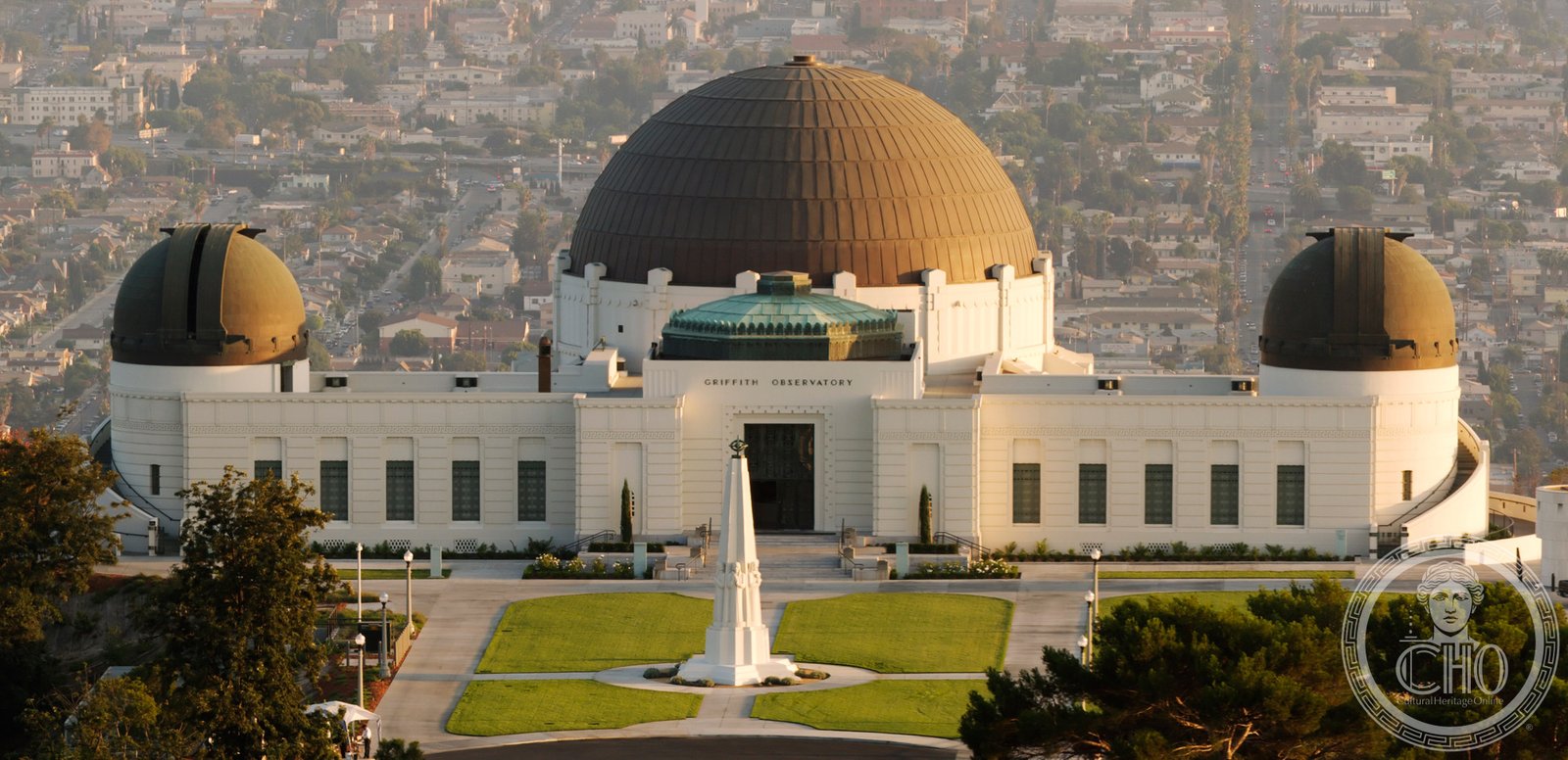
James Dean stood on this terrace before the knife fight in Rebel Without a Cause, and a million Los Angeles evenings have ended watching the city lights spread below the copper domes of the Griffith Observatory — the gift of a Welsh immigrant who wanted every Angeleno to look at the stars for free.
At a glance
The Griffith Observatory was completed in 1935 on the south slope of Mount Hollywood in Griffith Park, overlooking the Los Angeles Basin from an elevation of approximately 1,100 feet. Designed by architects John C. Austin and Frederick M. Ashley, it is one of the most visited public observatories in the world, offering free access to planetarium shows, astronomical exhibits, and public telescope viewings. The building was constructed with funds from the bequest of Colonel Griffith J. Griffith, a Welsh-born landowner who donated Griffith Park to the city of Los Angeles and left the greater part of his estate to construct the observatory. The building is a California Historical Landmark and is listed on the National Register of Historic Places.
Key facts
- Address: 2800 East Observatory Road, Griffith Park, Los Angeles, California
- Opened: 1935
- Architects: John C. Austin and Frederick M. Ashley
- Style: Art Deco
- Funded by: Bequest of Griffith J. Griffith
- Current use: Public observatory, planetarium, science museum; free admission to grounds and exhibit halls
- Historic designation: California Historical Landmark; National Register of Historic Places
History
Griffith J. Griffith was a Welsh-born immigrant who had made a fortune in California real estate and mining. In 1896 he donated 3,000 acres of his Rancho Los Feliz — the land that would become Griffith Park — to the city of Los Angeles with the explicit intention that it remain a public park in perpetuity. He later left the majority of his estate for the construction of a public observatory and a Greek theatre in the park, with the stipulation that access to both should be free for the citizens of Los Angeles. He believed, with missionary conviction, that every person who looked through a telescope would have a transformative experience that no religious or political authority could provide. The trust established under his will eventually built both the observatory and the Greek Theatre in the park that bears his name.
John C. Austin and Frederick M. Ashley designed the observatory in a restrained Art Deco style that suited both the scientific purpose and the hilltop setting. The building consists of a central wing flanked by two circular pavilions, each capped with a copper dome: the main dome houses the Zeiss refracting telescope, while the east and west domes enclose auxiliary instruments. The roofline is composed with the same care as a classical temple, the proportions of the three copper domes balanced against the white concrete of the walls and the surrounding parkland. The building was substantially renovated and expanded in the early 2000s, with new underground galleries constructed beneath the hillside; the original 1935 structure was preserved in its entirety.
The observatory is inseparable from the cultural history of Los Angeles. It has appeared in dozens of films and television productions; the most celebrated is Nicholas Ray’s Rebel Without a Cause (1955), in which the Observatory serves as the setting for the climactic confrontation between James Dean’s Jim Stark and the troubled Plato. A bust of James Dean stands outside the East Rotunda in recognition of the building’s place in the film. The building is also one of the principal viewpoints in the city, offering unobstructed panoramas from the San Gabriel Mountains to the Pacific Ocean on clear days.
What you see
The approach to Griffith Observatory from the parking areas below is along a walkway that brings the building into view progressively: first the copper domes against the sky, then the full white facade of the central block with its horizontal banding and Art Deco ornament, then the complete composition of three domes and central hall balanced on the hillside above the city. The south terrace, from which the observatory looks out over the Los Angeles Basin, is one of the most dramatic viewpoints in the city: from here, on a clear day, the full extent of the urban grid is visible from the mountains to the coast, with the Hollywood Hills framing the view to the west.
Inside, the main hall contains the Foucault pendulum, a 240-pound metal sphere that traces an arc across the floor as the Earth rotates beneath it. The pendulum has been swinging in the entrance hall since the observatory opened in 1935. The Zeiss refracting telescope in the east dome remains available for public viewings on clear evenings; the queue can be long, but the opportunity to look through an instrument that has been in continuous public service since 1935 is unlike that offered by most science museums.
Practical information
- Status: Open to the public (Tuesday–Sunday), free admission to grounds and exhibit halls; planetarium shows have a fee
- Hours: Tuesday–Friday noon to 10 PM; Saturday–Sunday 10 AM to 10 PM; closed Mondays
- Parking: Limited parking at the observatory; bus service recommended (DASH Observatory line from Hollywood & Highland)
- Telescope viewing: Free public viewings on clear evenings; check observatory schedule for current hours
Getting there
Griffith Observatory is at 2800 East Observatory Road in Griffith Park, accessible by car via the Vermont Avenue or Crystal Springs Drive entrances to the park. The most efficient public transit option is the DASH Observatory shuttle bus, which runs from the Vermont/Santa Monica Metro Red Line station (B Line) and the Hollywood & Highland station; the shuttle operates Thursday through Sunday. From Hollywood Boulevard, the drive through Griffith Park takes approximately 15 minutes. Walking or cycling up from Los Feliz Boulevard is possible but involves a significant elevation gain. The observatory is not accessible by Metro directly; the DASH shuttle or a car is necessary on most days.
Nearby
- Hollywood Sign — visible from the observatory terrace and from the hiking trails on the north side of Mount Hollywood, the sign is approximately 1.5 miles to the northwest as the crow flies
- Griffith Park (1896) — the 4,300-acre urban park surrounding the observatory, the largest municipal park in the United States with mountain parkland, containing hiking and equestrian trails, the Los Angeles Zoo, and the Greek Theatre
- Los Angeles Zoo (1966) — the Los Angeles Zoo and Botanical Gardens, at the northern end of Griffith Park, housing over 1,100 animals across a 133-acre property
- Ennis House (1924) — Frank Lloyd Wright’s Mayan Revival textile-block house at 2607 Glendower Avenue in the Los Feliz neighborhood below the park, one of the four textile-block houses Wright designed in Los Angeles
Sources
- Wikipedia: Griffith Observatory
- Official Griffith Observatory website, history section
- National Register of Historic Places nomination documentation
- California Office of Historic Preservation records
Find it on the map
See this place and what’s around it →Record researched and written by Luigi De Marchi for Cultural Heritage Online, 2026.
📷 Become a Cultural Heritage Online photographer
Share your photos of places: they stay published under your name as the author. The more they're seen, the more you get noticed — and soon a contest will reward the most appreciated photos.
Log in or sign up free to add a photoIs this page about you?
This page is read by travellers and heritage enthusiasts who find it on Google. Tell us how you are connected to this place and we will take it from there.