

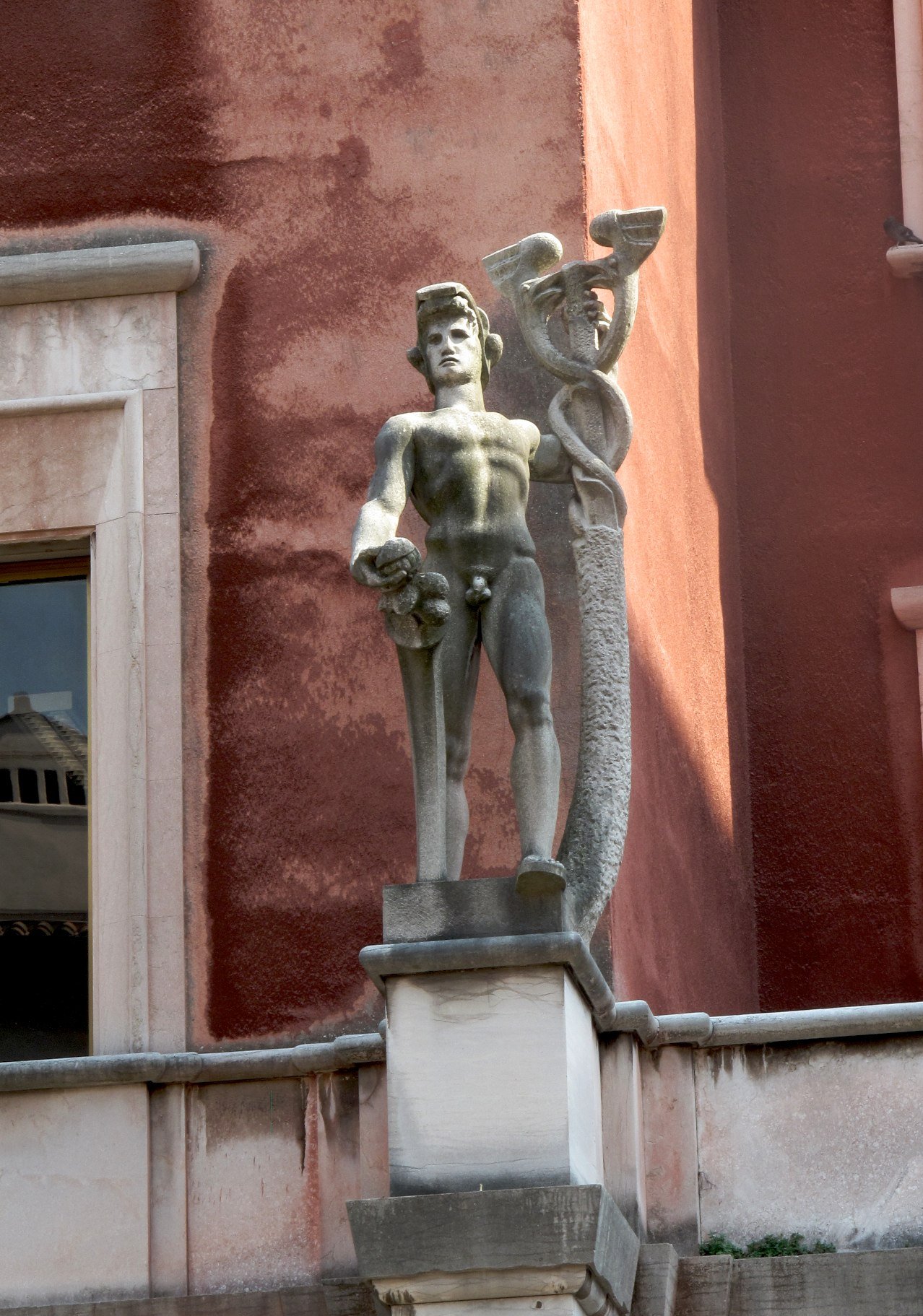
Built between 1932 and 1936 on Contra Garibaldi, the Palazzo delle Poste anchors a quiet corner of Vicenza’s historic centre with the disciplined volumes of Italian Rationalism. Roberto Narducci, an architect-engineer in the Ministry of Communications, signed the project as part of a national programme that placed dozens of new post offices and railway stations across Italy in the 1930s. Narducci worked under the hierarchical supervision of Angiolo Mazzoni until 1944, and the Vicenza building belongs to the same institutional family as Mazzoni’s Trento and Palermo post offices: civic-scale, plainly faced, openly modern.
- Address
- Contra Garibaldi, 36100 Vicenza VI, Italy
- Period
- 1932–1936
- Architects
- Roberto Narducci (1887–1979)
- Client
- Ministero delle Comunicazioni (Ministry of Communications), Kingdom of Italy
- Style
- Italian Rationalism (Razionalismo italiano)
- Function
- Original: central post and telegraph office. Current: Poste Italiane branch office
- Context
- One of roughly ten postal buildings designed by Narducci across Italy in the 1930s
- Status
- Active public post office; part of Vicenza’s twentieth-century architectural heritage in the UNESCO-listed historic centre buffer zone
- Coordinates
- 45.5462° N, 11.5449° E
Visit on the map
Contra Garibaldi, 36100 Vicenza · 45.5462° N, 11.5449° E
Download for your navigator
A single waypoint, ready for GPS apps, navigators, and contacts.
Story
Vicenza is best known for Andrea Palladio’s sixteenth-century palaces and villas, and the city’s UNESCO-listed core was already a protected ensemble when the Fascist government decided, in the late 1920s, to renew the national postal network. Roberto Narducci received the Vicenza commission in 1932 as a ministerial architect: trained in Rome, born there in 1887, he had spent the previous decade designing railway stations across the south and centre of the peninsula, including the Taormina-Giardini stop completed in 1928. The Vicenza brief required a building of clear civic presence that would also coexist with one of Italy’s most studied historic centres. Narducci answered with a compact volume on Contra Garibaldi, a short street that runs north from Piazza Castello toward the Duomo, calibrated to the height of the surrounding palazzi rather than competing with them. Construction proceeded between 1932 and 1936, and the building entered service while the broader programme of postal architecture, supervised from Rome by Angiolo Mazzoni, was still adding stations and offices across northern Italy.
The architectural language is recognisably razionalismo as it was practised inside the ministerial bureaucracy. Wall surfaces are stripped of historicist mouldings; openings are aligned on a strict grid; the entrance is a vertical accent rather than a triumphal portal. Where the Como group around Giuseppe Terragni pursued an abstract, almost manifesto-like rationalism, the ministerial wing in which Narducci and Mazzoni worked tended to soften the doctrine: high-quality stone facing, a measured cornice, and a willingness to absorb the proportions of older Italian palazzi. The Vicenza post office sits inside that softer reading. Its facade is articulated by repeating window bays at upper levels and by a more public, glazed ground floor that opens onto the street. Travertine and istrian-stone surfaces, common in the public buildings of the 1930s, give the building a quiet weight. The result is an office that reads as modern without quarrelling with the brick-and-stone register of the centro storico, a balance Narducci had already explored in earlier postal works and would refine in the Rome Ostiense station of 1940.
The Palazzo delle Poste has remained in continuous use as a Poste Italiane branch since its inauguration, an unusual fate for a building tied to the 1930s state programme. Many of its peers were repurposed, downgraded, or partially abandoned after the war; Vicenza’s office kept its postal function and its public counters, which has preserved both the plan and most of the original finishes. Historians of Italian twentieth-century architecture place Narducci in the second rank of the rationalist movement, below the manifesto figures of Gruppo 7 and the Como masters, but they recognise the ministerial network of stations and post offices as the largest single corpus of state razionalismo built across the peninsula. The Vicenza palace is one of the better-preserved provincial examples and a useful stop for anyone tracing the movement beyond the canonical sites of Como, Rome, and Forli. It is also a reminder that Italian modernism reached the country’s smaller capitals through the postal counter as much as through the polemics of the architectural reviews.
Visitors approach the Palazzo delle Poste through the same dense weave of Renaissance and medieval streets that surrounds the Basilica Palladiana, a few minutes’ walk to the south. The contrast is part of the building’s interest: a stripped 1930s civic block read against the porticoes and stone facades of the centro storico. The structure remains open to the public during normal postal hours, and the ground-floor counters are still accessible from Contra Garibaldi.
Resources & References
Editorial picks across Wikipedia, photo archives, and architectural databases.
Plan your visit
Open to visitors year-round; check local tourism offices for seasonal hours, admission fees, and guided tour availability. GPS coordinates: 45.5462, 11.5449.
Find it on the map
See this place and what’s around it →Record researched and written by Stefano Vigolo for Cultural Heritage Online, 2026.
📷 Become a Cultural Heritage Online photographer
Share your photos of places: they stay published under your name as the author. The more they're seen, the more you get noticed — and soon a contest will reward the most appreciated photos.
Log in or sign up free to add a photoIs this page about you?
This page is read by travellers and heritage enthusiasts who find it on Google. Tell us how you are connected to this place and we will take it from there.