
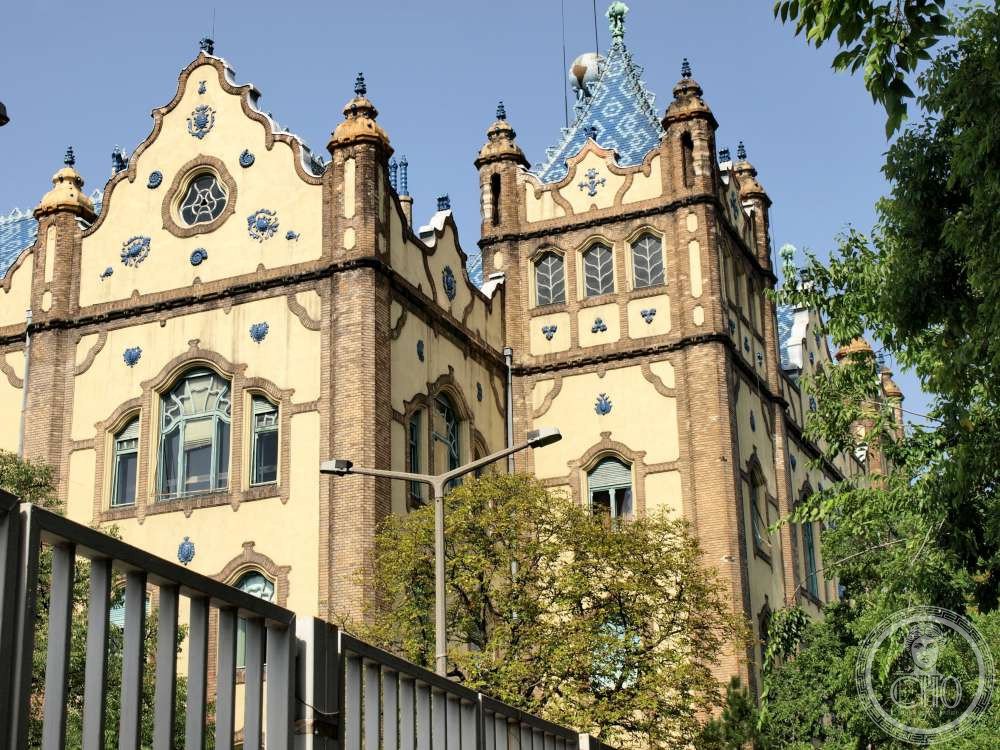
Lechner wanted a national style for a young nation. He found it, of all places, in a building for geologists.
At a glance
The headquarters of the Hungarian Geological Institute stands at Stefánia út 14 in the 14th district of Budapest. It was built in 1898–1899 to designs by Ödön Lechner, the leading figure of the Hungarian Szecesszió, under the building direction of Sándor Hauszmann, and was funded partly by a major private donation from Andor Semsey. A protected monument, it is one of the clearest statements of Lechner’s search for a distinctly Hungarian Art Nouveau, fusing folk-inspired ornament with brilliantly coloured ceramics.
Key facts
- Architect: Ödön Lechner
- Built: 1898–1899 (building direction Sándor Hauszmann)
- Institution founded: 1869, as the Royal Hungarian Geological Institute
- Benefactor: Andor Semsey, with a major donation
- Address: Stefánia út 14, District XIV, Budapest
- Style: Hungarian Secession (Szecesszió)
History
The institute itself dates from 1869, when it was established as the Royal Hungarian Geological Institute; its founding charter was signed by the emperor Franz Joseph I. By the end of the century the growing scientific body needed a headquarters of its own, and the commission went to Ödön Lechner at the height of his powers.
Built in 1898–1899 with Sándor Hauszmann directing the works, the building was made possible in part by the patronage of Andor Semsey, a wealthy supporter of the sciences. Lechner treated the project not as a routine office but as a chance to prove that a modern Hungarian architecture could stand beside the historical styles of the age.
The institute remained Hungary’s oldest scientific research body until it was merged into a successor organisation in 2012; the Lechner building survives as a protected monument and continues to hold geological collections.
What you see
The building is crowned by a steeply pitched roof clad in blue ceramic tiles, a colour that reads from a distance like a piece of sky set down among the trees. At the summit, sculpted figures appear to shoulder a great globe, turning the institute’s subject — the earth itself — into the building’s emblem.
Below, the walls carry the flowing, folk-derived ornament and the glazed ceramic detailing that Lechner made his signature, much of it from the Zsolnay works at Pécs. It is architecture as argument: every surface insists that a national modern style was possible.
Practical information
- The building holds geological collections; public access depends on current opening arrangements.
- The exterior, with its tiled roof, can be admired from Stefánia út at any time.
- It lies near the Puskás Aréna, away from the central tourist core.
- Time needed: 20–30 minutes for the exterior.
Getting there
The institute is on Stefánia út in the 14th district, reached from the Puskás Aréna metro station on line 2 and by tram and bus along Hungária körút.
Nearby
- City Park (Városliget) and its monuments.
- The Museum of Applied Arts, also by Lechner, across the city.
- Heroes’ Square and the Andrássy Avenue museums.
Sources
- Wikipedia (HU), “Magyar Állami Földtani Intézet”.
- Hungarian heritage monument register (műemlék).
- Institutional history of the Geological Institute.
Find it on the map
See this place and what’s around it →📷 Become a Cultural Heritage Online photographer
Share your photos of places: they stay published under your name as the author. The more they're seen, the more you get noticed — and soon a contest will reward the most appreciated photos.
Log in or sign up free to add a photoDo you manage this place?
This page is read by travellers and heritage enthusiasts who find it on Google. Keep it accurate — and make it work for you. Free for non-profit heritage institutions.