
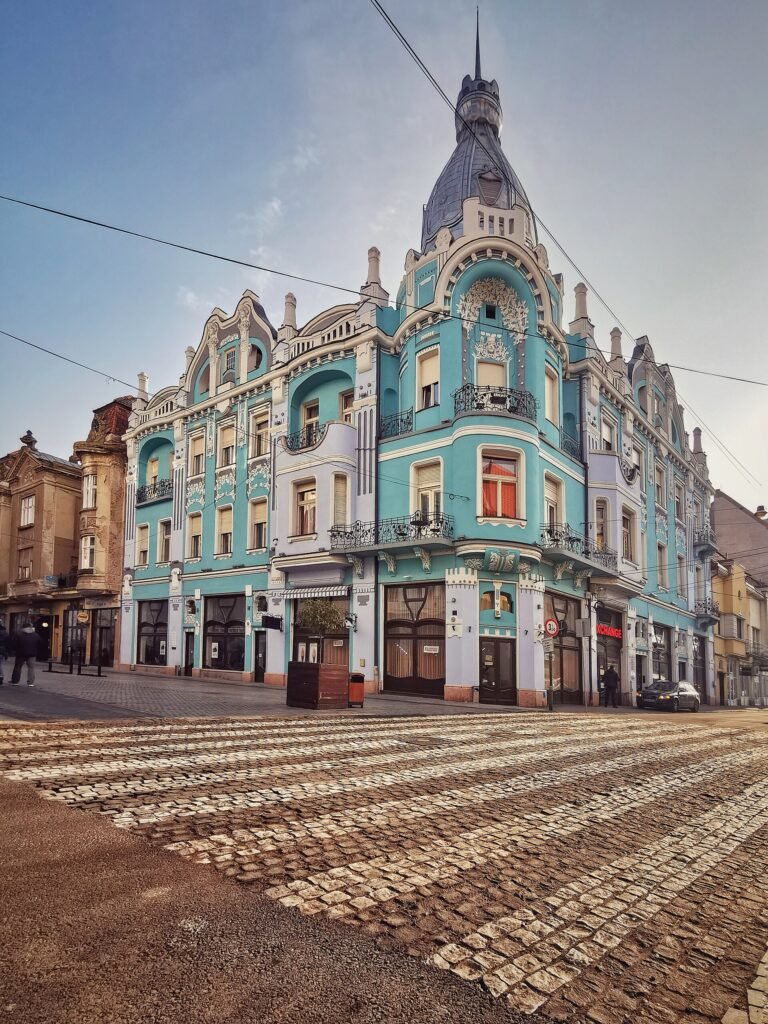
Sinuous lilies in stone and iron: an early Art Nouveau palace in a city that became Romania’s Secession capital.
At a glance
The Moskovits Miksa Palace stands in central Oradea, one of the earliest of the Secession palaces that crowd the city. Kálmán Rimanóczy Jr. designed it in 1904–1905 for the industrialist Miksa Moskovits, in the Munich variant of Art Nouveau known as Lilienstil, the “lily style”, for its flowing plant ornament. Shops filled the ground floor, apartments the storeys above.
Key facts
- Location: central Oradea (Piața Unirii area)
- Architect: Kálmán Rimanóczy Jr.
- Built: 1904–1905
- Style: Munich Secession (Lilienstil)
- Function: commercial and residential palace
History
Oradea grew rich around 1900 and its merchants competed to raise the most fashionable buildings. The industrialist Miksa Moskovits commissioned Rimanóczy, from a dynasty of local architects, to design a palace in the newest taste.
Finished in 1905, it was among the first Art Nouveau buildings in a city that would fill with them. Restored in recent years, it remains in mixed commercial and residential use, a fixed point on Oradea’s Art Nouveau trail.
What you see
The façade ripples with the lily-stalk curves of the Munich Secession, worked into stucco, stone and iron balconies. Plant forms wind around the windows and along the parapet. Beside the grander palaces nearby it reads as an opening statement, the city’s Art Nouveau finding its voice.
Practical information
- Open: private building; exterior viewable any time
- Cost: free to view from the street
- Best for: the lily-style façade ornament
- Time needed: 10–15 minutes
Getting there
The palace is in the centre of Oradea, on the Art Nouveau trail around Piața Unirii, a short walk from the river and the Black Eagle Palace.
Nearby
- Black Eagle Palace — the Secession passage nearby
- Darvas–La Roche House — the Art Nouveau museum a few streets away
Sources
- Oradea Heritage — The Moskovits Miksa Palace
- Primăria Oradea / Romanian heritage register — building information
- Wikimedia Commons — image source and licence
Find it on the map
See this place and what’s around it →Record researched and written by Luigi De Marchi for Cultural Heritage Online, 2026.

📷 Become a Cultural Heritage Online photographer
Share your photos of places: they stay published under your name as the author. The more they're seen, the more you get noticed — and soon a contest will reward the most appreciated photos.
Log in or sign up free to add a photoIs this page about you?
This page is read by travellers and heritage enthusiasts who find it on Google. Tell us how you are connected to this place and we will take it from there.