

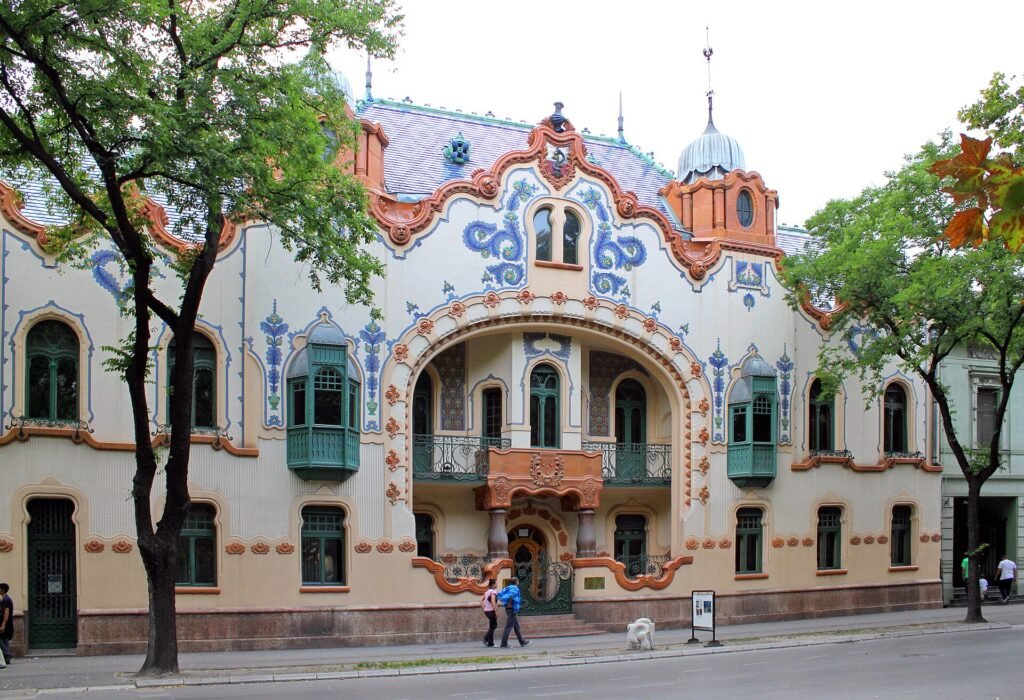
An architect’s self-portrait in brick and tile: Raichle built this riot of flowers and hearts as his own home.
At a glance
The Raichle Palace in Subotica is the most personal of the city’s Secession buildings: the architect Ferenc Raichle designed it in 1904 as his own house and studio. The façade is a burst of Hungarian Art Nouveau, red brick and pink render worked with floral ceramics, hearts and flowing ironwork. Raichle’s fortunes later collapsed; the palace is now a contemporary art gallery.
Key facts
- Location: Park Ferenca Rajhla 5, Subotica
- Architect: Ferenc Raichle (for himself)
- Built: 1904
- Style: Hungarian Secession (Art Nouveau)
- Today: contemporary art gallery
History
Raichle was a successful Subotica architect who decided to build himself a house that would also advertise his talent. He spared nothing, covering it in ceramic flowers and bespoke ironwork in the Hungarian Secession he loved.
He overreached financially and lost the palace within a few years; it passed through other hands and uses. Restored, it now houses the city’s gallery of contemporary art, still bearing his name.
What you see
The front blooms with stylised flowers and heart shapes in coloured ceramic, set against pink and red walls, with gates and railings of curling iron. Every detail, down to the fence, was designed as one. It is Art Nouveau at its most personal and exuberant, a building made to be looked at.
Practical information
- Open: as an art gallery; exhibition hours
- Cost: free or small admission
- Best for: the floral ceramic façade and ironwork
- Time needed: 20–40 minutes
Getting there
The palace is in central Subotica, a short walk from the railway station and the main square with the City Hall.
Nearby
- Subotica City Hall — the great Secession city hall nearby
- Subotica Synagogue — the Art Nouveau synagogue a few minutes away
Sources
- Wikipedia — Raichle Palace
- City of Subotica / Serbian heritage register — building information
- Wikimedia Commons — image source and licence
Find it on the map
See this place and what’s around it →Record researched and written by Luigi De Marchi for Cultural Heritage Online, 2026.
📷 Become a Cultural Heritage Online photographer
Share your photos of places: they stay published under your name as the author. The more they're seen, the more you get noticed — and soon a contest will reward the most appreciated photos.
Log in or sign up free to add a photoIs this page about you?
This page is read by travellers and heritage enthusiasts who find it on Google. Tell us how you are connected to this place and we will take it from there.