
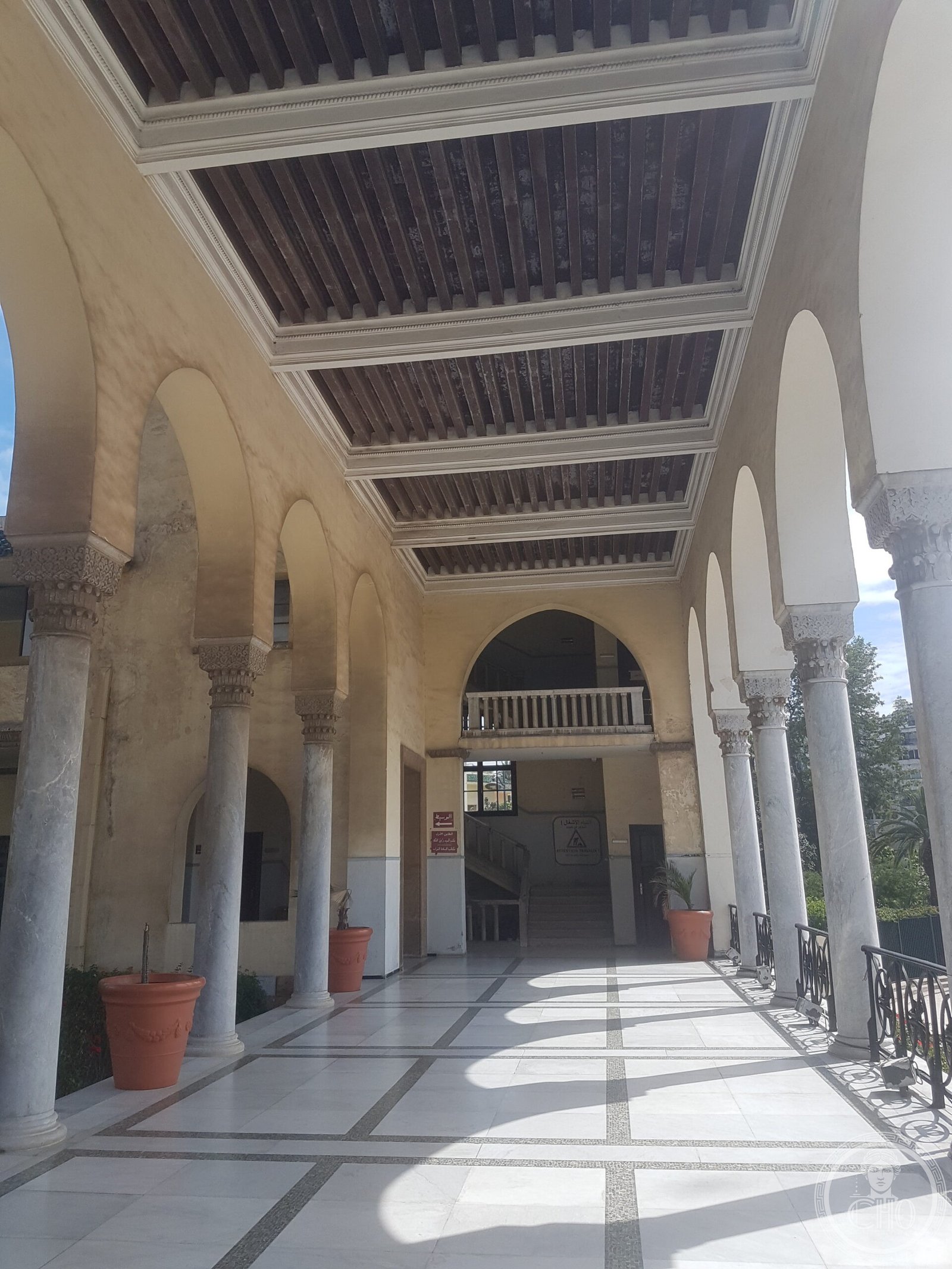
The Palais de Justice de Casablanca is a landmark courthouse situated on Place Mohammed V in the heart of Casablanca, Morocco. Completed in 1925 during the French Protectorate, the building stands as one of the finest examples of French Art Déco colonial architecture in North Africa. Its monumental facade, symmetrical composition, and elaborate ornamental details reflect the ambitions of French urban planners who sought to transform Casablanca into a modern metropolis while embedding distinctly European aesthetic ideals into the Moroccan urban fabric. Today the courthouse remains an active judicial institution and a defining element of Place Mohammed V, a civic ensemble widely celebrated as one of the most coherent Art Déco public squares in the world.
At a glance
- Type
- Courthouse / Public building
- Period
- Completed 1925
- Style
- French Art Déco Colonial
- Location
- Place Mohammed V, Casablanca, Morocco
- Coordinates
- 33.5916° N, 7.6198° W
- Architect(s)
- French Protectorate public works administration
Overview
Standing on Place Mohammed V alongside the Préfecture de Police, the post office, and several other monumental Protectorate-era buildings, the Palais de Justice de Casablanca forms part of a carefully planned civic ensemble. Its restrained yet authoritative Art Déco character expressed through clean geometric volumes, decorative friezes, and a commanding central entrance made it a blueprint for the administrative architecture that French planners deployed across Morocco during the interwar period. The building continues to serve as an active courthouse, giving it a civic vitality that many of its contemporaries have since lost to museum or hotel conversion.
History
The French Protectorate, established in Morocco in 1912, rapidly set about rebuilding Casablanca as a showcase colonial city. Resident-General Hubert Lyautey commissioned urban planner Henri Prost to design a new European quarter that would stand apart from the medina and project French civic authority. Place Mohammed V, then known as Place de France, was conceived as the administrative heart of this new city, and the Palais de Justice was among the first major public buildings to be completed there in 1925. The square and its surrounding buildings survived Moroccan independence in 1956 and have since been embraced as part of national architectural heritage, a legacy of the interwar period that shaped modern Casablanca.
Architecture & Design
The Palais de Justice exemplifies the French Art Déco colonial style as it was adapted for the North African context. The facade is composed of bold horizontal bands punctuated by vertical pilasters, creating a rhythm typical of 1920s institutional Art Déco. Decorative motifs including geometric friezes and carved reliefs overlay the structural framework without overwhelming it. Arched openings at the ground level introduce a Moorish inflection that French architects used to negotiate between European modernism and local visual culture. The warm stone tones of the exterior are characteristic of the broader Place Mohammed V ensemble, which was planned as a coherent visual whole rather than a collection of individual commissions.
Cultural significance
The Palais de Justice is an integral part of Place Mohammed V, an urban ensemble discussed in the context of UNESCO recognition for its exceptional concentration of interwar Art Déco architecture. As a product of French colonial urban planning, the building embodies a complex legacy: it represents both the imposition of European institutional forms upon a colonised country and the emergence of a distinctive hybrid architectural language blending Art Déco geometry with Moroccan decorative traditions. This ambivalence makes it a significant site for understanding how architectural style was deployed as an instrument of colonial governance, and how Moroccan society has since reinterpreted these spaces as its own.
Visiting today
The Palais de Justice is an active working courthouse; access to interior spaces is restricted to those with judicial business. The building is best appreciated from the exterior at Place Mohammed V, which is a public square and one of Casablanca’s most photogenic civic spaces. The square is easily walkable and offers a panoramic view of the entire Art Déco ensemble. Photography of the exterior is generally permitted from public areas. Visitors exploring Casablanca’s Art Déco heritage typically begin at this square before moving to other nearby landmarks.
Getting there
Place Mohammed V lies at the centre of Casablanca’s historic European quarter and is accessible by multiple means. The Casablanca Tramway serves the area, with stops within short walking distance of the square. Casa-Port railway station is approximately one kilometre to the north, walkable for those arriving by train. Taxis are plentiful throughout the city centre. From Mohammed V International Airport, the Airport Express train runs to Casa-Voyageurs station, from which the square is reachable by tram or short taxi ride.
Sources & resources
Find it on the map
See this place and what’s around it →📷 Diventa un fotografo di Cultural Heritage Online
Condividi le tue foto dei luoghi: restano pubblicate con la tua firma come autore. Più vengono viste, più ti fai conoscere — e presto un concorso premierà le foto più apprezzate.
Accedi o registrati gratis per aggiungere una fotoDo you manage this place?
This page is read by travellers and heritage enthusiasts who find it on Google. Keep it accurate — and make it work for you. Free for non-profit heritage institutions.