
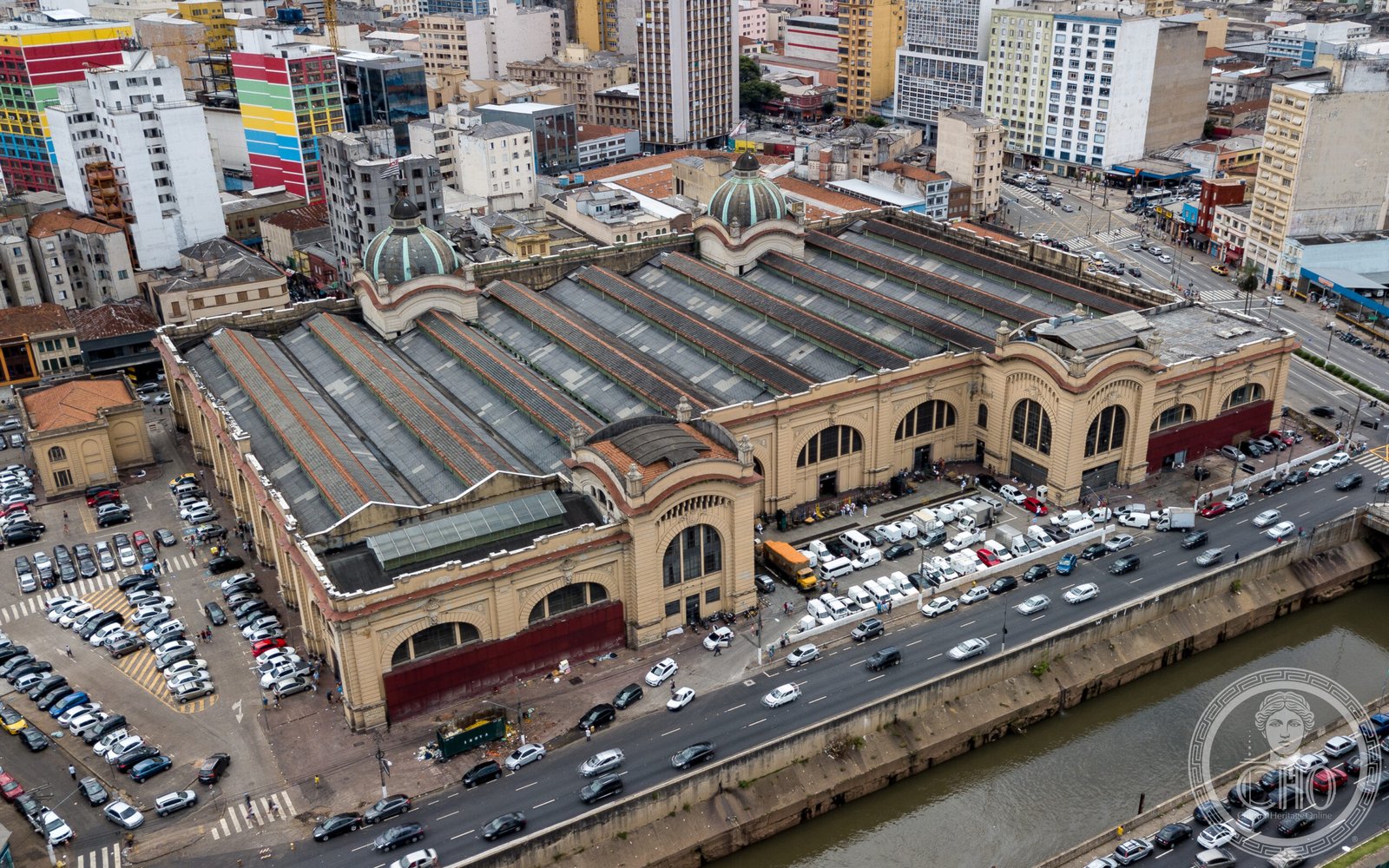
Known universally as the Mercadão, the Municipal Market of São Paulo has been the gastronomic heart of Brazil’s largest city since its inauguration on 25 January 1933, the city’s 379th anniversary. Designed by Francisco Ramos de Azevedo with a façade by Felisberto Ranzini, the vast structure sprawls across 12,600 square metres in the historic centre, its mixed Ionic and Doric columns framing enormous glazed bays that flood the interior with natural light. Seventy-two stained-glass windows — arranged in 32 panels — depict scenes of regional food production across Brazil, turning a working market into an accidental cathedral of commerce. Today the Mercadão processes roughly 450 tonnes of food daily through more than 290 vendor stalls on the ground floor, while a restaurant mezzanine above serves iconic dishes — the mortadella sandwich and the pastel de bacalhau — that have become pilgrimage food for visitors from across the world.
At a glance
- Type
- Public market
- Period
- 1928–1933
- Style
- Art Deco / Eclectic (Neo-Classical influences)
- Location
- Rua da Cantareira 306, Centro Histórico, São Paulo, Brazil
- Coordinates
- 23.5417° S, 46.6292° W
- Architect(s)
- Francisco Ramos de Azevedo; Felisberto Ranzini (façade)
Overview
The Mercado Municipal de São Paulo — the Mercadão — is one of Latin America’s grandest public markets and a landmark of São Paulo’s historic centre. Its two-story structure houses wholesale and retail stalls selling fruits, vegetables, meats, cereals, spices and artisan products. The mezzanine level hosts restaurants and snack bars famed citywide. Formally renamed Mercado Municipal São Paulo in 1995, the building underwent a major renovation in 2004 financed by the Inter-American Development Bank as part of a broader programme for the revitalisation of central São Paulo. The neighbourhood surrounding the market takes its name from the building, testament to its central place in the city’s identity.
History
São Paulo’s rapid growth in the early twentieth century, driven by coffee wealth and mass immigration, strained its food supply infrastructure. City authorities commissioned a purpose-built central market to rationalise distribution and provide hygienic conditions for food sale. Construction began in 1928 under the direction of Francisco Ramos de Azevedo, one of São Paulo’s most prolific architects, responsible for dozens of public buildings across the state. The market was inaugurated on 25 January 1933, chosen to coincide with the city’s founding anniversary. Renovation works in 2004 modernised services while preserving the historic fabric, including the celebrated stained-glass windows. The market was formally renamed in 1995 to reflect its status as the city’s principal municipal market.
Architecture & Design
The building’s façade deploys a mixed Ionic and Doric colonnade that supports wide glazed bays, admitting generous daylight into the cavernous interior. The structural system was designed to span large open trading floors without the intrusion of load-bearing columns that would obstruct commerce. The defining decorative element is the set of 72 stained-glass windows arranged in 32 panels running along the nave walls. Each panel depicts a different aspect of Brazilian agricultural and food production — coffee harvests, cattle herding, fishing, wheat cultivation — executed in rich jewel tones that cast coloured light across the market floor. New granite flooring was installed during the 2004 renovation. The overall character sits between the civic rationalism of Art Deco and the ornamental legacy of nineteenth-century eclectic architecture.
Cultural significance
The Mercadão is inseparable from São Paulo’s identity as a city of immigration and culinary diversity. Its stalls reflect the full range of communities that settled the city — Italian, Japanese, Lebanese, Portuguese, northeastern Brazilian — through their produce, spices and prepared foods. The mortadella sandwich served here has achieved near-mythological status in Brazilian food culture. The market also anchors the historic centre’s Tamanduateí riverfront district, an area undergoing gradual regeneration. Its 1933 inauguration on the city’s anniversary embedded it in the civic calendar from the outset, and it continues to draw hundreds of thousands of visitors annually.
Visiting today
The Mercadão is open Monday to Saturday from 06:00 to 18:00 and on Sundays from 06:00 to 16:00. Admission is free. The ground floor hosts more than 290 vendor stalls; the mezzanine level offers sit-down restaurants and snack counters. Signature items include the mortadella sandwich (mortadela) and the pastel de bacalhau (salt cod pastry). The market is busiest in the morning hours when wholesale buyers are active; afternoons are calmer for leisurely visits.
Getting there
The Mercado Municipal is located at Rua da Cantareira 306 in the Centro Histórico. The nearest metro station is São Bento (Line 3 – Red), approximately 400 metres away. Numerous bus lines serve the surrounding streets. The market is also within walking distance of the Luz train station and the Pinacoteca do Estado museum, making it a natural stop on a tour of central São Paulo.
Sources & resources
Find it on the map
See this place and what’s around it →Record researched and written by Luigi De Marchi for Cultural Heritage Online, 2026.
📷 Become a Cultural Heritage Online photographer
Share your photos of places: they stay published under your name as the author. The more they're seen, the more you get noticed — and soon a contest will reward the most appreciated photos.
Log in or sign up free to add a photoIs this page about you?
This page is read by travellers and heritage enthusiasts who find it on Google. Tell us how you are connected to this place and we will take it from there.