
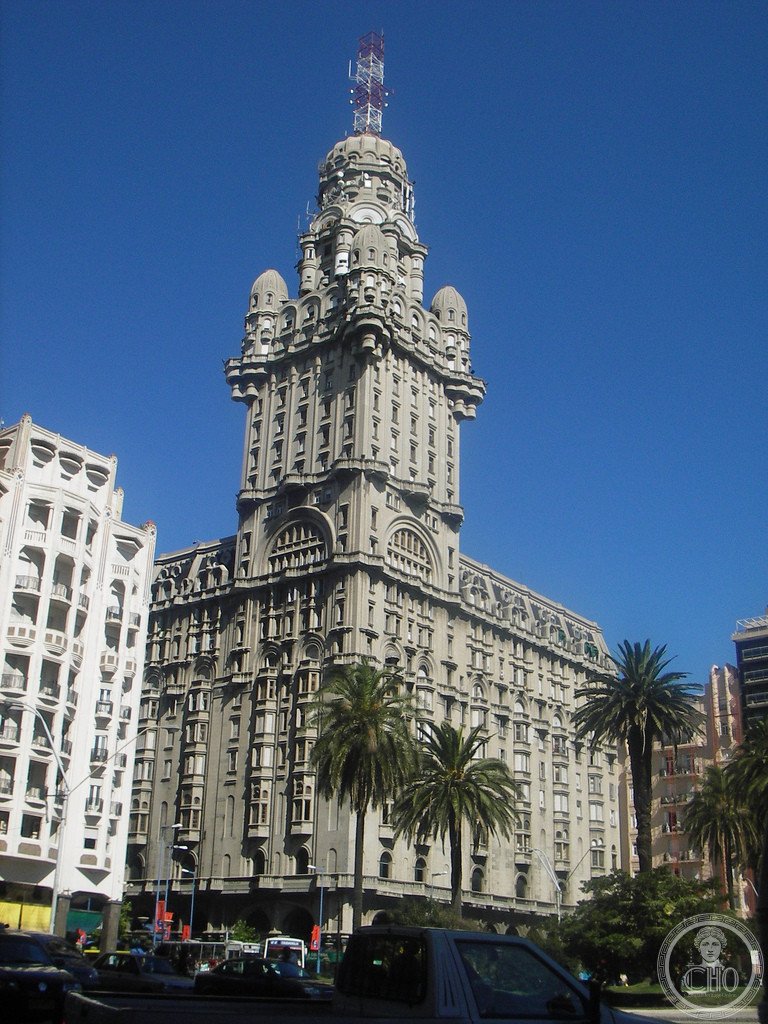
Anchoring the eastern end of Plaza Independencia in the heart of Montevideo, Palacio Salvo is the definitive landmark of the Uruguayan capital. Designed by Italian-Argentine architect Mario Palanti and completed in 1928, the 27-storey, 105-metre tower was briefly the tallest reinforced concrete structure in the world and the tallest building in Latin America. Commissioned by the Salvo Brothers — Ángel, José and Lorenzo — the palace blends Renaissance, Gothic and Neoclassical elements into an eclectic silhouette that remains instantly recognisable on the Río de la Plata skyline. Its ground floor once housed a theatre where Josephine Baker performed, and the site itself carries deep tango heritage: the legendary “La Cumparsita” was first played in 1917 at the pastry shop that previously stood here. Declared a National Historical Monument in 1996, Palacio Salvo is Montevideo’s most beloved architectural symbol and a proud emblem of early-20th-century prosperity.
At a glance
- Type
- Mixed-use tower (offices, apartments, commercial)
- Period
- 1925–1928
- Style
- Eclectic (Renaissance, Gothic, Neoclassical)
- Location
- Plaza Independencia, Centro, Montevideo, Uruguay
- Coordinates
- 34.9067° S, 56.1983° W
- Architect(s)
- Mario Palanti
Overview
Palacio Salvo rises 27 storeys — with two basement levels — from the most prestigious address in Montevideo, Plaza Independencia, where 18 de Julio Avenue begins its sweep through the city centre. Commissioned by the wealthy Salvo Brothers and designed by Mario Palanti, an Italian architect working out of Buenos Aires, it was originally envisioned as a grand hotel. The final programme combined 370 residential units with office and commercial spaces. Upon completion in 1928 it briefly held the record as the world’s tallest reinforced concrete structure and the tallest building in Latin America. A distinctive LED beacon, inaugurated in 2017, crowns its tower, replacing an earlier lighthouse and antenna.
History
Construction began in 1925 on a site formerly occupied by La Giralda, a celebrated Montevideo pastry shop where composer Gerardo Matos Rodríguez premiered “La Cumparsita” in 1917 — the tango that would become Uruguay’s unofficial anthem. The Salvo Brothers spared no expense: the building’s basement once contained a theatre that hosted international performers including Josephine Baker. At completion in 1928, Palacio Salvo’s 101-metre architectural height (105 metres with beacon) placed it at the forefront of global engineering achievement. Uruguay’s government recognised its historic importance by designating it a National Historical Monument in 1996. The building’s grand stained-glass window has been undergoing restoration since 2021, while internal spaces house a Tango Museum celebrating La Cumparsita’s heritage.
Architecture & Design
Mario Palanti drew on a rich eclectic vocabulary for Palacio Salvo, weaving Renaissance arcading, Gothic verticality and Neoclassical ornament into a composition unlike anything else on the South American continent. The design shares a conceptual kinship with Palanti’s contemporaneous Palacio Barolo in Buenos Aires — both buildings are said to be inspired by Dante’s Divine Comedy, with the tower representing a journey from the inferno of the basement to the paradiso of the crown. The silhouette tapers through multiple setbacks toward an octagonal lantern tower, once functioning as a lighthouse over the Río de la Plata. A wide ground-floor passageway connects Plaza Independencia directly with Andes Street, integrating the building into the city’s pedestrian fabric.
Cultural significance
Palacio Salvo is the architectural emblem of Montevideo, symbolising the optimism and prosperity of Uruguay in the early 20th century. Its image appears on postcards, souvenirs and city branding, and it has inspired artists and musicians internationally — most recently Damon Albarn of Blur and Gorillaz, who wrote the 2021 song “The Tower of Montevideo” in its honour. The building’s tango heritage — standing on the birthplace of “La Cumparsita” — deepens its cultural resonance, now celebrated in the on-site Tango Museum. The LED beacon inaugurated in 2017 has given the tower a vibrant new nocturnal identity visible across the Río de la Plata.
Visiting today
Guided tours of Palacio Salvo operate daily from 10:30 to 13:30. The Tango Museum on the lower floors is open to visitors and features a dedicated exhibition on La Cumparsita. The building’s ground-floor passageway between Plaza Independencia and Andes Street is freely accessible at all times. The tower offers panoramic views over Montevideo and the Río de la Plata from its upper levels during tour hours. Photography is permitted throughout.
Getting there
Palacio Salvo stands directly on Plaza Independencia in central Montevideo, one of the city’s primary public squares and transport hubs. Numerous bus lines converge on 18 de Julio Avenue immediately adjacent to the plaza. The building is a 15-minute walk from the Old City (Ciudad Vieja) and within easy reach of the Montevideo Port area. Taxis and ride-sharing services are readily available throughout the Centro neighbourhood.
Sources & resources
Find it on the map
See this place and what’s around it →Record researched and written by Luigi De Marchi for Cultural Heritage Online, 2026.
📷 Become a Cultural Heritage Online photographer
Share your photos of places: they stay published under your name as the author. The more they're seen, the more you get noticed — and soon a contest will reward the most appreciated photos.
Log in or sign up free to add a photoIs this page about you?
This page is read by travellers and heritage enthusiasts who find it on Google. Tell us how you are connected to this place and we will take it from there.