
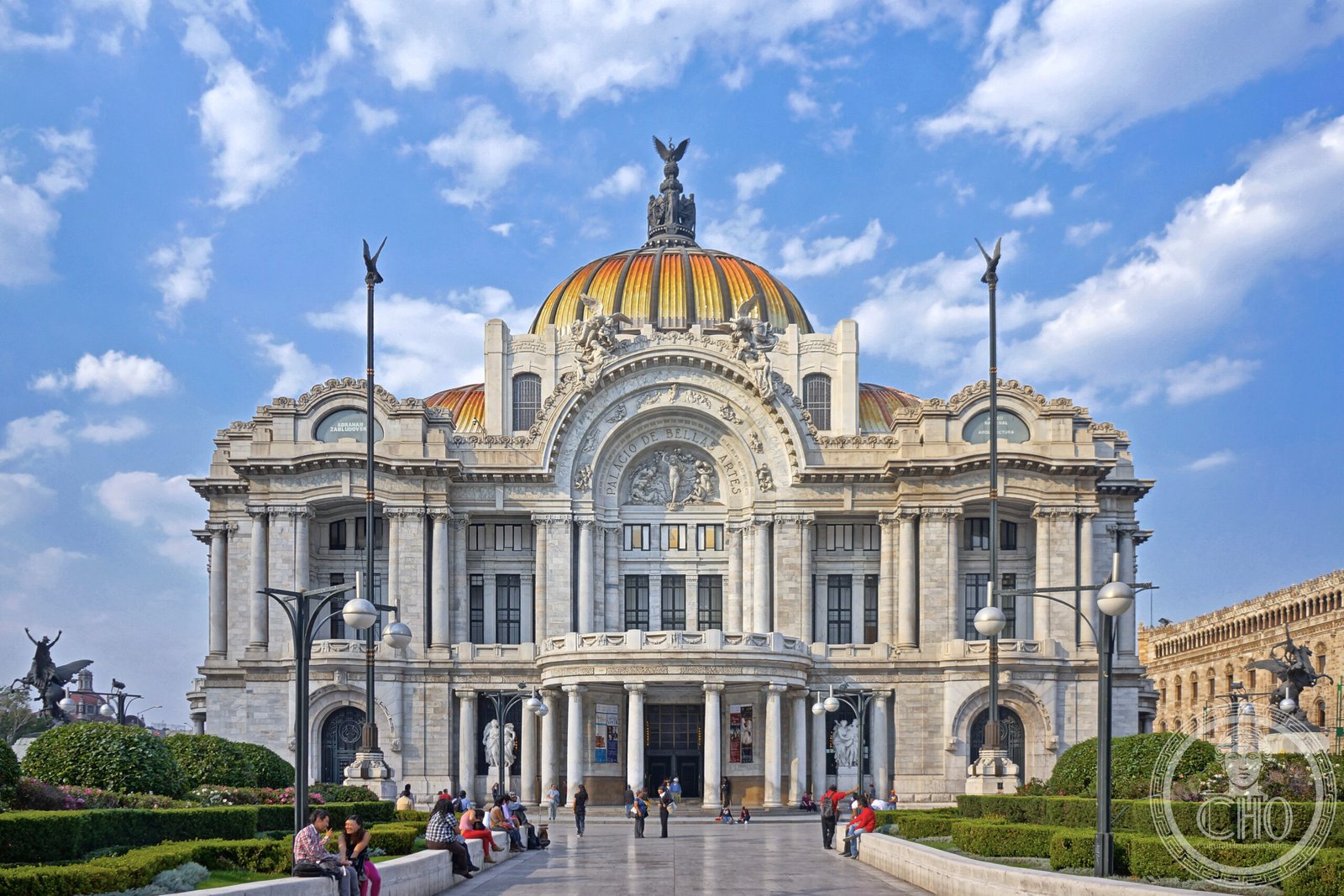
Rising from the heart of Mexico City like a marble dream, the Palacio de Bellas Artes is one of the most recognisable buildings in the Western Hemisphere. Begun in 1904 under Italian architect Adamo Boari and completed in 1934 by Federico Mariscal after a two-decade halt caused by the Mexican Revolution and subsidence of the soft lakebed soil, the palace is a singular fusion of two eras and two aesthetic visions. Its exterior wraps Beaux-Arts neoclassical forms in sinuous Art Nouveau ornament executed in white Carrara marble and glazed domes of jade green and yellow, while the interior pivots dramatically to Art Deco: geometry, murals by Diego Rivera, David Alfaro Siqueiros, Jose Clemente Orozco, and Rufino Tamayo, and a remarkable Tiffany glass curtain depicting the Valley of Mexico. The building hosts the Ballet Folklorico de Mexico, the National Symphony Orchestra, and major visual arts exhibitions, making it the most important cultural venue in the country.
At a glance
- Type
- Cultural centre, opera house, art museum
- Period
- 1904–1934 (inaugurated 29 November 1934)
- Style
- Art Nouveau / Beaux-Arts exterior; Art Deco interior
- Location
- Centro Historico, Mexico City, Mexico
- Coordinates
- 19.4353° N, 99.1414° W
- Architect(s)
- Adamo Boari (1904–1913); Federico Mariscal (1932–1934)
Overview
The Palacio de Bellas Artes stands at the eastern end of the Alameda Central park in the Historic Centre of Mexico City, a UNESCO World Heritage Site. It serves simultaneously as an opera house, a concert hall, and a fine-arts museum housing permanent murals by the great masters of Mexican painting. The building is considered the premier cultural institution of Mexico and was declared a Historic Monument in 1987. Its main stage features the celebrated glass curtain depicting the volcanoes Popocatepetl and Iztaccihuatl, designed by the Tiffany Studios of New York from nearly one million pieces of opalescent glass.
History
President Porfirio Diaz commissioned Italian architect Adamo Boari in 1904 to design a grand national theatre to replace the old Teatro Nacional. Construction began the same year but immediately encountered the challenge of Mexico City’s unstable clay subsoil, the former lakebed of Lake Texcoco. The building began to sink almost from the start. Progress was further interrupted by the Mexican Revolution of 1910–1920, and Boari left Mexico in 1916 with the structure still incomplete. Work halted entirely for nearly two decades until 1932, when the government appointed Federico Mariscal to resume and complete the project. Mariscal adapted the unfinished shell to the Art Deco aesthetic then in fashion, completing the interior with geometric ornament, Aztec motifs, and commissioning major murals from the foremost Mexican painters of the era. The palace was finally inaugurated on 29 November 1934.
Architecture & Design
The exterior is clad in white Carrara marble imported from Italy and features elaborate Art Nouveau ornament: sinuous vegetal reliefs, sculpted eagles, and allegorical figures by Italian and Mexican sculptors. Two large domes finished in glazed tiles of jade green and ochre dominate the roofline. The main facade opens onto an atrium of arched windows and colonnades in a Beaux-Arts register. The interior shifts entirely to Art Deco: stepped geometric forms in yellow onyx, marble, and bronze, with murals on the upper gallery levels by Diego Rivera, David Alfaro Siqueiros, Jose Clemente Orozco, and Rufino Tamayo. The stage curtain — the Tiffany glass depiction of the Valley of Mexico at sunrise — is lowered for public viewing on weekends.
Cultural significance
The Palacio de Bellas Artes is Mexico’s most celebrated architectural monument and its foremost stage for the performing and visual arts. It is home to the Ballet Folklorico de Mexico, which has performed here since 1952, and to the National Symphony Orchestra. The permanent mural collection represents the apex of the Mexican Muralism movement — one of the most significant art movements of the twentieth century — and draws hundreds of thousands of visitors annually. The building was declared a Historic Monument in 1987 and sits within the Historic Centre of Mexico City, inscribed as a UNESCO World Heritage Site in 1987.
Visiting today
The museum galleries on levels two through four are open Tuesday to Sunday, 10:00–17:00, with free admission on Sundays. The performing arts programme — opera, dance, orchestral concerts — requires ticketing via the official box office or the INBA website. Photography is permitted in the galleries without flash.
Getting there
The palace sits immediately adjacent to Bellas Artes metro station on Lines 2 and 8, the most direct connection from any part of the city. It is a five-minute walk from the Zocalo and served by numerous Metrobus routes along Avenida Juarez. Parking in the Historic Centre is limited; arriving by metro or Ecobici bike-share is strongly recommended.
Sources & resources
Find it on the map
See this place and what’s around it →Record researched and written by Luigi De Marchi for Cultural Heritage Online, 2026.
📷 Become a Cultural Heritage Online photographer
Share your photos of places: they stay published under your name as the author. The more they're seen, the more you get noticed — and soon a contest will reward the most appreciated photos.
Log in or sign up free to add a photoIs this page about you?
This page is read by travellers and heritage enthusiasts who find it on Google. Tell us how you are connected to this place and we will take it from there.