

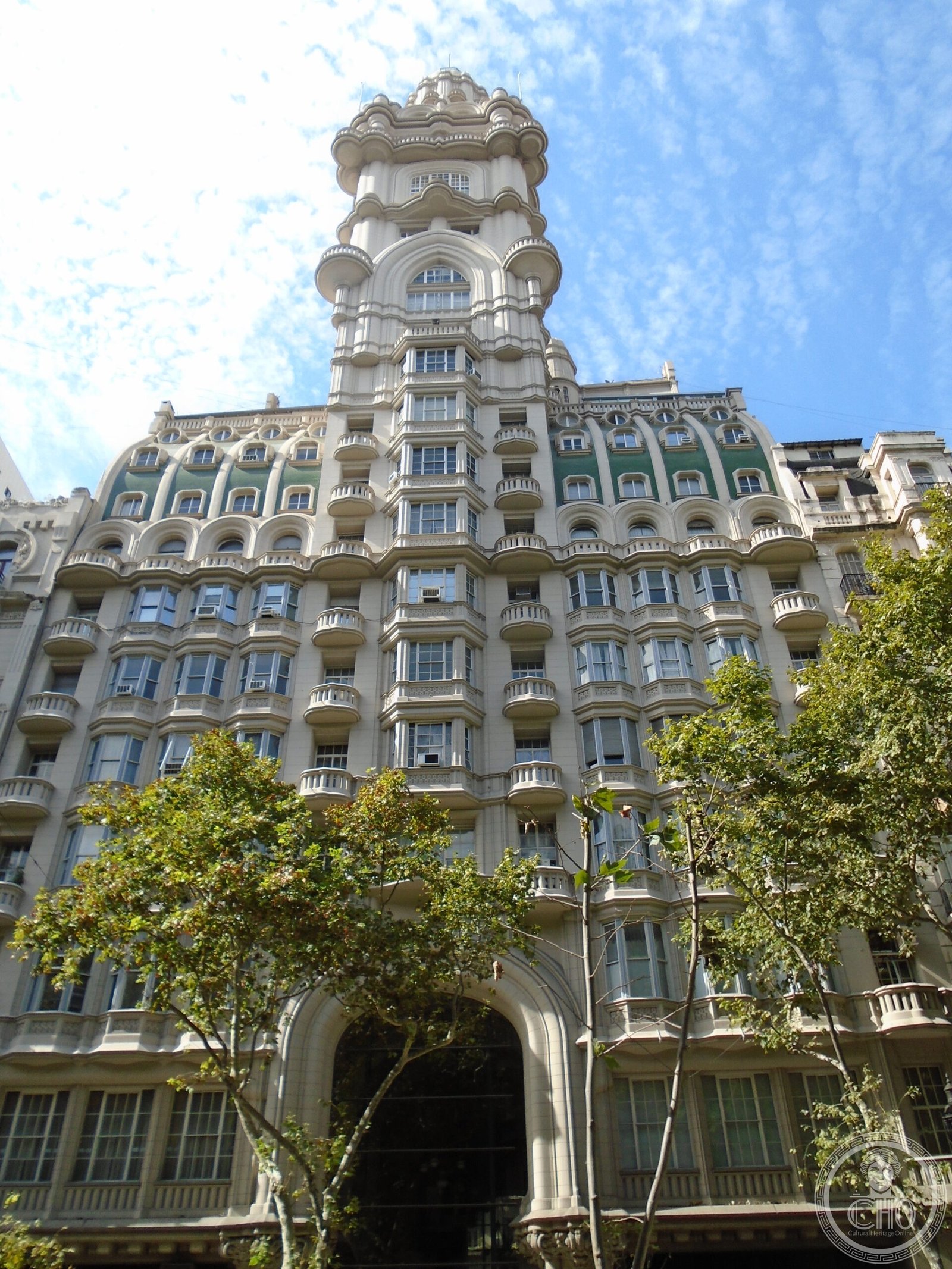
Rising 100 metres above Avenida de Mayo, Palacio Barolo was South America’s tallest building upon its completion in 1923 — a record it held for over a decade. Commissioned by Italian-Argentine entrepreneur Luis Barolo and designed by Milan-born architect Mario Palanti, the tower is one of the most symbolically charged structures in the Americas. Every dimension, every ornamental detail, every floor references Dante Alighieri’s Divine Comedy: the basement evokes Hell, the middle floors Purgatory, and the upper levels Heaven. The spire that crowns the building doubles as a lighthouse whose beam once aligned with the Southern Cross constellation on Argentine Independence Day, a visual allegory of Dante’s celestial journey. Declared a National Historic Monument of Argentina, Palacio Barolo is both a masterpiece of early twentieth-century eclecticism and an enduring monument to the cultural ambitions of Buenos Aires’ Italian immigrant community.
At a glance
- Type
- Office skyscraper
- Period
- 1919–1923
- Style
- Eclectic / Proto-Art Deco (Gothic, Art Nouveau influences)
- Location
- Avenida de Mayo 1370, Monserrat, Buenos Aires, Argentina
- Coordinates
- 34.6096° S, 58.3859° W
- Architect(s)
- Mario Palanti
Overview
Palacio Barolo stands 100 metres tall across 22 floors, its height deliberately chosen to match the 100 cantos of Dante’s Divine Comedy — one metre per canto. When inaugurated in 1923 it was the tallest building in South America, surpassing all rivals until the Kavanagh Building in 1935. Its eclectic facade blends Gothic arches, Hindu-inspired motifs and Baroque ornament into a singular vision that defies easy classification. Today the building houses offices, boutiques and a rooftop observatory, drawing thousands of visitors who climb to the lighthouse lantern for panoramic views over the Rio de la Plata.
History
Luis Barolo arrived in Argentina from Italy in 1890 and built a fortune in the textile trade. A devoted admirer of Dante, he envisioned a building that would immortalise the poet’s work in stone and iron. He commissioned Mario Palanti, who had already made his name in Buenos Aires, and construction began in 1919. The project was enormously ambitious: the foundations alone required exceptional engineering, their proportions conforming to the golden ratio. The building opened on 18 July 1923. Barolo died in 1922, one year before its completion. In 1989 the Argentine government declared Palacio Barolo a National Historic Monument, recognising its outstanding architectural and cultural value. A symmetric twin — Palazzo Salvo — was simultaneously constructed by Palanti in Montevideo, Uruguay.
Architecture & Design
The building’s cosmological programme divides into three zones corresponding to Hell, Purgatory and Heaven. The ground-floor lobby features nine vaulted archways evoking the nine circles of Hell, with Latin inscriptions and sculpted monsters flanking the entrance. Floors 1 to 14 represent Purgatory; floors 15 to 22 Heaven, where the lantern room houses a 300,000-candlepower lighthouse beacon representing the nine choirs of angels. The facade mixes Ionic columns, Gothic tracery, Hindu-inflected carved medallions and a central mansard-style dome. Throughout, Palanti embedded symbolic numerology: 22 floors for 22 letters of the Hebrew alphabet, and the building’s precise 100-metre height. The foundations were engineered according to golden-ratio proportions.
Cultural significance
Palacio Barolo is one of Latin America’s most symbolically dense buildings, a material monument to the Italian immigrant imagination that shaped modern Buenos Aires. Its Dantesque programme reflects the broader cultural ambitions of an era when the Argentine capital saw itself as a new European metropolis. The building anchors Avenida de Mayo’s historic streetscape, a boulevard modelled on Paris’s grands boulevards and declared a UNESCO-tentative World Heritage corridor. It also stands as a tribute to the Italian diaspora’s cultural contribution to the Southern Cone, celebrated in literature, architecture and civic life alike.
Visiting today
The building is open to visitors with guided tours available through the official website (palaciobarolo.com.ar). Tours ascend to the lighthouse lantern at the top of the tower, offering panoramic views of Buenos Aires and, on clear days, the Río de la Plata. The ground-floor lobby is accessible during business hours. The building still operates as a working office block, so visitors share the lifts with tenants. Evening tours are particularly atmospheric, when the lantern beacon is illuminated.
Getting there
Palacio Barolo is located at Avenida de Mayo 1370 in the Monserrat neighbourhood of central Buenos Aires. The nearest Buenos Aires Underground (Subte) stations are Sáenz Peña (Line A) and Lima (Line A), both within two blocks. Numerous bus lines serve Avenida de Mayo. The building is a short walk from Plaza de Mayo and the Casa Rosada.
Sources & resources
Find it on the map
See this place and what’s around it →Record researched and written by Luigi De Marchi for Cultural Heritage Online, 2026.
📷 Become a Cultural Heritage Online photographer
Share your photos of places: they stay published under your name as the author. The more they're seen, the more you get noticed — and soon a contest will reward the most appreciated photos.
Log in or sign up free to add a photoIs this page about you?
This page is read by travellers and heritage enthusiasts who find it on Google. Tell us how you are connected to this place and we will take it from there.