
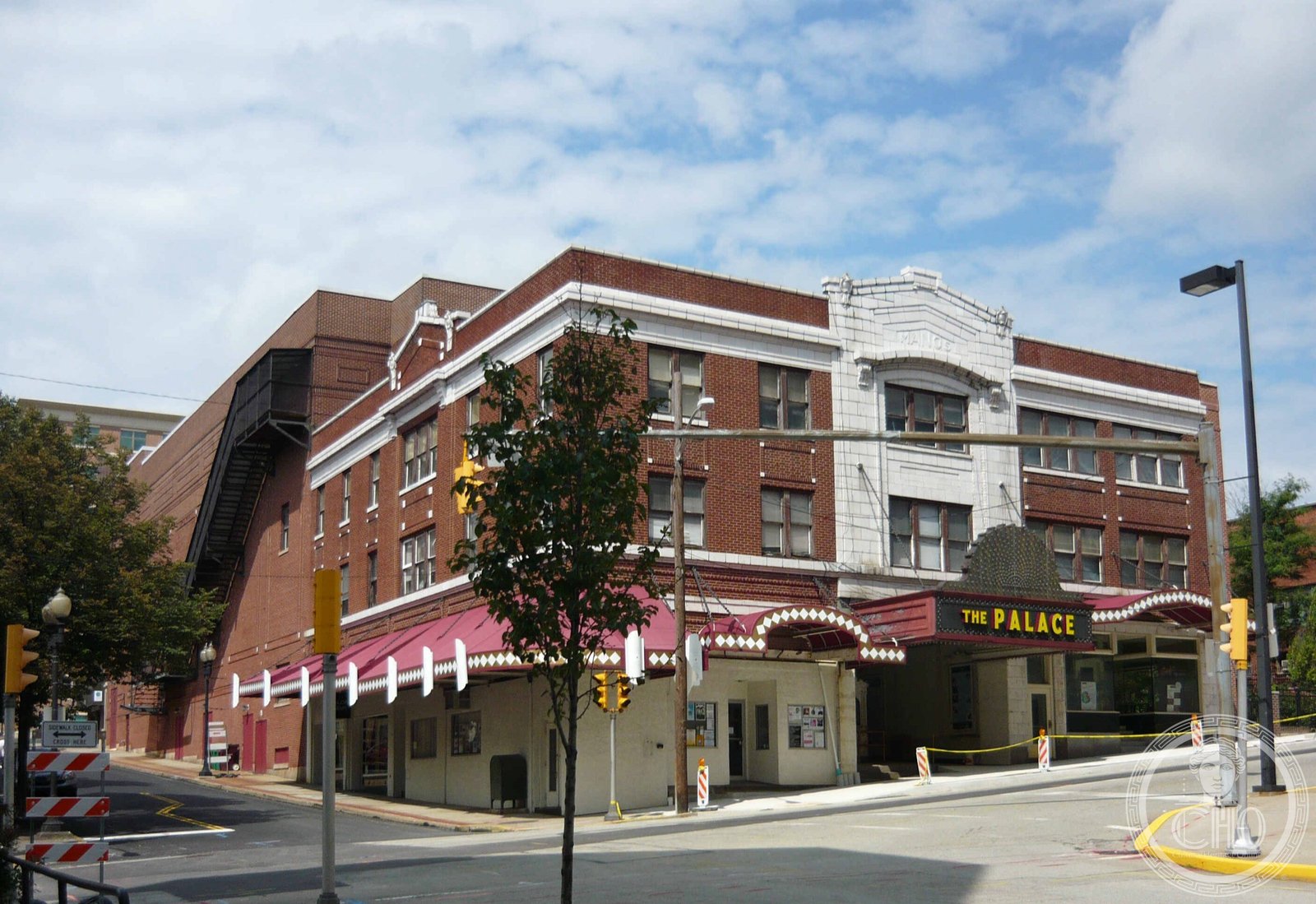
The county seat theater of Westmoreland County, Pennsylvania, built in the 1920s to serve a steel-industry community at the eastern edge of the Pittsburgh metropolitan orbit — a building that absorbed the decorative ambitions of the American entertainment boom and channeled them into a downtown that still bears the architectural confidence of a prosperous industrial era.
At a glance
The Palace Theater on West Otterman Street in Greensburg, Pennsylvania, is the performing arts anchor of Westmoreland County — the heart of the southwestern Pennsylvania county seat that served the coal, glass, and steel communities of the Laurel Highlands throughout the twentieth century. Built around 1926 at the height of the American theater construction boom, the Palace was designed to bring the decorative ambitions of the metropolitan entertainment palace to a market city whose industrial prosperity could support a venue of genuine architectural quality. Listed on the National Register of Historic Places as part of the Greensburg Downtown Historic District, the theater operates today as the home of the Westmoreland Symphony Orchestra and a presenter of touring Broadway productions, concerts, and community performing arts.
Key facts
- Address: West Otterman Street, Greensburg, PA 15601
- Built: c.1926
- Style: 1920s decorative theater design with Renaissance Revival elements
- Current use: Performing arts center; home of Westmoreland Symphony Orchestra
- GPS: 40.3021° N, 79.5461° W
- Status: NRHP — Greensburg Downtown Historic District
History
Greensburg in the mid-1920s was a prosperous county seat at the center of one of Pennsylvania’s most productive coal and steel regions. Westmoreland County’s mines fed the Pittsburgh furnaces thirty miles to the west; the Pennsylvania Turnpike corridor had not yet been built, but the Pennsylvania Railroad’s mainline through the Laurel Highlands made Greensburg accessible and commercially active. A city that could support a Sears, a Woolworth, and a J.C. Penney on its main commercial street in 1926 could also support an entertainment palace — and the Palace Theater was built to occupy that position.
The design drew on the same sources that were producing theater buildings across American commercial districts: the Roman arch vocabulary of the Renaissance Revival, the gilded plasterwork that audiences had come to associate with theatrical quality, and the marquee as primary architectural element that announced the building’s purpose from the end of the block. In Greensburg’s case, the scale was calibrated to a county seat rather than a metropolitan center — a theater intended to serve as the cultural summit of its immediate region rather than to compete with the downtown palaces of Pittsburgh or Philadelphia.
The theater survived the transition from vaudeville to film, the mid-century decline of downtown retail, and the competition from multiplexes to emerge as Westmoreland County’s primary venue for live performance. The Westmoreland Symphony Orchestra, which has presented seasons at the Palace since the mid-twentieth century, has been the building’s most important institutional tenant, giving it an identity as a classical music venue that distinguishes it from the pure commercial-entertainment history of many surviving theaters of this era.
What you see
The Palace’s facade presents the characteristic architecture of the 1920s county-seat theater: a commercial building block of three to five stories whose principal feature is the theater entrance marquee, which projects above the sidewalk and frames the entry zone with the ornamental language of the entertainment economy — terra cotta relief work, stylized geometric friezes, the bold lettering of the building’s name in signage that reads from the end of the block. The building’s upper stories carry the architectural vocabulary of the Renaissance Revival — round-arched windows, engaged pilasters, decorative cornice work — in the mode that the theater designers of the era used to dignify their commercial function with associations of European cultural heritage.
Inside, the auditorium follows the basic configuration of the 1920s movie palace adapted to the scale of a county seat: a proscenium stage suitable for both live performance and film projection, tiered seating on orchestra and balcony levels, and the decorative plasterwork program that gave audiences of the era a room substantially more elaborate than their domestic experience. The Westmoreland Symphony’s requirements have informed the acoustic modifications and stage configurations of subsequent decades, shaping the auditorium toward the live-performance uses that now define the building’s primary role.
Practical information
- Access: Performances and events; check palacetheater.net for the Westmoreland Symphony and touring production schedules
- Season: Year-round programming; symphony season typically September–May
- Duration: Concerts and performances typically 2–3 hours; Greensburg’s downtown historic district warrants a 45-minute walking exploration before or after
- Parking: Municipal garages and surface lots throughout downtown Greensburg
Getting there
Greensburg is approximately 30 miles east of Pittsburgh via the Pennsylvania Turnpike (I-76) to Exit 75 (New Stanton) and then US-119 north, or via US-30 (the Lincoln Highway) east from Pittsburgh. Pittsburgh International Airport (PIT) is approximately 45 miles west via I-76. Amtrak’s Capitol Limited (Washington to Chicago) and Pennsylvanian (New York to Pittsburgh) stop at Greensburg station on North Main Street, making the theater accessible by rail from both Pittsburgh (~35 minutes east) and Philadelphia (~5 hours west on the Pennsylvanian).
Nearby
- Westmoreland Museum of American Art — 221 N. Main Street, Greensburg; one of the most significant collections of American art in western Pennsylvania, with particular strengths in 19th- and early 20th-century painting
- Fallingwater — Edgar Kaufmann Sr. summer house designed by Frank Lloyd Wright (1939), approximately 40 miles southeast via US-119 and PA-381; the most visited private residence in the United States
- Laurel Highlands — the ridge-and-valley landscape east of Greensburg; Ohiopyle State Park and the Youghiogheny River gorge offer white-water rafting and hiking within 45 miles
- Ligonier — historic fort town approximately 12 miles east via US-30; Fort Ligonier (reconstructed, 1758) and the Ligonier Valley’s rural landscape complement the urban history of Greensburg
Sources
- Palace Theater official site — palacetheater.net
- National Register of Historic Places — Greensburg Downtown Historic District nomination
- Westmoreland Symphony Orchestra — westmorelandsymphony.org (institutional history)
- Wikimedia Commons — Palace Theater Greensburg, Pennsylvania (CC BY-SA 3.0, Canadian2006)
- Westmoreland County Historical Society — downtown Greensburg commercial history
Find it on the map
See this place and what’s around it →Record researched and written by Luigi De Marchi for Cultural Heritage Online, 2026.
📷 Become a Cultural Heritage Online photographer
Share your photos of places: they stay published under your name as the author. The more they're seen, the more you get noticed — and soon a contest will reward the most appreciated photos.
Log in or sign up free to add a photoIs this page about you?
This page is read by travellers and heritage enthusiasts who find it on Google. Tell us how you are connected to this place and we will take it from there.