
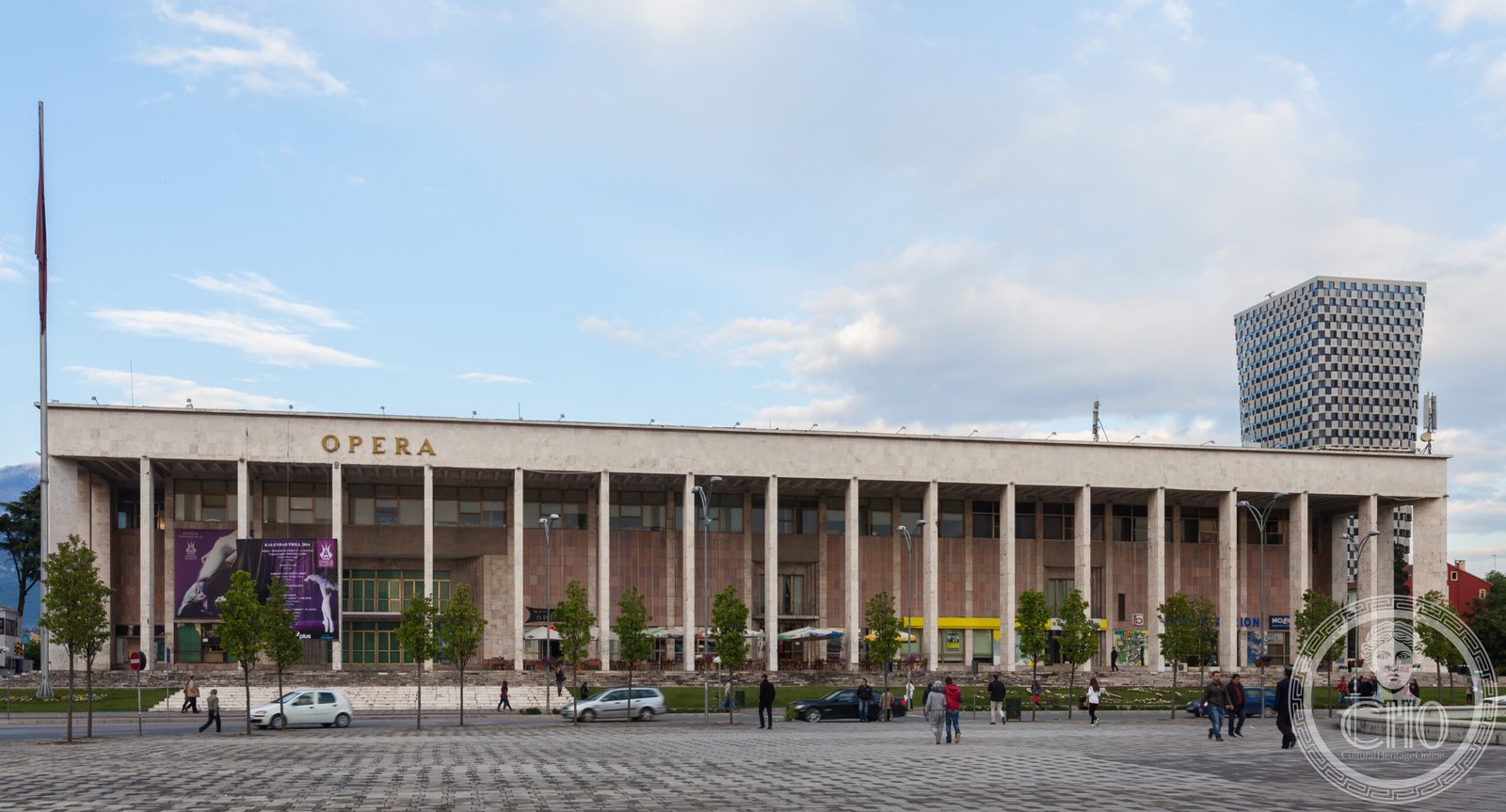
The most important civic building in the Albanian capital, designed by a joint Italian-Soviet team as a diplomatic gift from Khrushchev to Enver Hoxha, its monumental Rationalist facade housing the National Opera, National Library, and the collective memory of a generation who built it by hand.
At a glance
- Type
- Cultural palace / civic complex
- Period
- 1957 (designed), 1960-1963 (built)
- Style
- Socialist Realist / Italian Rationalist
- Location
- Skanderbeg Square, Tirana, Albania
- Coordinates
- 41.3295, 19.8185
- Architect
- Italian-Soviet team; attributed to Adamo Boari (initial design)
Overview
The Palace of Culture (Pallati i Kultures) in Tirana is the most important historic building in the Albanian capital and one of the defining works of Socialist-era architecture in the Western Balkans. Standing on the western edge of Skanderbeg Square – Albania’s main public plaza – it forms the cultural counterpart to the adjacent National Historical Museum with its famous mosaic facade. The building houses the Albanian National Opera and Ballet Theatre, the National Library of Albania, and several smaller cultural venues. Completed in 1963 and extensively restored in 2019, it remains the active heart of Tirana’s cultural life.
History
The Palace of Culture was designed in 1957 during the brief warm period of Soviet-Albanian relations under Nikita Khrushchev and Enver Hoxha’s communist government. The building was a state diplomatic gift from the Soviet Union, designed by a joint team of Italian and Soviet architects – a reflection of Albania’s unusual position between Soviet influence and Italian architectural heritage (Albania had been an Italian protectorate and then occupied territory from 1939 to 1943). Construction began in 1960 and was notable for the mass mobilization of Albanian citizens in voluntary communist work brigades (brigadat vullnetare), who participated in laying the foundations – an episode that became a defining collective memory for the generation that built communist Albania. The building was completed in 1963, two years after Albania’s rupture with the Soviet Union in 1961, giving the Soviet gift an ironic historical afterlife. After communism’s fall in 1992 parts of the ground floor were converted to commercial use; a comprehensive restoration completed in 2019 returned the building fully to cultural programming.
Architecture and Design
The building blends two architectural traditions: Italian Rationalism (the dominant influence on Albanian urban design from the 1930s Italian occupation) and Soviet Socialist Realism (the mandated aesthetic of communist prestige architecture). The result is a symmetrical, austere facade with classical proportions and a regular rhythm of rectangular bays, accented by monumental arched openings at the main entrance level and decorative relief panels. The composition avoids both the ornamental excess of high Stalinist buildings and the stripped austerity of pure Rationalism, achieving a formal civic grandeur appropriate for the building’s dual role as cultural institution and political monument. The interior is organized around a large lobby, the opera hall, library reading rooms, and a cinema. The 2019 restoration preserved the historic fabric while upgrading technical infrastructure for contemporary performance standards.
Cultural significance
The Palace of Culture concentrates several layers of Albanian historical memory in a single building. It embodies the Soviet-Albanian alliance that defined the first decades of communist Albania, the break with Moscow that followed, and the Italian cultural imprint that preceded both. It is the institution through which generations of Albanians were introduced to opera, ballet, and literature during an era of strict cultural isolation from the West. The communal labor brigades that built its foundations are remembered as a moment of genuine collective effort, distinct from the coercion that characterized much of Hoxha’s rule. Today the building anchors Skanderbeg Square – itself a contested space of post-communist renegotiation with the demolition of Hoxha’s statue in 1991 – as a living cultural venue rather than a museum of socialist heritage.
Visiting today
The Palace of Culture is open for performances and cultural events; the Opera and Ballet Theatre season runs from October through June with tickets available at the box office on Skanderbeg Square. The National Library is open to the public during standard library hours. The exterior can be viewed freely at any time as part of a walk around Skanderbeg Square – the best approach is from the central boulevard Bulevardi Deshmoret e Kombit, which frames a direct view of the building alongside the National Museum mosaic opposite. Guided tours of Tirana typically include the palace as part of a Skanderbeg Square circuit.
Getting there
The Palace of Culture is on Skanderbeg Square in the center of Tirana, within easy walking distance of virtually all city-center hotels. Tirana does not currently have a metro system; the city is served by buses and minibuses (furgon) with multiple routes converging on or near Skanderbeg Square. The square itself is pedestrianized. Tirana International Airport Nene Tereza is approximately 17 km northwest; taxis, airport buses (Rinas Express), and ride-hailing apps connect the airport to the city center in 25-40 minutes depending on traffic.
Sources and resources
Find it on the map
See this place and what’s around it →Record researched and written by Luigi De Marchi for Cultural Heritage Online, 2026.
📷 Become a Cultural Heritage Online photographer
Share your photos of places: they stay published under your name as the author. The more they're seen, the more you get noticed — and soon a contest will reward the most appreciated photos.
Log in or sign up free to add a photoIs this page about you?
This page is read by travellers and heritage enthusiasts who find it on Google. Tell us how you are connected to this place and we will take it from there.