
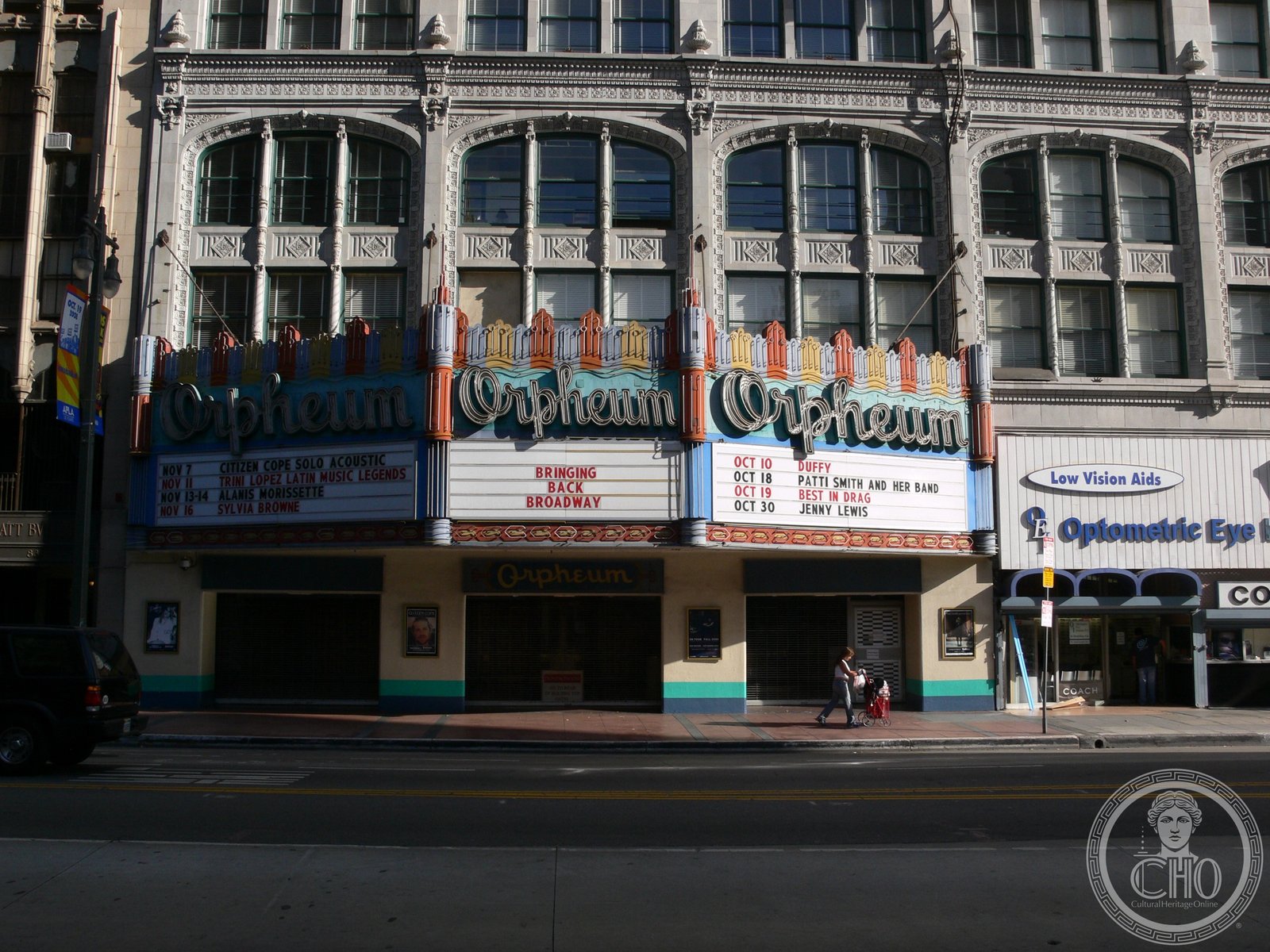
G. Albert Lansburgh’s 1926 design for the Orpheum on South Broadway gave Los Angeles’s vaudeville circuit its most extravagant local address — a Renaissance Revival palace on a street then transforming itself into the entertainment corridor of the American West, where the glamour of the movies met the industrial ambition of a city reinventing itself in real time.
At a glance
The Orpheum Theatre at 842 South Broadway is among the finest surviving examples of the 1920s entertainment palace on the Los Angeles Broadway corridor — a street that once concentrated more movie palaces per block than any other in the United States. Designed by G. Albert Lansburgh, who had established himself as one of California’s leading theater architects, the Orpheum opened in 1926 as the flagship of the Orpheum Circuit’s Los Angeles operations. Its Renaissance Revival exterior and lavish Baroque interior placed it at the top of the Orpheum chain’s West Coast portfolio. Today it operates as a concert venue and special event space, preserved as a Los Angeles Historic-Cultural Monument and contributing to the Broadway Historic Theater and Commercial District listed on the National Register of Historic Places.
Key facts
- Address: 842 South Broadway, Los Angeles, CA 90014
- Opened: 1926
- Architect: G. Albert Lansburgh
- Style: Renaissance Revival with ornate Baroque interior
- Capacity: approximately 2,000 seats
- GPS: 34.0452° N, 118.2532° W
- Status: Los Angeles Historic-Cultural Monument; NRHP Broadway Historic Theater District
History
G. Albert Lansburgh arrived in California from Eastern Europe in the late nineteenth century and built a practice on the premise that theaters deserved the same architectural seriousness as banks and courthouses. By the 1920s he had designed major venues in San Francisco, Los Angeles, and Portland, establishing a West Coast tradition of theater architecture that paralleled the Rapp & Rapp model being deployed simultaneously in Chicago and New York. The Orpheum on South Broadway was his most complete Los Angeles statement: a building whose exterior columns and arched windows announced serious civic intentions, and whose interior carried those intentions into a realm of deliberate theatrical excess.
South Broadway in 1926 was the entertainment spine of a city growing faster than any in America. The concentration of theaters — the Million Dollar, the Globe, the Tower, the Los Angeles, the Roxie, the United Artists, the State — created a pedestrian entertainment district without equivalent west of Chicago. The Orpheum stood near the southern end of this corridor, serving an audience that had ridden streetcars from the residential districts and expected an experience commensurate with the thirty-five cents they had paid for admission. Lansburgh delivered: a lobby whose ornamental plasterwork and gilded surfaces exceeded anything most of those audiences had encountered in daily life, and an auditorium whose acoustics and sight lines performed the specific theatrical function of making a vaudeville comic’s timing land in the upper balcony as cleanly as in the front row.
The Orpheum Circuit’s transition from vaudeville to film in the late 1920s and early 1930s — a transition forced by the talkies and by radio’s erosion of the live-performance market — changed the building’s programming more than its physical character. The elaborate stage machinery and the deep proscenium remained, useful for the orchestral performances and live events that have characterized the building’s later history. Restoration work has returned much of Lansburgh’s original decorative scheme, making the Orpheum one of the more complete surviving examples of 1920s West Coast theater design.
What you see
The facade presents Lansburgh’s characteristic approach to the street-level theater: a ground floor of arched openings that invite the pedestrian toward the lobby, a middle zone of engaged pilasters and decorative panels that frame the main body of the building, and an upper parapet that carries the Orpheum name in the assertive signage of the 1920s commercial street. The surface materials — ornamental terracotta, cast stone, and the gilded lettering of the marquee — achieve a density of ornament that reads as wealth and pleasure from across the street, precisely the effect Lansburgh and his clients were pursuing.
Inside, the auditorium is organized around a deep U-shape of balconies, each faced in the gilded relief ornament that Lansburgh borrowed from the French Renaissance tradition and adapted to the dimensions of the American movie palace. The ceiling carries painted panels set within elaborate plasterwork frames; the proscenium arch extends the decorative vocabulary of the side walls into the stage opening, blurring the boundary between the performed world and the audience’s space in a way that was the deliberate theatrical strategy of the era.
Practical information
- Access: Concert venue and event space; check orpheum-la.com for programming
- Location: Broadway Historic Theater District, Downtown Los Angeles; Grand Central Market one block north at 317 S. Broadway
- Transit: Metro B (Red) and D (Purple) Lines at Pershing Square; multiple bus lines on Broadway
- Duration: Events typically 1.5–3 hours; the Broadway corridor can occupy a full afternoon for architecture enthusiasts
Getting there
Los Angeles International Airport (LAX) is approximately 18 miles southwest of the Broadway corridor via the 105 Freeway and the 110 Freeway into downtown. Metro Rail’s C Line (Green) connects LAX-adjacent stations to the Blue Line, which reaches downtown; alternatively, the LAX FlyAway bus operates to Union Station in approximately 30–40 minutes, where Metro B and D Lines provide direct downtown access. From Union Station, South Broadway is walkable (approximately 10 minutes south) or one stop on the Gold/A Line to Little Tokyo/Arts District. Parking garages operate throughout the Broadway district; street parking is metered.
Nearby
- Bradbury Building — 304 S. Broadway; the 1893 office building whose light-flooded atrium and Victorian iron galleries are among the most photographed interiors in Los Angeles
- Grand Central Market — 317 S. Broadway; historic covered food market operating since 1917, now housing dozens of vendors in a restored 1920s commercial space
- Broad Museum / MOCA Grand Avenue — Grand Avenue corridor, 8–10 minutes on foot; the Eli Broad collection and the Museum of Contemporary Art occupy adjacent buildings on the Civic Center’s cultural axis
- Los Angeles City Hall — 200 N. Spring Street; the 1928 Art Deco tower that appears in countless films is a 12-minute walk north
Sources
- Los Angeles Conservancy — Broadway Historic Theater District documentation
- Cultural Heritage Commission of Los Angeles — Historic-Cultural Monument designation files
- Architectural Record — G. Albert Lansburgh theater practice survey
- Wikimedia Commons — Los Angeles Orpheum Theatre 2008 (CC BY 3.0, Andreas Praefcke)
- National Register of Historic Places — Broadway Theater and Commercial District nomination
Find it on the map
See this place and what’s around it →Record researched and written by Luigi De Marchi for Cultural Heritage Online, 2026.
📷 Become a Cultural Heritage Online photographer
Share your photos of places: they stay published under your name as the author. The more they're seen, the more you get noticed — and soon a contest will reward the most appreciated photos.
Log in or sign up free to add a photoIs this page about you?
This page is read by travellers and heritage enthusiasts who find it on Google. Tell us how you are connected to this place and we will take it from there.