
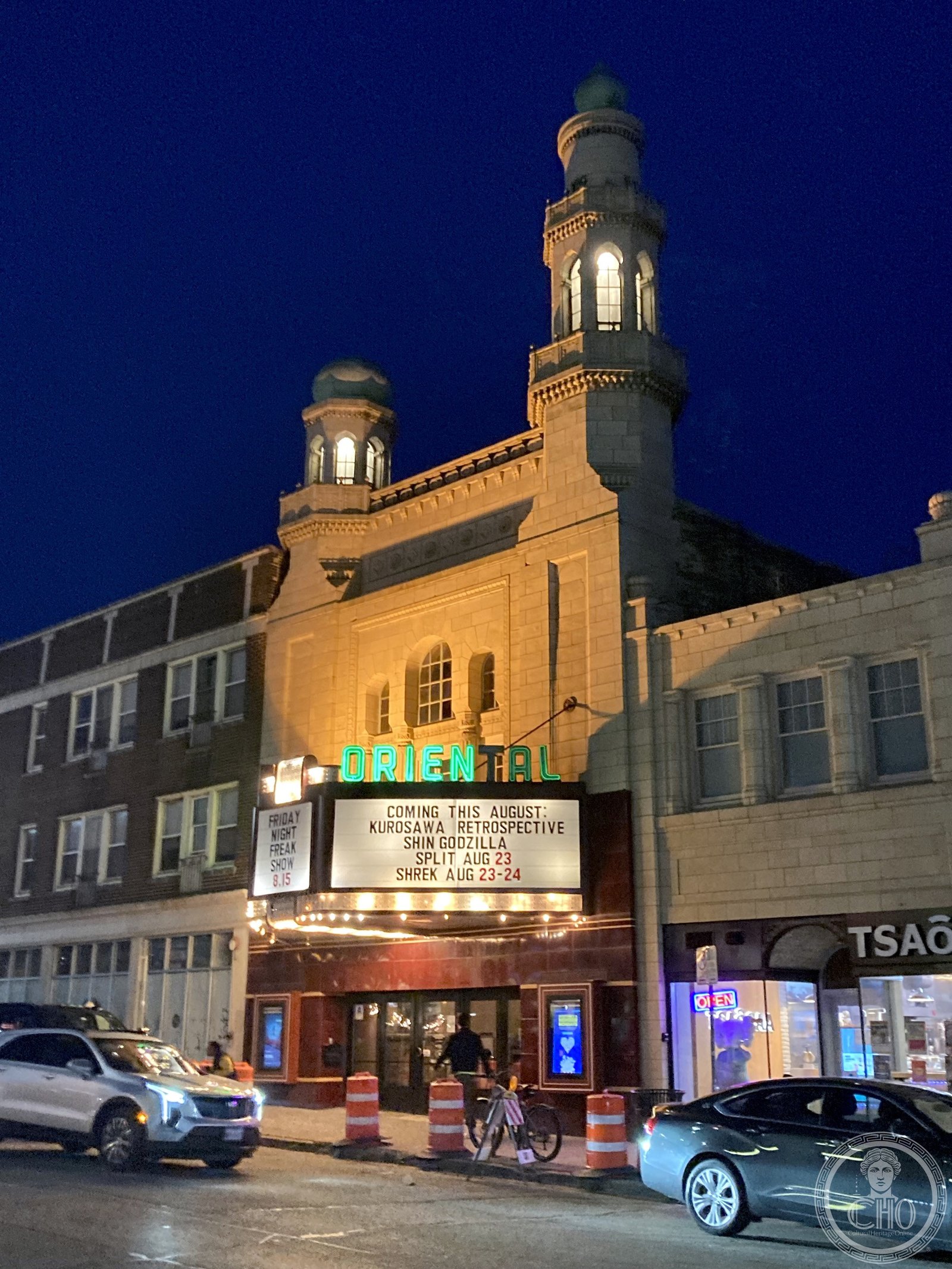
A Mughal palace on Milwaukee’s Near East Side, the Oriental wraps every surface in carved teak, plaster elephants, and a vaulted sky ceiling—making it one of the country’s most elaborately preserved atmospheric movie theaters.
At a glance
The Oriental Theatre stands on Milwaukee’s Near East Side as one of the most intact atmospheric movie palaces surviving in the United States. Opened in 1927, it draws its decorative program from Mughal India—onion domes, Burmese teak paneling, carved deity reliefs, and a ceiling painted to simulate a star-filled tropical courtyard. Milwaukee Film, the city’s nonprofit cinema organization, operates the theater as its flagship venue for year-round film programming and the annual Milwaukee Film Festival.
Key facts
- Address: 2230 N Farwell Ave, Milwaukee, WI 53202
- GPS: 43.0615° N, 87.9000° W
- Built: 1927
- Architects: Dick & Bauer
- Style: Atmospheric theater / Indo-Islamic Revival
- Capacity: approximately 800 seats (main auditorium)
- Status: Active cinema; Milwaukee Film flagship
- NRHP: Listed on National Register of Historic Places
History
The Near East Side corridor at Farwell and North Avenues had already established itself as Milwaukee’s neighborhood entertainment district when Dick & Bauer received the commission for a large atmospheric theater in the Indo-Islamic style. The mid-1920s were the zenith of the picture palace era, and architects competed to create the most immersive fantasy environments their budgets allowed—a Mughal courtyard on Wisconsin’s lakefront was precisely the kind of extravagance the moment welcomed.
The Oriental opened in 1927 to immediate success. Its decorative vocabulary—onion domes above the marquee, latticed screens, carved deity figures, and painted ceilings that simulated a tropical night sky—set it apart from downtown Milwaukee’s Beaux-Arts grandeur and gave the neighborhood a lasting identity. The transition from silent films to talkies posed no operational disruption; the theater’s programming ran continuously through the sound era.
The postwar decades brought suburban multiplex competition and urban disinvestment, and the Oriental narrowed to single-screen programming under a succession of ownership arrangements. Milwaukee Film took over management in the 2000s and eventually secured ownership, investing in the building’s mechanical systems while preserving its decorative fabric. The theater today hosts more than 200 film events per year alongside the week-long Milwaukee Film Festival each October.
What you see
The lobby announces the theater’s register immediately: Burmese teak paneling lines the approach corridor, brass fittings frame every door, and plaster reliefs of Hindu deities and painted elephants lead the eye toward the auditorium. The ceiling above the lobby simulates a vaulted Mughal arcade, with arched niches carrying painted devotional figures.
Inside the auditorium, the atmospheric effect is fully realized. The ceiling dome is painted to suggest a star-filled tropical sky, with slow-moving cloud formations rendered in plaster and lit from below to imply open air. Side walls carry carved Portland cement textures imitating sandstone from the Agra workshops; elephant corbels support the balcony brackets. The proscenium carries a carved peacock arch whose feathered tail spreads across the full width of the screen opening. The decorative vocabulary is dense but internally consistent—every surface decision reinforces the Mughal courtyard conceit without slipping into scenographic pastiche.
Practical information
- Active cinema with first-run and independent film programming; check Milwaukee Film’s schedule for current showtimes.
- Food and beverages served in the lobby; the concession program includes local craft beer and specialty popcorn.
- Fully accessible; wheelchair seating in orchestra and balcony levels.
- Photography welcome in the lobby and exterior; ask staff about in-auditorium policies.
- Allow 90 minutes including pre-show lobby time to study the decorative program at leisure.
Getting there
The Oriental Theatre is at 2230 N Farwell Ave on Milwaukee’s Near East Side, approximately one mile north of downtown via E Wisconsin Avenue. Milwaukee County Transit System Route 30 (Farwell) runs directly to the theater. Street parking is available on Farwell and surrounding blocks; a surface lot behind the building on N Hackett Ave provides additional spaces. From Mitchell International Airport, the drive north via I-43 takes approximately 20 minutes.
Nearby
- North Avenue: the commercial strip running east from the theater connects the Near East Side to Milwaukee’s Riverwest district—bars, record shops, and cafes along its entire length.
- Milwaukee Art Museum (2 miles southwest): the Santiago Calatrava brise-soleil pavilion (2001) overlooks Lake Michigan from the War Memorial lakefront campus.
- Pabst Mansion (2 miles west): the 1892 Flemish Renaissance house built for Captain Frederick Pabst; guided tours available year-round.
- Brady Street: Milwaukee’s oldest continuously commercial street runs parallel one block west, concentrated with Italian restaurants, bookshops, and neighborhood bars.
Sources
- Milwaukee Film, orientaltheatermilwaukee.org — venue history and programming archive
- National Register of Historic Places, “Oriental Theatre Milwaukee” nomination
- Wisconsin Historical Society, Milwaukee theater records
- Cinema Treasures, “Oriental Theatre, Milwaukee” database entry
Find it on the map
See this place and what’s around it →Record researched and written by Luigi De Marchi for Cultural Heritage Online, 2026.
📷 Become a Cultural Heritage Online photographer
Share your photos of places: they stay published under your name as the author. The more they're seen, the more you get noticed — and soon a contest will reward the most appreciated photos.
Log in or sign up free to add a photoIs this page about you?
This page is read by travellers and heritage enthusiasts who find it on Google. Tell us how you are connected to this place and we will take it from there.